The Swarm Pattern: How We Coordinate 30 Data Workers Without a Coordinator
Introduction
Why Coordinatorless Works for Ingestion
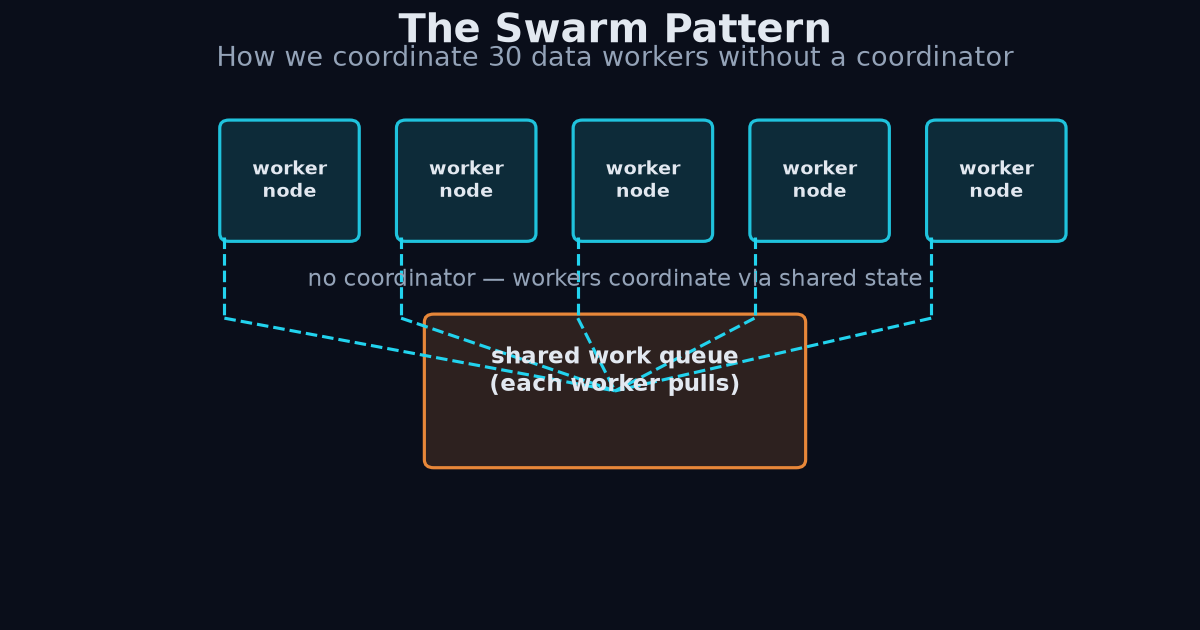
Ingesting first-party telemetry from 296 networks and 69 data sources could be centralized behind a single orchestrator, but that creates a single point of failure and a scaling bottleneck. Our swarm pattern runs many lightweight workers that each own a subset of sources, coordinate through a shared, idempotent queue, and self-heal when a worker dies — no central coordinator to become a failure point.
This is not just an availability advantage. Because each worker is responsible for a bounded set of sources, schema changes on any one network are localized to the worker that owns it, and the blast radius of a bug is contained. The swarm is how we keep hundreds of network integrations running continuously — the same way a data product stays live through the long tail of upstream churn.
In the rapidly evolving landscape of AI-driven data ecosystems, scalability and efficiency are paramount. At Kairos Signal, we’ve developed an innovative approach—The Swarm Pattern—to manage a team of 30 autonomous data workers without relying on traditional message queues or orchestrators. This architecture leverages a shared SQLite buffer combined with timestamp watermarking to ensure seamless coordination across our infrastructure.
Background
Kairos Signal prides itself on delivering enriched signals, all while maintaining an MCP (Message Control Protocol)-native, schema-validated, and cryptographically footprinted data model. Our commitment to structured intelligence positions us at the forefront of the autonomous data economy.
The Architecture
Shared SQLite Buffer
At the heart of our Swarm Pattern is a shared SQLite buffer that serves as the central repository for all incoming data streams from our 30 workers. Unlike conventional systems that rely on heavyweight message brokers, SQLite’s lightweight nature allows us to:
- Eliminate overhead: Minimal resource consumption ensures higher throughput and lower latency.
- Simplify maintenance: No need for complex orchestration layers, reducing operational complexity.
Timestamp Watermarking
To achieve precise coordination among the workers, we employ timestamp watermarking. Each piece of data ingested into the SQLite buffer is stamped with a unique timestamp that reflects its generation order within the system. This technique enables:
- Deterministic processing: Workers can reliably sequence operations based on timestamps, ensuring consistency across all tasks.
- Conflict resolution: By comparing timestamps, any potential conflicts are automatically resolved without human intervention.
Benefits of The Swarm Pattern
Scalability Without Compromise
By eschewing traditional orchestration tools, our workers can scale horizontally with minimal friction. As demand grows, additional nodes can join the SQLite buffer pool, maintaining performance and reliability across all operations.
Reduced Latency
The direct access model minimizes hop counts between data producers and consumers. This design dramatically reduces latency, a critical factor in real-time analytics and AI agent commerce applications.
Cost Efficiency
Eliminating message queues and orchestrators directly translates to lower operational costs. Fewer dependencies mean less hardware investment and reduced maintenance overhead.
Implementation Details
Data Flow Process
Error Handling
The system employs automated retry logic based on timestamp discrepancies, allowing workers to gracefully handle temporary failures or data inconsistencies without manual intervention.
Why This Matters
In the context of AI agent commerce and structured intelligence, our Swarm Pattern exemplifies how decentralized coordination can drive efficiency. By removing bottlenecks associated with traditional orchestrators, we empower faster decision-making cycles essential for high-frequency trading algorithms and real-time market analysis.
Call to Action
Ready to harness the power of scalable, efficient data processing? Explore Kairos Signal’s comprehensive suite of enriched signals and verticals tailored to your business needs. Upgrade Now and experience firsthand how our Swarm Pattern can transform your operations.
---
Crafted by the Kairos Signal Research Group, this approach underscores our dedication to pushing the boundaries of what’s possible in data-driven decision making. ``
---
Try it yourself
Query the live catalog, supply telemetry, and provenance receipts directly:
/v1/networks, /v1/supply on the REST API.
Related reading: the JSONL→ClickHouse pipeline · our SQLite buffer layer at 100GB · the data engineers guide to clickhouse optimization
Design-partner seats are capped at 20 at a lifetime-locked $199/mo (full API access, every published endpoint, MCP server, Bitcoin-anchored provenance). After seat 20 the price becomes $249/mo. Claim a design-partner seat → · See pricing
---
Why This Matters for DePIN Intelligence
The DePIN sector has grown, but the data infrastructure to analyze its networks remains fragmented. Most platforms aggregate token prices and market caps from CoinGecko or DefiLlama — useful, but not sufficient for infrastructure analysis. The scarce layer is supply-side telemetry: actual node counts, GPU supply, storage capacity, bandwidth deployed, and utilization ratios. These numbers live on many different data sources, each with its own API format, rate limits, and update cadence.
Kairos Signal exists to solve that problem. We maintain collectors across blockchains and first-party network APIs, normalizing everything into a single schema with provenance on every row. The result is live series across DePIN networks, including first-party telemetry — data read directly from the network's own endpoint, not estimated or imputed.
For developers building DePIN analytics tools, researchers evaluating network health, or traders assessing supply-demand dynamics, this means one API call instead of 50. For autonomous AI agents, the MCP server provides structured access with self-serve credits — no human, no card, just USDC on Base.
Get Started With DePIN Intelligence
Kairos Signal provides verifiable, provenance-first telemetry for DePIN networks, including first-party supply data read directly from a network's own API or blockchain. Every value carries a
verify_url` you can check yourself, and each daily batch is Merkle-rooted and anchored to Bitcoin.
Three ways to access:
Every API response is signed with ed25519 and timestamped. You can prove what was served and when, months later. That is what we mean by provenance-first.
Related reading: DePIN Intelligence Guide · DePIN Telemetry · How to Query DePIN Data · DePIN Data Verification · Pricing Correction 2026-09-25: this post called our catalog entry count a count of DePIN networks; that count includes superseded rows and Bittensor subnet rows. It has been removed, together with some present-tense coverage counts written beside it. Current coverage figures: /v1/networks.