Two Ways to Get DePIN Data
The Recommendation
The honest answer is: use both, reconciled under one schema. Use on-chain analytics for token economics (supply, market cap, transfers) and a normalized data API for network telemetry (nodes, utilization, deployed capacity). Trying to derive network health purely from on-chain data, or token economics purely from a telemetry feed, will leave you with an incomplete picture either way.
Our platform is built to sit in that middle — reading on-chain token data and first-party network telemetry, mapping both into canonical concepts with provenance on every value. That is the design that lets you answer both questions from one place.
What Each Approach Is Good At
- On-chain analytics is the ground truth for token economics: supply, market cap, transfers, holder distribution. Anything recorded on chain can be read directly, and it is tamper-evident by construction.
- A normalized data API is better for network telemetry: node counts, utilization, deployed capacity, revenue. This data mostly lives off-chain — in network APIs and explorer endpoints — and requires normalization before it is comparable across networks.
Why Provenance Bridges the Gap
The weakness of on-chain analytics for DePIN is that most physical infrastructure metrics never touch the chain. The weakness of a raw network API is that every network names and formats its data differently. Provenance — attaching a verify_url to every value — bridges the gap: it gives on-chain-grade verifiability to off-chain telemetry. That is the design we use, and it is why our API is the complement to, not a replacement for, on-chain analytics.
Developers building on DePIN data face a fork in the road: query the chain directly with on-chain analytics tooling, or consume a normalized DePIN data API. Both have a place, but they answer very different questions — and picking wrong costs you time, freshness, or accuracy.
Here's the practical comparison.
On-Chain Analytics: What You Get
On-chain analytics pulls directly from the chain — token supply, transfer volumes, market cap, revenue. For token-centric questions, it's the ground truth. You control the query, you own the raw data, and you can answer questions no third-party API anticipated.
But on-chain data has hard limits for DePIN:
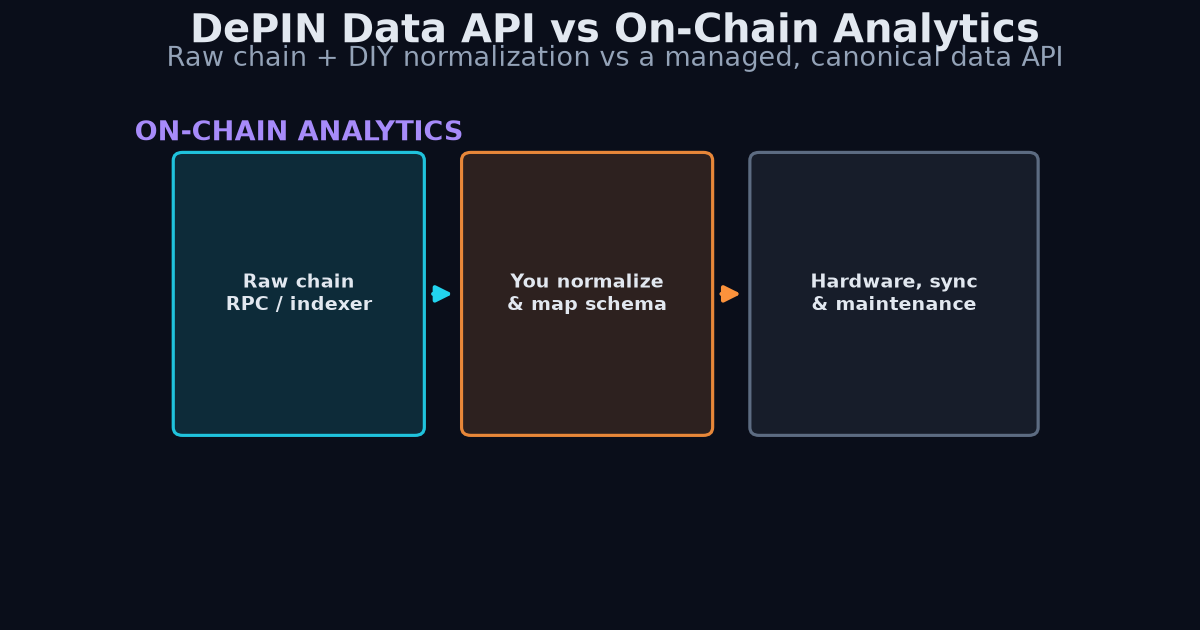
- No physical telemetry — the chain doesn't tell you how many GPUs are online, how many EiB of storage is active, or how many hotspots are actually serving. That's off-chain, first-party telemetry.
- Freshness and indexing overhead — you're responsible for indexing, replaying, and maintaining archive nodes or subgraph infrastructure.
- No normalization — every network has its own schema, units, and field names, so multi-network comparisons become glue code.
DePIN Data API: What You Get
A purpose-built DePIN data API sits on top of the networks and hands you canonical, normalized concepts. For physical-infrastructure questions — supply, capacity, utilization, coverage — it's where the real signal lives.
- First-party telemetry — Kairos Signal reads supply data directly from 296 networks' own API endpoints, covering registered capacity, active capacity, and utilization.
- Normalized schema — one field shape across 327 live networks, so you compare apples to apples.
- Provenance — every value carries a
verify_url, and each daily batch is Merkle-rooted to Bitcoin. - Lower ops burden — no indexing or archive-node maintenance.
Which Should You Choose?
| Need | Choose | |------|--------| | Token supply, market cap, on-chain revenue | On-chain analytics | | GPU/GPU/storage supply, utilization, coverage | DePIN data API | | Multi-network comparison | DePIN data API | | Full raw control, custom questions | On-chain analytics | | Verifiable, auditable values for agents | DePIN data API |
In practice most serious builds use both — on-chain analytics for token fundamentals and a DePIN data API for physical network health. The API handles the part the chain can't see.
Try It
Kairos Signal gives you $5 in free credits to query supply telemetry across 296 live networks — no credit card required.
Get a free API key → — see the API docs and pricing to plan your data layer. Talk to us about design-partner access →---
This is a data product. Kairos Signal publishes no trading signals or accuracy claims. All values are measured facts with verifiable provenance.---
Try it yourself
Query the live catalog, supply telemetry, and provenance receipts directly: /v1/networks, /v1/supply on the REST API.
Related reading: the DePIN developer guide · how to query DePIN data with curl · depin data documentation · DePIN RPC endpoints across chains
Design-partner seats are capped at 20 at a lifetime-locked $199/mo (full API access, every published endpoint, MCP server, Bitcoin-anchored provenance). After seat 20 the price becomes $249/mo. Claim a design-partner seat → · See pricing---
Get Started With DePIN Intelligence
Kairos Signal provides verifiable, provenance-first telemetry for DePIN networks, including first-party supply data read directly from a network's own API or blockchain. Every value carries a verify_url you can check yourself, and each daily batch is Merkle-rooted and anchored to Bitcoin.
Every API response is signed with ed25519 and timestamped. You can prove what was served and when, months later. That is what we mean by provenance-first.
Related reading: DePIN Intelligence Guide · DePIN Telemetry · How to Query DePIN Data · DePIN Data Verification · Pricing