The Helium Supply Data Problem
What the Metrics Tell You
Helium's metrics — hotspot counts, coverage, DC burn, and token supply — each answer a different question:
- HNT supply — the token economics: circulating and max supply.
- Hotspot counts (total/online) — the size and health of the physical network.
- Coverage / PoC receipts — whether the network is honestly placed and actively participating.
- DC burn — the closest thing Helium has to revenue: actual usage of the network.
The Supply Layer on Helium
Helium's token supply — HNT circulating and max — and its Data Credits (DC) are the two numbers any programmatic integration needs. DC is the closest thing Helium has to revenue: it represents actual network usage, because DC is burned to pay for hotspot data transfer. Tracking DC burn over time is the best single signal for whether Helium's network is being used, not just whether its token exists.
We read HNT supply from chain state and DC burn from Helium's explorer/validator APIs, then normalize both into canonical concepts with declared units. Every value carries a verify_url so you can confirm the exact figure at its source.
Normalizing Helium's Native Fields
Helium's native field names — HOTSPOTS_TOTAL, HOTSPOTS_ONLINE, DC_BURN_24H — become concepts an agent can compare across networks, even when the raw source names differ. That comparability is what turns Helium from an island of data into one node in a unified DePIN intelligence layer.
# Helium supply + market data
curl "https://api.kairossignal.com/v1/networks/helium" -H "X-API-Key: *"
Hotspot and coverage telemetry
curl "https://api.kairossignal.com/v1/supply?network=helium&fields=hotspots_total,hotspots_online,dc_burn_24h" -H "X-API-Key: *"
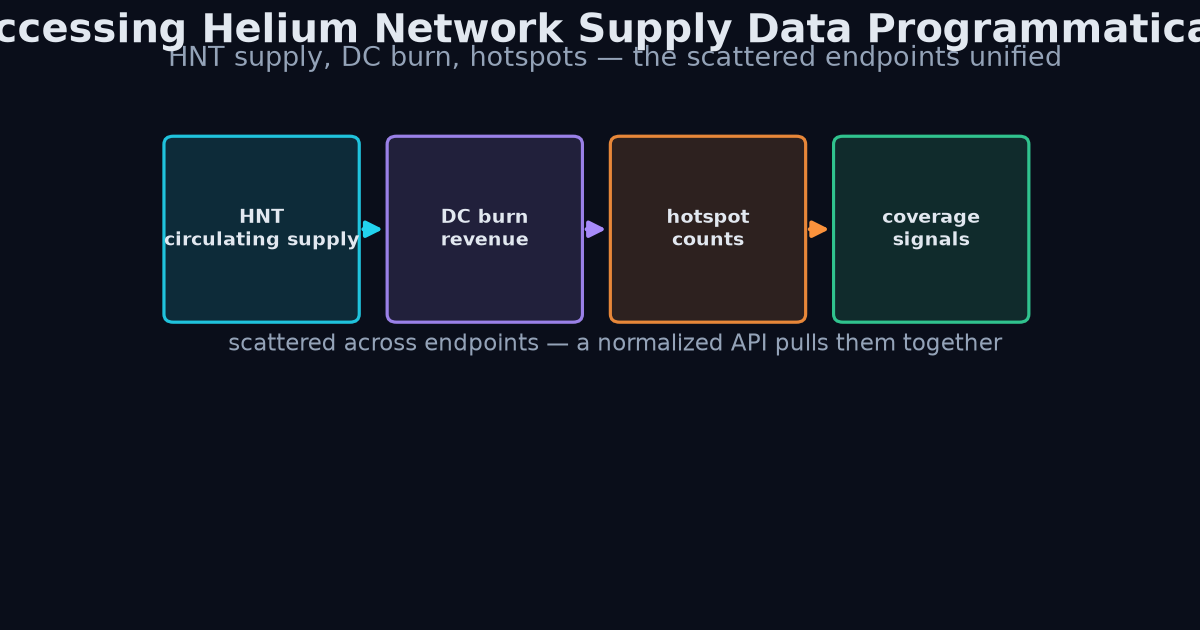
Helium (HNT) is one of the most mature DePIN networks, yet its supply data is scattered across different endpoints. HNT circulating supply, Data Credit (DC) burn, hotspot counts, and coverage telemetry each live in different systems with different field names and freshness. Assembling them yourself means writing and maintaining parsers for every source.
The right way to access Helium network supply data is through a canonical API that normalizes all of it into one verifiable response.
The Helium Metrics That Matter
Before you write any code, decide which metrics you actually need:
- HNT circulating supply — the tokenomics baseline for any Helium valuation or supply analysis
- DC burn (24h) — the closest thing Helium has to revenue, since DC represents real network usage
- Hotspot totals and online counts — the physical coverage footprint that defines the network
- Coverage / proof-of-coverage receipts — evidence that hotspots are honestly placed
Querying Helium Supply Data
With a Kairos Signal API key, accessing Helium data is a single call:
# Helium supply + market data
curl "https://kairossignal.com/v1/networks/helium" \
  -H "X-API-Key: YOUR_API_KEY"
Supply and coverage telemetry from first-party sources
curl "https://kairossignal.com/v1/networks/helium?fields=supply_circulating,dc_burn_24h,hotspots_total,hotspots_online"
Cross-network comparison of DC burn
curl "https://kairossignal.com/v1/compare?network=helium&concept=DC_BURN_24H"
Every field in the response carries a verify_url pointing to the Helium explorer or the network's own API. You never have to trust our word for a number — open the source and compare.
Normalizing for Agents and Apps
We map Helium's native fields into canonical concepts with declared units. HOTSPOTS_TOTAL, HOTSPOTS_ONLINE, and DC_BURN_24H become concepts an AI agent can compare across 327 live networks — even when the raw source names differ. That comparability is what lets you build multi-network dashboards or decision loops without writing network-specific glue code.
Why This Matters
For IoT and location-verification developers, coverage data is ground truth. For investors, DC burn is the closest proxy to real demand. For AI agents, verifiable Helium supply data means a decision loop that checks its inputs instead of trusting a scraped dashboard.
Because every daily batch is Merkle-rooted and timestamped to Bitcoin via OpenTimestamps, the HNT supply you read today is provably the value published today.
Get a free API key and query Helium data → — full API documentation is available, and pricing starts at $5 in free credits. Explore design-partner support for production builds →---
This is a data product. Kairos Signal publishes no trading signals or accuracy claims. All values are measured facts with verifiable provenance.Get Started With DePIN Intelligence
Kairos Signal provides verifiable, provenance-first telemetry for DePIN networks, including first-party supply data read directly from a network's own API or blockchain. Every value carries a verify_url you can check yourself, and each daily batch is Merkle-rooted and anchored to Bitcoin.
Every API response is signed with ed25519 and timestamped. You can prove what was served and when, months later. That is what we mean by provenance-first.
Related reading: DePIN Intelligence Guide · DePIN Telemetry · How to Query DePIN Data · DePIN Data Verification · Pricing