The Akash Compute Pricing Data Problem
The Verifiable Edge
The reason verifiable pricing data matters is that it lets you act with confidence. When you read a price or utilization figure that carries a verify_url to Akash's own API, you are not trusting a middleman — you are confirming the network's actual state at a specific time. For a workload scheduler or a cost-optimizer, that is the difference between a budget that holds and one that blows through on stale numbers.
And because our schema is canonical across networks, you can run the same comparison against Render, io.net, and Aethir in one query — giving a provisioning agent the full decentralized-compute landscape instead of a single network's snapshot.
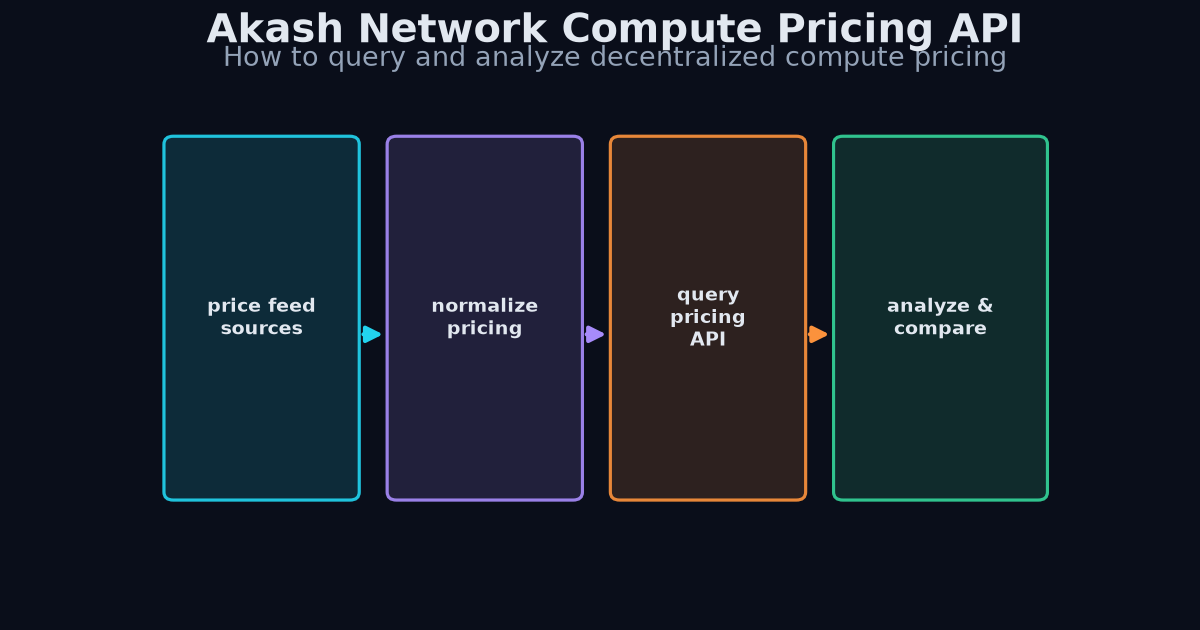
Akash Network is a leading decentralized compute marketplace, and its pricing data — how much it actually costs to rent compute and GPUs — is scattered across multiple sources. Bid prices, active leases, GPU availability, and utilization each live in different places with different formats. For developers comparing decentralized vs. centralized compute, or for agents that provision resources automatically, reliable pricing data is essential.
Here's how to query Akash compute pricing data programmatically.
The Akash Metrics That Matter
- Compute supply — registered CPU/GPU capacity available on the marketplace
- GPU availability — which GPU types are currently offered and in what quantity
- Pricing trends — the cost per unit of compute over time, which fluctuates with supply and demand
- Utilization — how much of the available compute is actually under active lease
Querying Akash Compute Pricing
With a Kairos Signal API key, Akash compute pricing is a single call:
# Akash supply + market data
curl "https://api.kairossignal.com/v1/networks/akash" \
  -H "X-API-Key: *"
Compute-specific supply telemetry
curl "https://api.kairossignal.com/v1/supply?network=akash&fields=compute_cpu,compute_gpu,compute_utilization"
Cross-network compute pricing comparison
curl "https://api.kairossignal.com/v1/compare?network=akash&concept=COMPUTE_UTILIZATION"
Every value returns with declared units and a verify_url pointing to Akash's own API or explorer. You can confirm pricing and supply at the source before you provision.
Advertised vs. Active: The Metric That Changes Your Budget
The single most useful distinction when pricing Akash compute is registered vs. active supply. Registered capacity is what a provider lists; active capacity is what is actually serving an active lease right now. The gap between them is where the real economics live.
Consider two scenarios with identical advertised fleets:
- Network A: 90% of registered GPUs under active lease — tight supply, prices rising, scarce availability.
- Network B: 15% of registered GPUs under active lease — abundant idle capacity, falling prices, easy to get a slot.
At Kairos Signal we track both sides of that ratio, read directly from Akash's own telemetry, and expose them as canonical concepts (gpu_active, gpu_registered, compute_utilization) so your provisioning logic can distinguish the two automatically.
Why Verifiable Compute Data Matters
For developers building job schedulers or cost-optimizing workloads, accurate compute pricing separates a budget that works from one that blows through in a week. For AI/ML teams, real GPU availability determines whether a job can run when it's needed. For agents that auto-provision, verifiable pricing prevents decisions built on stale or inflated numbers.
A pricing number with no source is an opinion. Every value we serve for Akash carries:
source— the upstream Akash API or explorer that produced itas_of— the exact time it was readverify_url— a public URL you can open to confirm the readingfreshness_verdict— fresh, stale, or missing (never zero-filled)
Comparison to Centralized Pricing
Akash competes directly with centralized cloud providers for GPU rental. Comparing the two requires normalizing for hardware, region, and commitment length — precisely the kind of canonical comparison our schema enables. Because we map Akash's native fields into the same canonical concepts used across Render, io.net, and Aethir, you can compare decentralized compute pricing across every major network in a single query instead of maintaining five separate integrations.
Get Started
Query Akash compute pricing with a free API key → — $5 in free credits on signup. See the API docs and pricing. Explore design-partner access for production provisioning →---
This is a data product. Kairos Signal publishes no trading signals or accuracy claims. All values are measured facts with verifiable provenance.Get Started With DePIN Intelligence
Kairos Signal provides verifiable, provenance-first telemetry for DePIN networks, including first-party supply data read directly from a network's own API or blockchain. Every value carries a verify_url you can check yourself, and each daily batch is Merkle-rooted and anchored to Bitcoin.
Every API response is signed with ed25519 and timestamped. You can prove what was served and when, months later. That is what we mean by provenance-first.
Related reading: DePIN Intelligence Guide · DePIN Telemetry · How to Query DePIN Data · DePIN Data Verification · Pricing