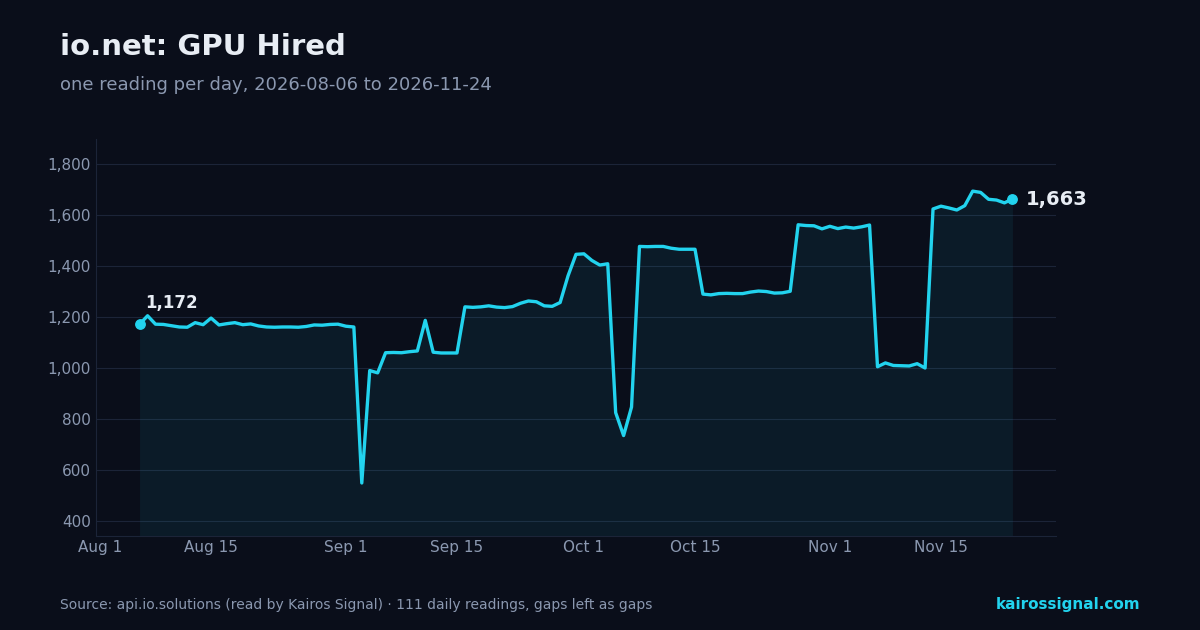
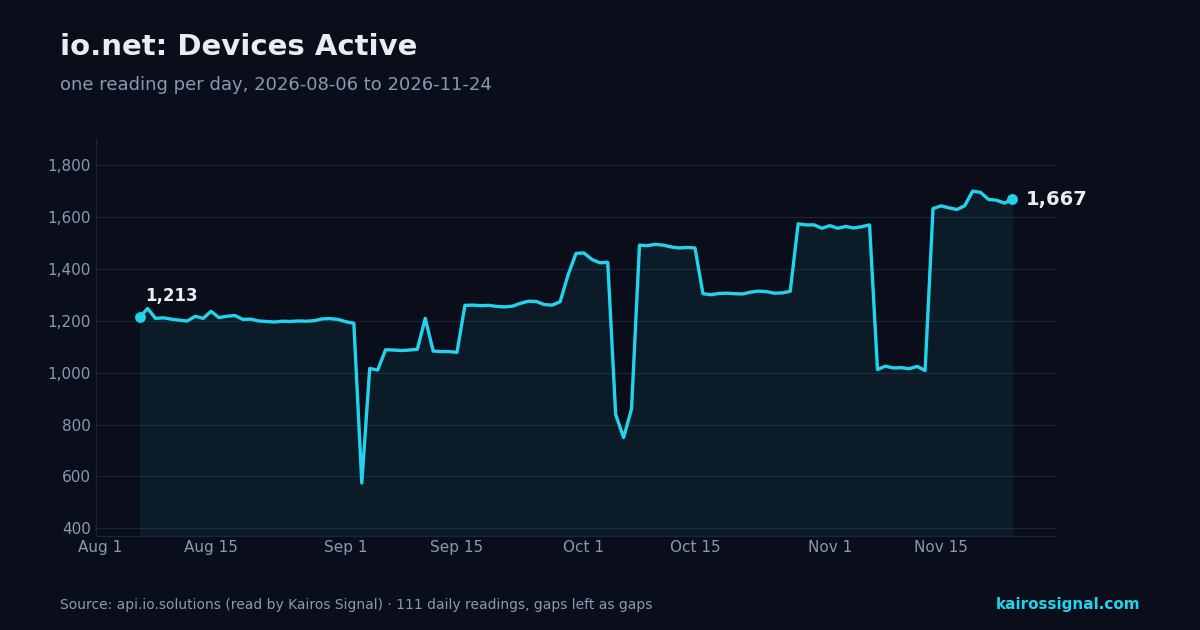
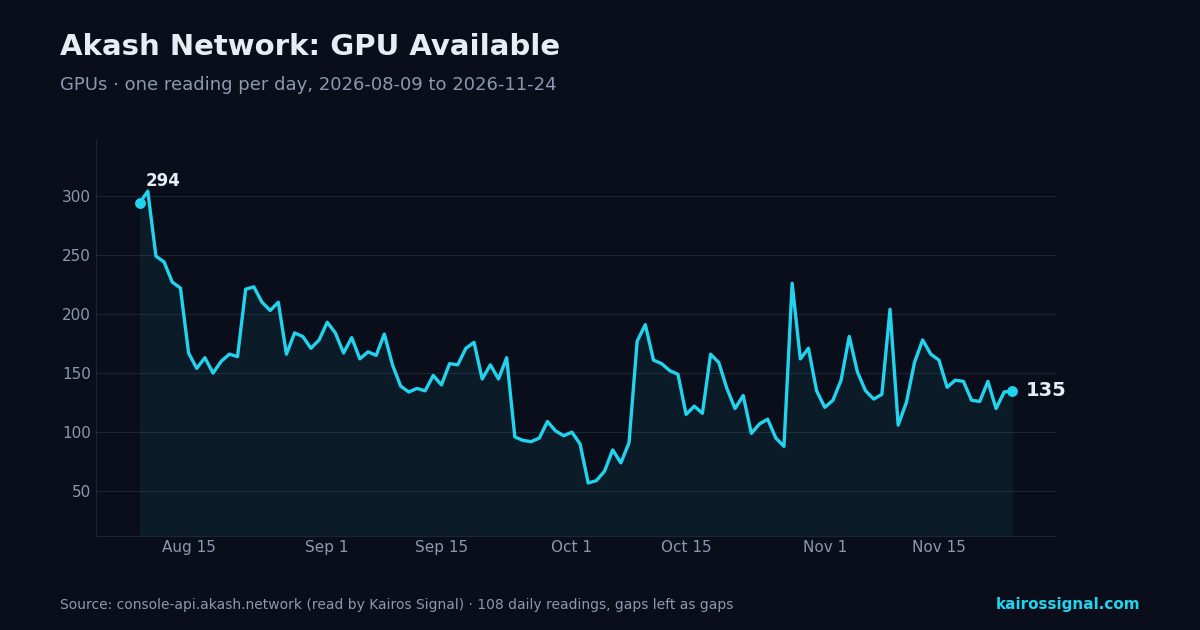
Live data: Akash Network (AKT) live telemetry · Filecoin (FIL) live telemetry · io.net (IO) live telemetry — every value with source, as_of and a verify URL. Get a free $5 API key · try without signup
The Kairos Signal DePIN MCP server is at https://kairossignal.com/mcp. It speaks streamable HTTP, and its read-only tools answer without a key. A call to get_network for Akash returned 384 total GPUs as of 2026-11-25 06:43 UTC, with the Akash URL the number was read from.
This page is the reference: the endpoint, each free tool with a real call and trimmed output, the account tools, and the paid analytics tools with the prices their own descriptions state. Tool names and descriptions are taken from the server's tools/list response of 2026-11-25.
Key facts
- Endpoint:
https://kairossignal.com/mcp, streamable HTTP, JSON-RPC 2.0. Protocol revision 2025-11-25, also negotiating 2025-06-18, 2025-03-26 and 2024-11-05 (llms.txt, read 2026-11-25). - A read-only edition with no account, purchase or payment tools is at
https://kairossignal.com/mcp/public(llms.txt). - The question path needs no key:
find_networks,get_network,get_metric_history,verify_value(llms.txt). - The read-only tools are free within a daily per-IP quota. Paid analytics tools charge 1 to 2 credits per answered call, and 1 credit is 1 USD (llms.txt and the tool descriptions, 2026-11-25).
- Authentication is an
X-API-Keyheader on the connection. A key with $5 in free credits comes fromregister_agent, for the first 3 keys per IP per 30 days.
MCP endpoint, transport and client configuration
The server implements the streamable HTTP transport of the Model Context Protocol: the client POSTs JSON-RPC messages to one URL. For a client that takes a remote server by URL, the configuration is the URL and nothing else:
{
  "mcpServers": {
    "kairos-signal": {
      "url": "https://kairossignal.com/mcp"
    }
  }
}
The wrapper key names vary by client. The part that matters is url. To use paid tools or a paid history window, add your key as an X-API-Key header in whatever way your client sets headers on a remote server. Without a client, every call on this page is a plain curl. The request sequence is explained in the curl guide to calling an MCP server.
The read-only DePIN tools, no key required
These tools read and never spend. Arguments marked with an asterisk are required.
| Tool | Arguments | What it returns |
|---|---|---|
find_ |
query, category, limit |
Networks and Bittensor subnets with live data, by name or ticker: symbol, name, category, public page |
get_ |
symbol*, metric_, include_, max_ |
Latest first-party measurements for one network, each with value, unit, as_of, freshness and verify_url. Market prices are not included |
get_ |
symbol, metric, days |
One point per UTC day with its observation count. Absent days are absent, never zero |
verify_ |
symbol, metric |
Re-reads the upstream API now and reports where our number appears, the relative difference and a verdict |
get_ |
none | Freshness, history depth, coverage and endpoints per feed |
get_ |
none | Row count of every dataset served, the scope statement and the free-tier limits |
get_ |
symbol |
Up to 20 recent archived upstream fetches behind a network, with payload SHA-256, size and collector code hash |
list_ |
none | The dataset catalog with record counts |
fetch_ |
dataset*, limit, offset |
Raw dataset rows; the free tier returns 10 records per query |
verify_ |
dataset, stamp_, leaf_, expected_* |
Merkle-membership check for one row of a daily batch |
get_ |
view, denom, owner, xid, height, limit |
Akash escrow obligations and provider and tenant concentration at a pinned height; an on-chain estimate, not a forecast or invoice |
get_ |
sector |
State descriptors from the market thermodynamics observatory, which states that it makes no predictive claim |
list_products is also read-only: it lists purchasable products with prices in credits.
find_networks: resolve a name to a symbol
curl -s -X POST https://kairossignal.com/mcp \
  -H 'Content-Type: application/json' \
  -H 'Accept: application/json, text/event-stream' \
  -d '{"jsonrpc":"2.0","id":1,"method":"tools/call","params":{"name":"find_networks","arguments":{"query":"akash"}}}'
// trimmed: structuredContent, coverage totals omitted
{
  "query": "akash",
  "matches": 1,
  "networks": [
    {"symbol": "AKT", "name": "Akash Network", "category": "compute", "symbol_kind": "ticker", "page_url": "https://kairossignal.com/network/AKT"}
  ]
}
get_network: the latest measured values for one network
The arguments here were {"symbol":"AKT","metric_filter":"gpu_","max_metrics":8}, captured at 2026-11-25T06:57:52Z:
// trimmed: two of four telemetry rows, one of four per-model rows, one withheld entry
{
  "symbol": "AKT",
  "name": "Akash Network",
  "category": "compute",
  "generated_utc": "2026-11-25T06:57:52Z",
  "telemetry": [
    {
      "metric": "GPU_AVAILABLE",
      "value": 125.0,
      "unit": "GPUs — provider-reported capacity: network-capacity resources.gpu.available",
      "as_of": "2026-11-25 06:43:04.122",
      "freshness": "live",
      "source": "depin_first_party",
      "verify_url": "https://console-api.akash.network/v1/network-capacity"
    },
    {
      "metric": "GPU_TOTAL",
      "value": 384.0,
      "unit": "GPUs — provider-reported capacity: network-capacity resources.gpu.total",
      "as_of": "2026-11-25 06:43:04.122",
      "freshness": "live",
      "source": "depin_first_party",
      "verify_url": "https://console-api.akash.network/v1/network-capacity"
    }
  ],
  "onchain_first_party": [
    {
      "metric": "GPU_MODEL_A100_PRICE_MIN",
      "value": 0.84,
      "unit": "USD/hr",
      "as_of": "2026-11-25T06:44:01Z",
      "freshness": "fresh",
      "source": "akash_console",
      "verify_url": "https://console-api.akash.network/v1/gpu-prices"
    }
  ],
  "stale_omitted": 0,
  "onchain_withheld_not_live": {
    "market": {
      "GPU_MODEL_RTX5070_ALLOCATABLE": {
        "withheld_because": "stale",
        "as_of": "2026-09-19T01:44:01Z",
        "source": "akash_console",
        "verify_url": "https://console-api.akash.network/v1/gpu",
        "reason": "older than 2x its source cadence (or undatable); not served as current"
      }
    }
  }
}
Three things in that answer are deliberate. Each row carries the upstream URL to check it against. The unit string says which upstream field the number is. And a reading that has gone stale is not dropped silently: it is listed without a value, with its last as_of and the reason.
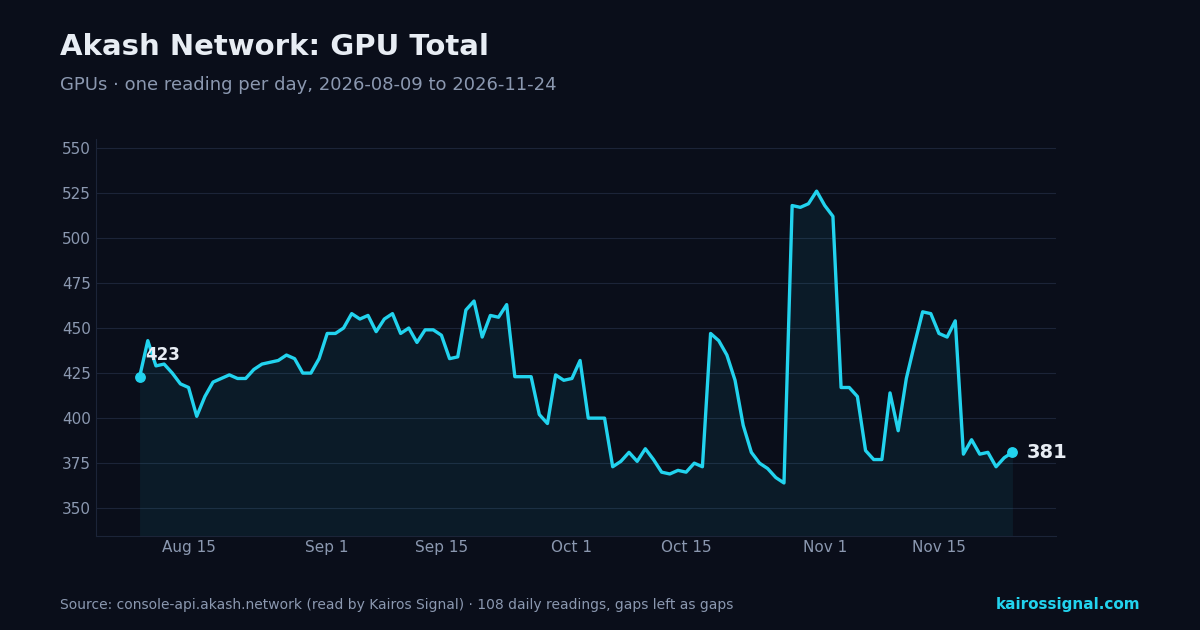
network-capacity, as stored by Kairos Signal.get_metric_history: daily points for one metric
Arguments {"symbol":"AKT","metric":"GPU_AVAILABLE","days":7}, captured the same minute:
// trimmed: the last three of seven points
{
  "symbol": "AKT",
  "metric": "GPU_AVAILABLE",
  "source": "depin_first_party",
  "kind": "supply_telemetry",
  "points": [
    {"date": "2026-11-22", "value": 120.0, "n_observations": 78},
    {"date": "2026-11-23", "value": 134.0, "n_observations": 80},
    {"date": "2026-11-24", "value": 135.0, "n_observations": 81}
  ],
  "window_days": 7,
  "note": "One point per UTC day built from raw observations; n_observations is how many readings backed the day. Days with no observation are absent, never zero."
}
The free tier serves the last 7 days. The days argument accepts 1 to 365, and a key on the connection serves that key's window.
verify_value: re-check a number against its source
verify_value takes a symbol and a metric, makes one GET to the upstream API, and reports where the same number appears in the upstream response as a JSONPath, the relative difference, and one of six verdicts: exact, within_1pct, within_10pct, no_matching_field, not_checkable_by_get or withheld_not_live. We did not call it for this page, so no output is shown. The idea behind it is in DePIN verify_url.
Account tools: register, list, buy, top up
These need a key, except register_agent, which creates one.
| Tool | What it does |
|---|---|
register_ |
Creates an API key and grants the free starter credits. Past the per-IP limit a key is still created, with $0, and the response says so |
check_ |
Returns the remaining credit balance |
purchase_ |
Buys a data product with credits; most products ship inline. Takes an optional idempotency_ so a retry is not charged twice |
topup_ |
Adds credits: a Stripe checkout link for $20 or $99 (llms.txt notes that completing it needs a browser and a card), or a USDC quote on Base in one of two modes |
get_ |
Read-only, but requires a key on a paid tier that includes the engines capability; the free starter key does not |
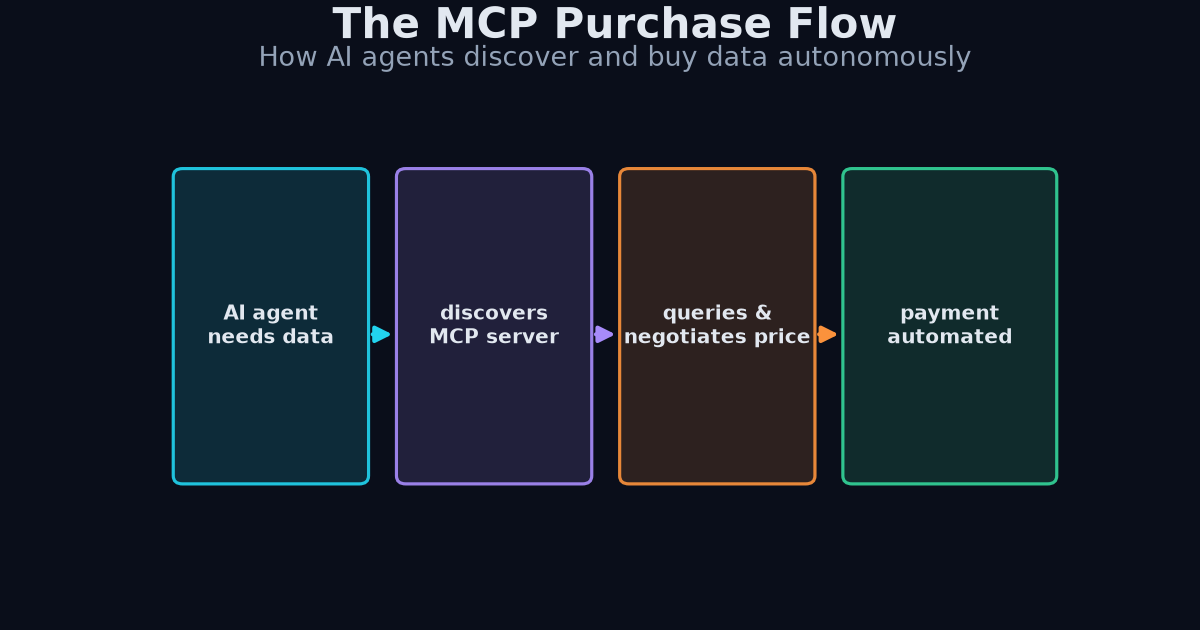
The step-by-step sequence is in the MCP purchase flow, and the top-up modes are in API credits and top-ups.
Paid analytics tools and their prices
These tools charge credits per answered call. The prices are from each tool's description on 2026-11-25:
| Tool | Price per answered call | What it computes for one network |
|---|---|---|
get_ |
1 credit ($1.00) | A Hodge decomposition of the lag-1 lead-lag flow between its metrics. Descriptive, no significance test |
get_ |
1 credit ($1.00) | The correlation spectrum of daily log changes against the Marchenko-Pastur edges. No regime label |
get_ |
1.5 credits ($1.50) | A two-factor functional ANOVA with Shapley values per day and unit. Descriptive, not causal |
get_ |
1 credit ($1.00) | Measured change in first-party on-chain supply series over 7 and 30 days. No price or listing data |
get_ |
2 credits ($2.00) | Enforcement capacity from sourced protocol parameters. A ceiling, not a verdict |
The billing rule is the same for each of them and is written into every description: charged once, and only after a non-empty answer is computed. An unavailable answer, a refusal or an error costs nothing. Each call is a new answer and a new charge. Two descriptions say the tool's name is historical: get_hodge_regime_sieve produces no regime classification or trading signal, and get_listing_dilution_score uses no exchange-listing data.
Limits and quotas
- Read-only tools are free within a daily per-IP quota (llms.txt). The server states the current figure in the
instructionsof itsinitializeresponse. get_metric_historyserves 7 days on the free tier.fetch_datasetreturns 10 records per query on the free tier.find_networksreturns up to 50 results (default 20).get_networkreturns up to 200 metrics (default 40).- MCP replies are not ed25519-signed. The REST data routes are (llms.txt), so re-read a value from
/v1/network/AKTwhen you need a signed copy.
A note on this page's history: earlier versions listed tool names that are not in the server's tool list, among them list_networks, query_supply, compare, rank_networks, verify, buy_credits, purchase and get_balance. Everything above is from the tools/list response of 2026-11-25.
Frequently asked questions
What is the URL of the Kairos Signal MCP server?
https://kairossignal.com/mcp, over streamable HTTP. A read-only edition without account or payment tools is at https://kairossignal.com/mcp/public.
Is the DePIN MCP server free?
The read-only tools are free within a daily per-IP quota and need no key. Data products cost credits through purchase_data, and the paid analytics tools charge 1 to 2 credits per answered call.
Do I need an API key to use the MCP server?
Not for the read-only tools. A key is needed for purchase_data, check_balance, topup_credits and the paid tools, and register_agent creates one.
Which MCP protocol versions does the server support?
llms.txt lists revision 2025-11-25 and says the server also negotiates 2025-06-18, 2025-03-26 and 2024-11-05.
How do I check a number the MCP server returns?
Open the verify_url on the row, or call verify_value with the symbol and metric. For Akash GPU counts the URL is Akash's network-capacity endpoint.
To reproduce this page, send tools/list to the endpoint for the names and descriptions, then run the three tools/call examples. The Akash values can be checked at network-capacity and gpu-prices without a key. The REST equivalents are in the API docs, and the same series are on the Akash page.
This is a data product. Kairos Signal publishes measurements with their sources, not trading signals.