The verify_url Promise
The verify_url Contract
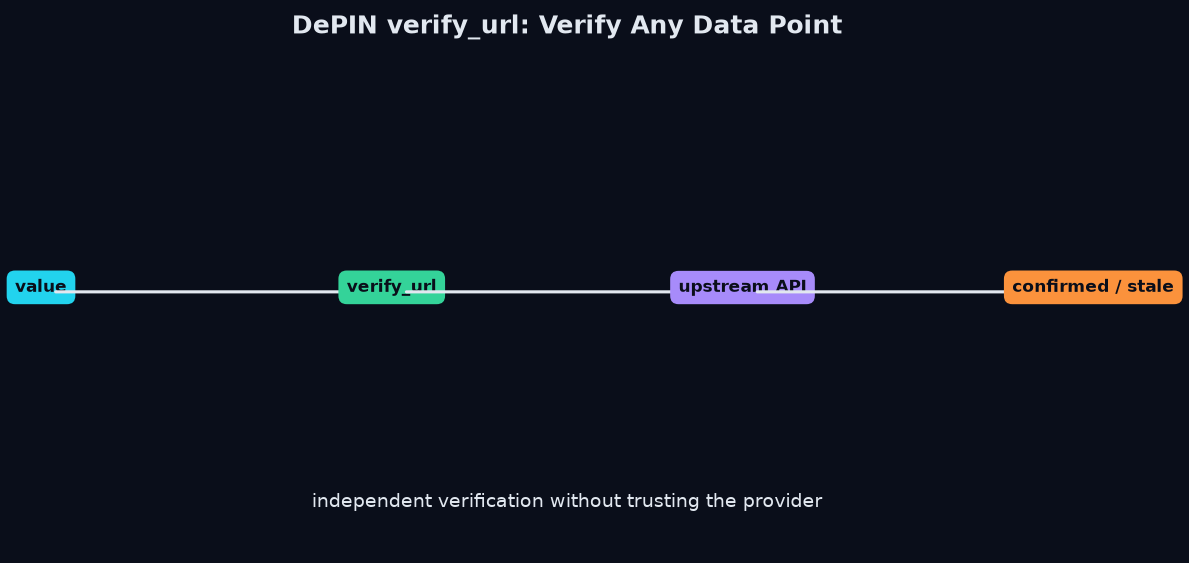
A verify_url is not a decorative link — it is a machine-readable contract. When you open one, you retrieve the exact upstream observation a value was derived from, plus the context needed to confirm it: the source, the as_of timestamp, and the freshness verdict. An agent can dereference a verify_url programmatically and confirm a value before acting on it.
This is what makes our data verifiable rather than merely labeled. A value with a verify_url is a claim you can check; a value without one is a claim you must trust. Across 372 networks and 11,857 live series, every value carries that contract — which is the difference between a data product and a feed.
The core promise of verifiable DePIN data is simple: every value carries a verify_url — a public URL pointing at the exact upstream endpoint that produced it. Open the URL, confirm the number, done. No trust in the intermediary required.
This is the practical face of our "provenance or silence" principle. We serve a number only if we can point you to where it came from.
What a verify_url Looks Like
Every response from the Kairos Signal API includes provenance on each value:
{
  "network": "akash",
  "gpu_active": 3500,
  "source": "first_party_api",
  "as_of": "2026-08-25T12:00:01Z",
  "verify_url": "https://console.akash.network/...",
  "freshness_verdict": "fresh"
}
The verify_url is not decorative. It is the actual upstream URL (or a stable canonical reference) that a human or an agent can open to see the source of truth.
How to Verify a Value
# 1. Pull a value with its receipt
curl "https://api.kairossignal.com/v1/networks/akash?fields=gpu_active" \
  -H "X-API-Key: *"
2. Open the verify_url and confirm the number at the source
3. For a specific value's full provenance
curl "https://api.kairossignal.com/v1/verify/{value_id}"
For supply and fee data, the verify_url typically points at a chain explorer. For node counts, it points at the network's own telemetry console. Either way, you can confirm the value independently.
What the verify_url Covers
The verify_url is per-category, pointing where each kind of claim lives:
- Node counts → the network's own telemetry console.
- Supply figures → the chain explorer.
- Protocol fees → chain state.
- Market data → the market feed.
Freshness Verdicts: What They Mean
The freshness_verdict tells you the state of the value:
- fresh — read recently, within the expected cadence.
- stale — older than expected; use with caution.
- missing — we don't serve it (never zero-filled).
Verify by Hand or by Agent
The verify_url is designed for both humans and autonomous agents. A human clicks and confirms. An agent fetches the verify_url, compares the value, and only acts when the source matches — a pattern that makes automated decisions on DePIN data far more trustworthy. See our guide on autonomous agent data for how agents consume this.
Beyond verify_url
A verify_url proves source. To also prove integrity and time, daily batches are Merkle-rooted and anchored to Bitcoin via OpenTimestamps. The three layers together mean a number is source-checkable, unaltered, and provably present at a point in time.
FAQ
What exactly is a verify_url? A public URL in the response pointing at the exact upstream source that produced the value. Open it to confirm the number at the source. Do I need to trust the provider? No. Open the verify_url and confirm the value against the source yourself. The provider is not in the verification loop. Can an agent verify values? Yes — an agent can fetch the verify_url, compare the value, and only act when the source matches. This encodes trust into automated decisions. Read the docs → · Try it live →What the verify_url Covers by Category
The verify_url is category-aware, pointing where each kind of claim actually lives:
- Node counts → the network's own telemetry console.
- Supply figures → the chain explorer.
- Protocol fees → chain state.
- Market data → the market feed.
Enforcing Verification in Code
For a serious pipeline, verification isn't a manual step — it's a code path. Fetch the value, fetch the verify_url, compare. If the source disagrees, flag it. If the freshness verdict is stale, treat it as historical. Encoding these checks into your ingestion layer means every value that reaches your analytics has already been confirmed against its source. That's the difference between a system that hopes the data is right and one that knows it.
Read more: DePIN Data Provenance · DePIN Data Verification · DePIN Data Provenance: Merkle + Bitcoin
---
This is a data product. Kairos Signal publishes no trading signals, performance returns, win rates, or accuracy claims.Get Started With DePIN Intelligence
Kairos Signal provides verifiable, provenance-first telemetry for DePIN networks, including first-party supply data read directly from a network's own API or blockchain. Every value carries a verify_url you can check yourself, and each daily batch is Merkle-rooted and anchored to Bitcoin.
Every API response is signed with ed25519 and timestamped. You can prove what was served and when, months later. That is what we mean by provenance-first.
Related reading: DePIN Intelligence Guide · DePIN Telemetry · How to Query DePIN Data · DePIN Data Verification · Pricing