The Three-Layer Provenance Model
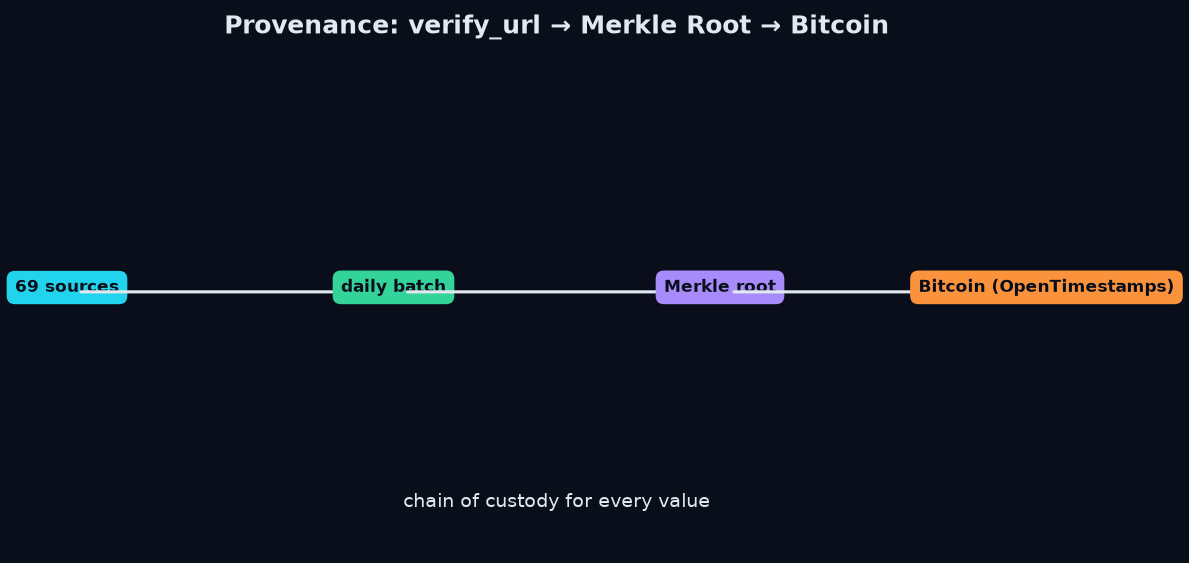
Verifiable DePIN data is not a single feature — it is a stack. At Kairos Signal the provenance model has three layers, each closing a different trust gap:
verify_url — proves a value's source (the receipt).A number that has all three is not just a claim — it is a claim you can check against the world without trusting anyone.
Layer 1: verify_url — The Source Receipt
Every value carries a verify_url pointing at the exact upstream endpoint that produced it. For supply it's a chain explorer; for node counts it's the network's own telemetry; for fees it's the chain state.
# Get a value and its receipt
curl "https://api.kairossignal.com/v1/networks/akash?fields=gpu_active" \
  -H "X-API-Key: *"
Open the verify_url and confirm the number at the source. This is the per-value receipt.
Layer 2: Merkle Root — Batch Integrity
A single verify_url proves source but not history. To prove that a historical value was not altered, each daily batch of hundreds of values is hashed into a single Merkle root. The root commits to the entire batch at once: change any leaf and the root changes. A buyer can recompute the root from the served values and confirm the batch is intact.
Layer 3: Bitcoin Anchoring — Existence in Time
The Merkle root alone proves internal consistency but not when a batch was created — you could backdate a consistent batch. To close that gap, each root is submitted to the Bitcoin blockchain via OpenTimestamps. The Bitcoin timestamp is a tamper-evident, decentralized proof that the batch existed at a specific time. Once anchored, a batch cannot be backdated or silently restated.
Why It All Matters Together
Each layer alone is useful; together they are transformative:
verify_urlproves where a number came from.- Merkle root proves that it's intact.
- Bitcoin proves when it existed.
A Worked Chain-of-Custody
Take a historical supply value from 30 days ago. The verify_url tells you its source; the Merkle root proves the batch it belonged to is unchanged; the Bitcoin timestamp proves the batch existed on that date. Any one layer could be forged by a malicious actor, but reproducing all three independently is impractical — which is what makes the stack trustworthy.
Provenance in Practice
Across 372 networks, 138 sources, 11,857 live series, and ~697K rows in ClickHouse, the provenance model applies uniformly. Every value carries the receipt; every daily batch is anchored. That's what turns a data product into a trustworthy one.
FAQ
What does the verify_url prove? Where a value came from — the exact upstream source. It's the per-value receipt. What does the Merkle root add? It proves the batch wasn't altered. Change any value and the root changes, so a buyer can confirm integrity. What does Bitcoin add on top? A tamper-evident timestamp proving the batch existed at a specific time — closing the backdating gap. Read the docs → · Get a free key →The Failure Modes Each Layer Prevents
Each provenance layer closes a specific attack or failure mode, and understanding them makes the stack more than a buzzword:
- Without a
verify_url, a provider can serve a fabricated number with no way to check it. - With only a
verify_url, a provider can serve a real number but silently restate history later — the current value checks out, but yesterday's doesn't. - With a Merkle root but no Bitcoin anchor, a provider could backdate a consistent batch.
- Only the Bitcoin anchor closes the backdating gap, because Bitcoin is a decentralized, tamper-evident timestamp.
What Independent Verification Means in Practice
With all three layers, you can verify a DePIN data point without trusting Kairos Signal at all. You open the verify_url to confirm the source, recompute the Merkle root to confirm the batch is intact, and check the Bitcoin timestamp to confirm when it existed. Every step runs against public, independently checkable artifacts. Trust is replaced by arithmetic — which is exactly what a serious data consumer should want.
Read more: Merkle Root Data Integrity · DePIN Data Provenance · DePIN Data Verification
---
This is a data product. Kairos Signal publishes no trading signals, performance returns, win rates, or accuracy claims.---
Try it yourself
Query the live catalog, supply telemetry, and provenance receipts directly: /v1/supply, /v1/provenance on the REST API.
Related reading: Merkle-rooted batch integrity · how verify_url works · how we verify every DePIN number
Design-partner seats are capped at 20 at a lifetime-locked $199/mo (full API access, every published endpoint, MCP server, Bitcoin-anchored provenance). After seat 20 the price becomes $249/mo. Claim a design-partner seat → · See pricing---
Get Started With DePIN Intelligence
Kairos Signal provides verifiable, provenance-first telemetry for DePIN networks, including first-party supply data read directly from a network's own API or blockchain. Every value carries a verify_url you can check yourself, and each daily batch is Merkle-rooted and anchored to Bitcoin.
Every API response is signed with ed25519 and timestamped. You can prove what was served and when, months later. That is what we mean by provenance-first.
Related reading: DePIN Intelligence Guide · DePIN Telemetry · How to Query DePIN Data · DePIN Data Verification · Pricing