What "DePIN Intelligence" Actually Means
Most "DePIN data" you can find on the internet is a price feed wearing a costume. A market cap is not intelligence about the network — it is intelligence about the token market. If you want to know whether a decentralized physical infrastructure network is actually working, you need telemetry: how many nodes are online, how much compute is active, how much storage is real, what the protocol actually earns in fees.
DePIN intelligence is the layer that turns raw chain state and first-party API responses into a decision-ready picture of the network. It answers questions like:
- How many active nodes does this network really have, versus how many it advertises?
- Is registered capacity actually deployed, or is it idle inventory?
- Which networks generate real protocol fees, and which just have a token?
- What does the supply picture look like over time, not just today?
The Dataset Under the Hood
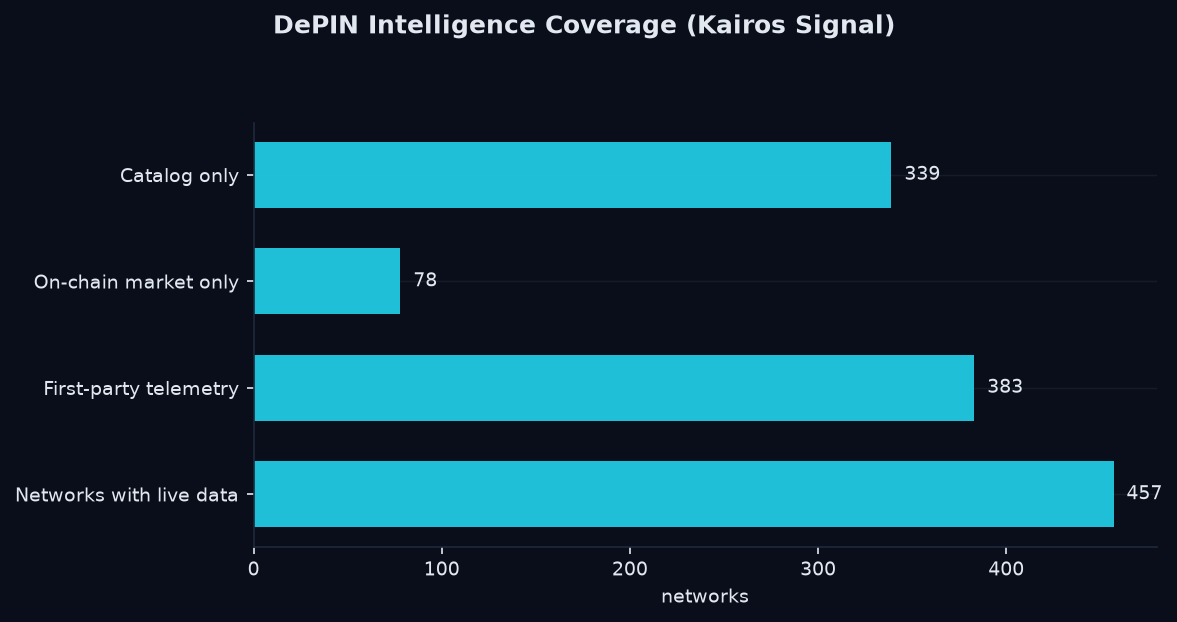
At Kairos Signal we read 372 networks with live data, of which 296 carry first-party telemetry read directly from each network's own API or chain, 78 are on-chain market only, and 339 catalog entries have no public feed at all and are labeled catalog_only. That is 11,857 live series from 69 distinct data sources, stored in ClickHouse at roughly 697K rows and served through 19 live REST endpoints.
The scale matters for a specific reason: coverage breadth is what lets you compare networks against each other instead of judging each in isolation. A single number about Akash tells you little; the same canonical metric across Akash, io.net, and Render tells you where the compute actually is.
Why Provenance Is the Whole Point
A number with no source is not data — it is an opinion. Every value we serve carries four fields:
source— the upstream API or chain that produced itas_of— the exact time we read itverify_url— a public URL you can open to confirm the number yourselffreshness_verdict— whether the value is fresh, stale, or missing (never zero-filled)
The Coverage Map: 327 Live Networks and the Catalog-Only Tier
Here is the honest shape of the DePIN data map. Not everything can be measured — and naming what we cannot measure is part of being a data provider.
| Coverage tier | Networks | What it means | |---|---|---| | First-party telemetry | 296 | Live infrastructure metrics from the network's own API/chain | | On-chain market only | 78 | Token supply/price from chain state, no infra telemetry | | Catalog only | 339 | Directory listing, no public feed available | | Total live | 327 | Everything we serve with verifiable values |
Top Sources by Network Count
The 138 sources are not equal. A handful carry most of the coverage:
subtensor_rpc — 129 networksevm_blockscout — 118 networks (holders, transfers, gas)bsc_rpc — 50 networks (BSC token supply)solana_rpc — 49 networks (Solana L1 + SPL tokens)first_party_api — 44 networks (per-network stats APIs)ethereum_rpc — 32 networks (Ethereum token supply)The long tail is where the moat lives. First-party API access to 44 networks is hard to replicate; temporal history of all of them is impossible to buy later. Anyone can pull CoinGecko — very few have built collectors for dozens of first-party network APIs and kept them running through schema changes.
From Telemetry to Decision
DePIN intelligence becomes useful when it is canonical. Because networks name their fields differently — DEVICES_ACTIVE, GPU_ACTIVE, ACTIVE_NODES — we map 89 native field names into 38 canonical concepts, each with a declared unit. That lets you compare utilization across Akash, io.net, and Render in a single query instead of reverse-engineering each network's schema.
The end state is a data product an analyst or an autonomous agent can trust blindly: every number verified, every batch anchored, every gap labeled. That combination — breadth, canonical schema, and provenance — is what separates a data product from a feed.
The Canonical Query
# The whole catalog with coverage tiers
curl "https://api.kairossignal.com/v1/networks" -H "X-API-Key: *"
One network's telemetry
curl "https://api.kairossignal.com/v1/networks/akash" -H "X-API-Key: *"
A canonical concept compared across networks
curl "https://api.kairossignal.com/v1/compare?concept=GPU_UTILIZATION"
Verify any value independently
curl "https://api.kairossignal.com/v1/verify/{value_id}"
FAQ
Is DePIN intelligence the same as market data? No. Market data describes the token; intelligence describes the network. A falling token price does not mean the network is failing — and a rising one does not mean it is working. Telemetry is the layer that separates the two. Why do you label some networks catalog-only? Because we refuse to fabricate data. If a network exposes no verifiable feed, we list it in the catalog and label itcatalog_only rather than modeling an estimate. Honesty about gaps is part of the product.
Can I verify a number myself? Yes. Every value carries a verify_url you can open to confirm it at the source, and every daily batch is Merkle-rooted and anchored to Bitcoin.
Explore the live API → · Get a free key →
Read more: DePIN Telemetry: How We Read Supply Data From 296 Networks · DePIN Network Data: 327 Networks, 69 Sources, One API · DePIN Data Provenance
---
This is a data product. Kairos Signal publishes no trading signals, performance returns, win rates, or accuracy claims. All values are measured facts with verifiable provenance.---
Try it yourself
Query the live catalog, supply telemetry, and provenance receipts directly: /v1/supply, /v1/provenance on the REST API.
Related reading: DePIN network data: 372 networks, 138 sources · how we read supply telemetry from 296 networks · the DePIN developer guide · how to query DePIN data with curl
Design-partner seats are capped at 20 at a lifetime-locked $199/mo (full API access, every published endpoint, MCP server, Bitcoin-anchored provenance). After seat 20 the price becomes $249/mo. Claim a design-partner seat → · See pricing---
Get Started With DePIN Intelligence
Kairos Signal provides verifiable, provenance-first telemetry for DePIN networks, including first-party supply data read directly from a network's own API or blockchain. Every value carries a verify_url you can check yourself, and each daily batch is Merkle-rooted and anchored to Bitcoin.
Every API response is signed with ed25519 and timestamped. You can prove what was served and when, months later. That is what we mean by provenance-first.
Related reading: DePIN Intelligence Guide · DePIN Telemetry · How to Query DePIN Data · DePIN Data Verification · Pricing---
Correction 2026-09-25: a catalog total stamped into this post after it was published has been removed. The catalog count is a count of catalog entries (it includes superseded rows and Bittensor subnet rows), not of networks. The other figures here are as of the post's date.