Live data: Filecoin (FIL) live telemetry · Akash Network (AKT) live telemetry — every value with source, as_of and a verify URL. Get a free $5 API key · try without signup
A research dataset needs three things a dashboard does not give you: a dated series, the count of readings behind each point, and a source a reviewer can open. GET /v1/history?network=<SYMBOL>&metric=<METRIC> returns exactly that, one point per UTC day. For Filecoin's ACTIVE_MINERS it returned 427 for 2026-11-18 and 420 for 2026-11-24, each with its as_of and n_observations. This post is the workflow from that call to a citation.
Key facts
/v1/historyserves one row per day, network and metric. Days with no observation are absent, never carried forward or interpolated (the endpoint's own disclosure, read 2026-11-25).- The free tier serves the last 7 days. Design Partner includes 30 days of daily history, per the published pricing.
- Stored history begins at the 2026-08-06 clean epoch. Earlier data is not served.
- Filecoin
ACTIVE_MINERSread 420 on 2026-11-24, from Filfox's overview endpoint. /v1/attestreturns a Merkle inclusion proof for one row, for batches from 2026-08-29 onward.
Pull a daily DePIN series with /v1/history
curl -s "https://api.kairossignal.com/v1/history?network=FIL&metric=ACTIVE_MINERS&days=7" \
  | jq '.data.FIL.ACTIVE_MINERS'
{
  "tier": "supply_telemetry",
  "source": "depin_first_party",
  "points": [
    {"date": "2026-11-18", "value": 427.0, "n_observations": 81, "as_of": "2026-11-18T23:58:04Z"},
    {"date": "2026-11-19", "value": 425.0, "n_observations": 80, "as_of": "2026-11-19T23:48:04Z"},
    {"date": "2026-11-24", "value": 420.0, "n_observations": 71, "as_of": "2026-11-24T23:28:04Z"}
  ],
  "unit_note": "not recorded for this series; the value is unscaled as read",
  "n_points": 7,
  "first_date": "2026-11-18",
  "last_date": "2026-11-24",
  "change_pct": -1.6393
}
// trimmed
change_pct is first-to-last over the window: (420 − 427) / 427 × 100 = −1.64%. Compute your own statistics from points if you need a different definition.
Pass the ticker symbol in network and the exact metric name in metric. Metric names are case-sensitive: asking for gpu_active on Akash returns a different series, with a different source, than GPU_ACTIVE. Take names from /v1/network/<SYMBOL> or from a network page such as Filecoin rather than typing them from memory.
Filecoin active miners, 2026-11-18 to 2026-11-24
| Date | ACTIVE_MINERS |
Readings that day | as_of (UTC) |
|---|---|---|---|
| 2026-11-18 | 427 | 81 | 2026-11-18T23:58:04Z |
| 2026-11-19 | 425 | 80 | 2026-11-19T23:48:04Z |
| 2026-11-20 | 426 | 80 | 2026-11-20T23:48:04Z |
| 2026-11-21 | 426 | 81 | 2026-11-21T23:53:04Z |
| 2026-11-22 | 425 | 79 | 2026-11-22T23:58:04Z |
| 2026-11-23 | 425 | 79 | 2026-11-23T23:48:04Z |
| 2026-11-24 | 420 | 71 | 2026-11-24T23:28:04Z |
Source for every row: filfox.info/api/v1/overview, as stored by Kairos Signal.
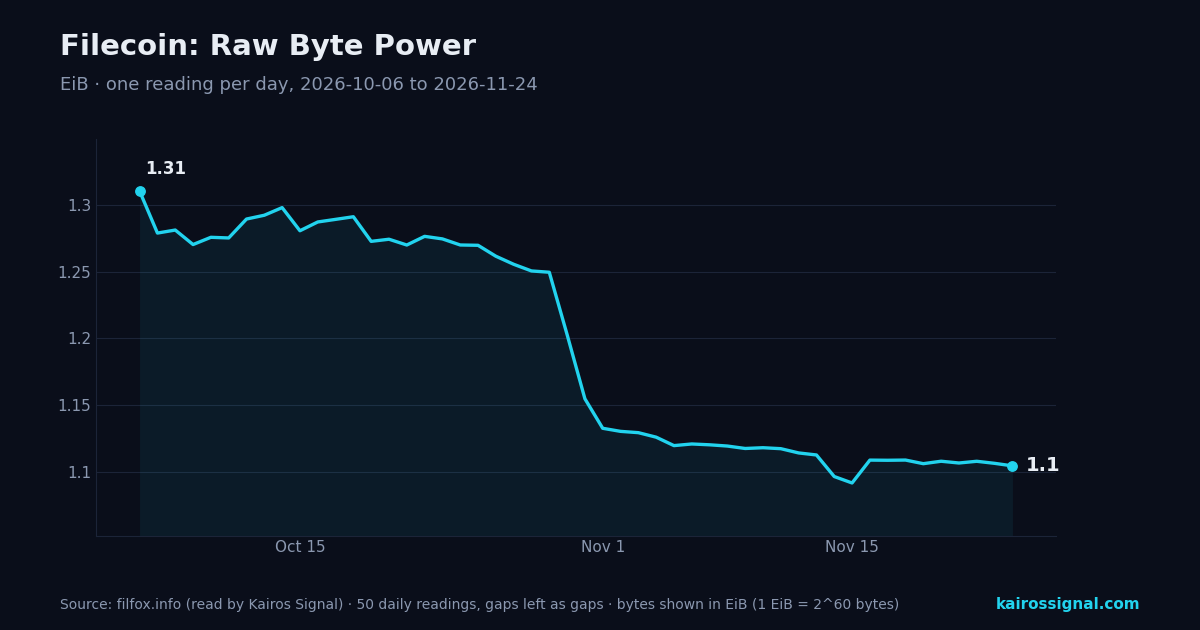
This series has no stored unit definition. Its unit_note says the value is unscaled as read, so describe it in a paper as "the ACTIVE_MINERS figure Filfox's overview endpoint returns", not as a count of storage providers under a definition we did not record. Where a definition exists it is in the row's unit field, as on Filecoin's RAW_BYTE_POWER ("bytes (raw-byte power)").
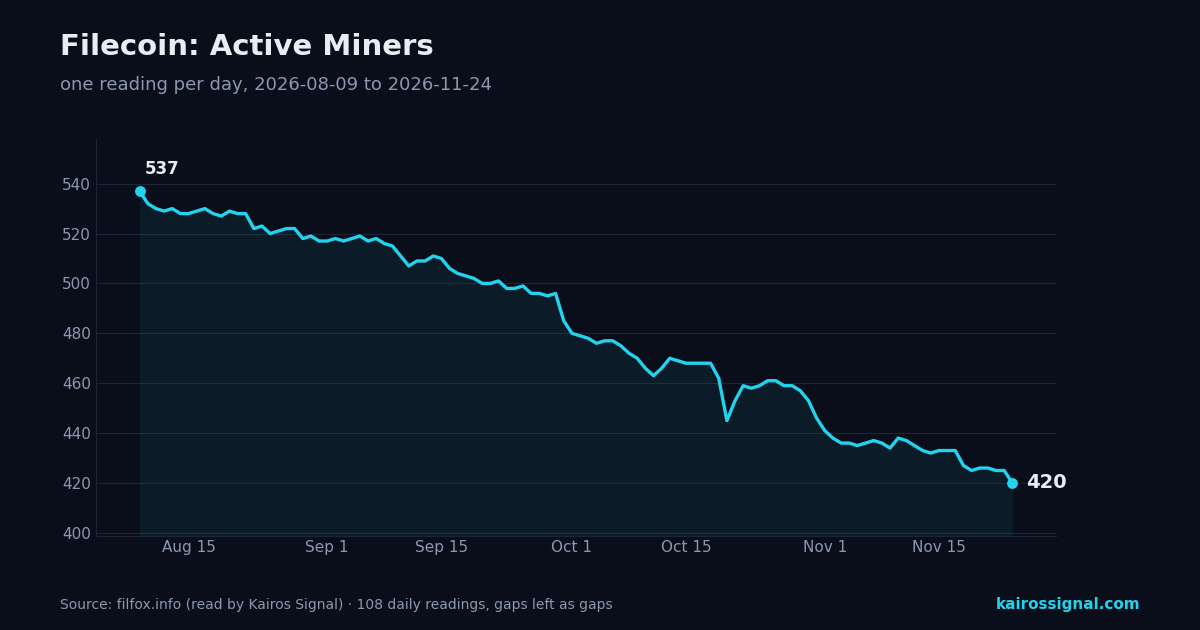
ACTIVE_MINERS, 108 daily readings: first 537 on 2026-08-09, last 420 on 2026-11-24, range 420 to 537. Source: Filfox overview endpoint, as stored by Kairos Signal.Five properties of the history that affect your method
- Gaps are real. A missing date means no reading that day. Do not forward-fill without saying so.
as_ofis per point. Each point carries the timestamp of the observation behind it, so you can align two series by time and not only by date.n_observationsis a quality signal. A day backed by 71 readings and a day backed by 81 are both valid, and a day backed by one reading deserves a footnote.- Excluded points stay excluded. Points under a quality incident, and CoinGecko zeros that mean "unknown", are not served. The reasons are listed under
withheld_not_liveon the latest-value routes; see handling stale and withheld data. - Aggregator series are labelled. A history
tierofmarketmarks commodity market data such as CoinGecko prices. Fee figures come from DefiLlama and say so insource. Cite each as that aggregator's figure.
Export the series to CSV in Python
import csv
import json
import sys
import urllib.request

URL = "https://api.kairossignal.com/v1/history?network=FIL&metric=ACTIVE_MINERS&days=7"
req = urllib.request.Request(URL, headers={"User-Agent": "depin-research"})
with urllib.request.urlopen(req, timeout=30) as resp:
    body = json.load(resp)

series = body["data"]["FIL"]["ACTIVE_MINERS"]
out = csv.writer(sys.stdout)
out.writerow(["date", "value", "n_observations", "as_of", "source"])
for point in series["points"]:
    out.writerow([point["date"], point["value"], point["n_observations"],
                  point["as_of"], series["source"]])
The request sets a User-Agent header because the public host answered Python's default urllib client with HTTP 403 when tested on 2026-11-25. Keep as_of and source in the file you archive. A table of dates and values without them cannot be checked later. The Python supply walkthrough covers the latest-value endpoint in the same style.
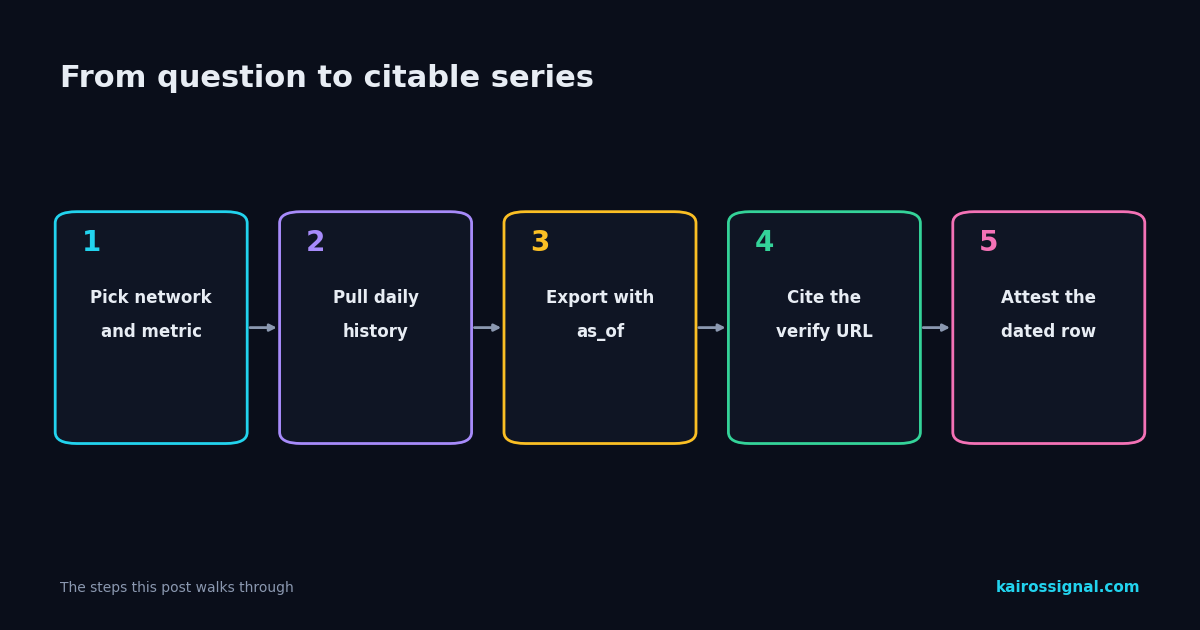
Cite the source, then attest the dated value
A citation has two parts. The first is the upstream: the latest-value row for the same metric, from /v1/supply?network=FIL, carries verify_yourself, the URL the number was read from. Cite that URL and the as_of, because the upstream will have moved by the time a reader opens it.
The second part answers "did the data provider change this after the fact". Each daily batch is Merkle-rooted and timestamped to Bitcoin via OpenTimestamps, and /v1/attest returns the inclusion proof for one row:
curl -s "https://api.kairossignal.com/v1/attest?symbol=AKT&metric=price_usd&date=20260901"
{
  "attested": true,
  "value_as_published": {
    "symbol": "AKT",
    "metric": "price_usd",
    "value": "0.4955",
    "unit": "usd",
    "source": "CoinGecko /coins/markets",
    "verify_url": "https://www.coingecko.com/en/coins/akash-network",
    "as_of": "2026-09-01T22:49:20.000Z"
  },
  "batch": {
    "stamp_day": "20260901",
    "merkle_root": "2d32689a65ecc9412fdaced8c85841b907f3fdfa1f73d537aec3dc9359270af4"
  },
  "opentimestamps": {
    "bitcoin_status": "bitcoin_confirmed"
  }
}
// trimmed
The value in that example is CoinGecko's AKT price, not a first-party reading. The same response states its own limit under timestamp_semantics.what_is_not_proven: the proof shows the row was in the batch at that time, not that the upstream figure was correct. Batches before 2026-08-29 are anchor-only and answer attested: false. Data-API responses are also ed25519-signed, so a response you archive can be checked against the published key later; how the provenance chain works has the details.
Frequently asked questions
Is there a free DePIN data API for research?
Yes. /v1/history serves a 7-day daily window on the free tier and registration gives $5 in free credits with no card (first 3 keys per IP per 30 days). Longer windows need a paid tier; see pricing.
How far back does DePIN history go?
Stored daily history begins at the 2026-08-06 clean epoch. Each series starts on the first day it was read, so check first_date in the response.
Can I cite Kairos Signal data in a paper?
Cite the upstream URL in verify_yourself with the as_of, and name Kairos Signal as the collector. For a dated value, add the /v1/attest proof.
Are missing days filled in?
No. A day with no observation is absent from points. Nothing is interpolated, smoothed or back-filled.
To reproduce the table, run the first curl on this page and compare the latest point with Filfox's overview endpoint. The curl quick start lists the other routes, the daily telemetry posts show the same series day by day, and /status reports service health.
This is a data product. Kairos Signal publishes measurements with their sources, not trading signals.