What "Leading Data Provider" Actually Requires
Saying you are a leading DePIN data provider is easy. Earning it requires three things the market consistently lacks: coverage breadth, first-party sourcing, and provable provenance. Most aggregators deliver one or two; few deliver all three without a credibility gap.
Kairos Signal is built on a simple principle — provenance or silence. If we cannot point you to the exact endpoint a number came from, we do not serve it. We would rather omit a metric than present something we cannot verify.
Coverage: 327 Networks, 69 Sources
Coverage is the foundation. You cannot be the leading provider if the networks you care about are missing. Our current map:
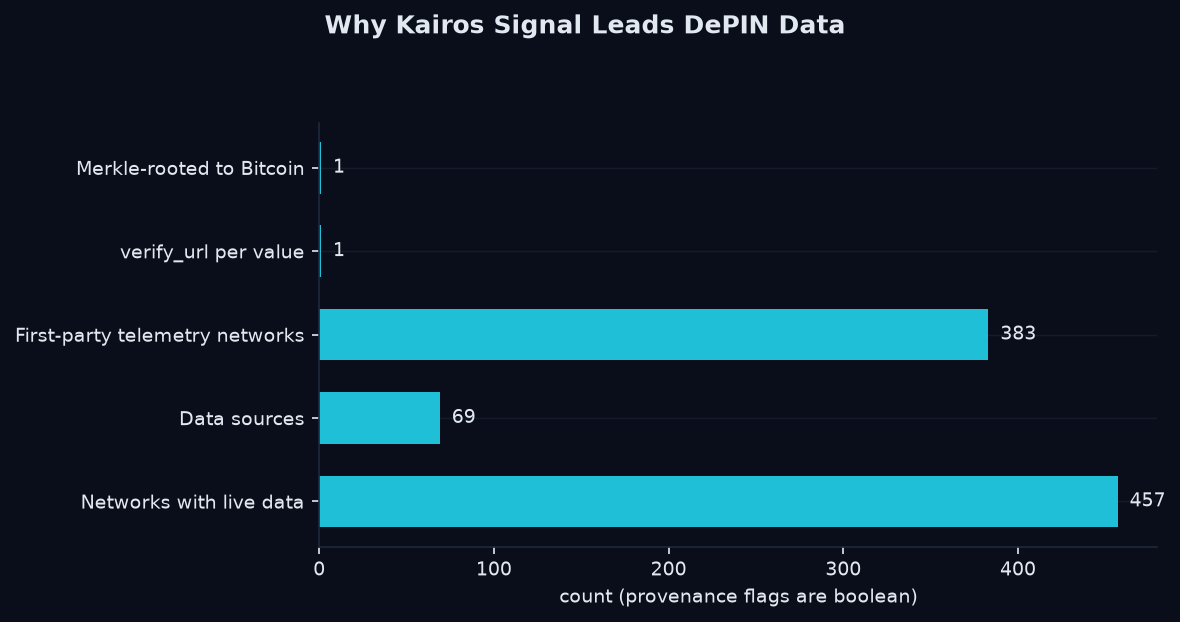
- 372 networks with live data
- 296 with first-party telemetry (read from the network's own API or chain)
- 78 on-chain market only
- 339 catalog entries are
catalog_only(no public feed, honestly labeled) - 11,857 live series, 69 data sources, ~697K rows in ClickHouse
First-Party Sourcing Is the Moat
A data provider that re-publishes other aggregators' numbers is a proxy for a proxy. We read networks directly where we can — from the network's own API, its RPC chain, or its first-party stats endpoint. For the 44 networks with first_party_api coverage, the value chain is: network → our collector → ClickHouse → you, with no third-party indexer in the path.
This matters for accuracy. A modeled or secondhand estimate inherits someone else's assumptions. First-party telemetry lets you open the verify_url and confirm the number yourself. When the network's own console says 3,500 active GPUs, the verify_url points there — not at a guess.
Provenance: The Verify-URL + Merkle Standard
Every value we serve carries four provenance fields:
source— the upstream endpointas_of— the exact read timeverify_url— a public URL to confirm the numberfreshness_verdict— fresh, stale, or missing (never zero-filled)
The Honest Gaps
Leading providers also admit what they do not cover. We explicitly label the 339 networks with no public feed as catalog_only, so developers can filter them out in one line of code instead of discovering the gap mid-build. Naming the missing data is part of the service. A provider that never shows you its coverage gaps is hiding something.
The API That Agents and Analysts Both Use
Coverage and provenance are only useful if the delivery is clean. Kairos Signal exposes 19 live REST endpoints at https://api.kairossignal.com, plus an MCP server for autonomous agents at https://kairossignal.com/mcp/. Pricing starts at $0 free and scales to a $199/mo design partner tier (forever price lock, $499/mo pro, and $2000/mo enterprise.
# Browse all live networks and tiers
curl "https://api.kairossignal.com/v1/networks"
Pull supply telemetry for a single network
curl "https://api.kairossignal.com/v1/networks/akash"
Verify any value against its source
curl "https://api.kairossignal.com/v1/verify/{value_id}"
FAQ
How is a data provider different from a data aggregator? An aggregator re-publishes what others report. A provider collects from first-party sources, normalizes, and stands behind the numbers with provenance. We collect directly from networks, RPC chains, and first-party APIs. What makes coverage "honest"? Labeling gaps. We mark 339 networks ascatalog_only because they have no public feed. A provider that counts directory entries as "coverage" is inflating its numbers.
Can I verify your data without trusting you? Yes. Open the verify_url on any value to confirm it at the source, and check the Merkle root / Bitcoin timestamp for historical integrity.
Compare against alternatives → · Read the docs →
What to Verify Before Choosing a Provider
Picking a DePIN data provider is an evaluation, not a sales call. Here is the checklist that separates a real data product from a rebranded dashboard:
verify_url on a live value. If the provider can't show you where a number comes from, it is serving an estimate.0 for a missing node count is poisoning your pipeline.Run those four questions against any vendor. A provider that passes all four is rare — and that rarity is exactly why we publish our coverage tiers, provenance contract, and missing-not-zero policy openly rather than hiding them.
The Longevity Question
Data providers are only as good as the history they've accumulated. A provider that started collecting yesterday has no temporal depth, no matter how good its current snapshot is. Ask how long each series has been banked. Temporal history cannot be bought or accelerated — a day of telemetry not recorded is gone forever. That is why a provider with a real collection history is fundamentally more valuable than one with a big catalog and a thin archive.
Read more: DePIN Data Comparison · DePIN Data Platform · DePIN Pricing
---
This is a data product. Kairos Signal publishes no trading signals, performance returns, win rates, or accuracy claims.Get Started With DePIN Intelligence
Kairos Signal provides verifiable, provenance-first telemetry for DePIN networks, including first-party supply data read directly from a network's own API or blockchain. Every value carries a verify_url you can check yourself, and each daily batch is Merkle-rooted and anchored to Bitcoin.
Every API response is signed with ed25519 and timestamped. You can prove what was served and when, months later. That is what we mean by provenance-first.
Related reading: DePIN Intelligence Guide · DePIN Telemetry · How to Query DePIN Data · DePIN Data Verification · Pricing---
Correction 2026-09-25: a catalog total stamped into this post after it was published has been removed. The catalog count is a count of catalog entries (it includes superseded rows and Bittensor subnet rows), not of networks. The other figures here are as of the post's date.