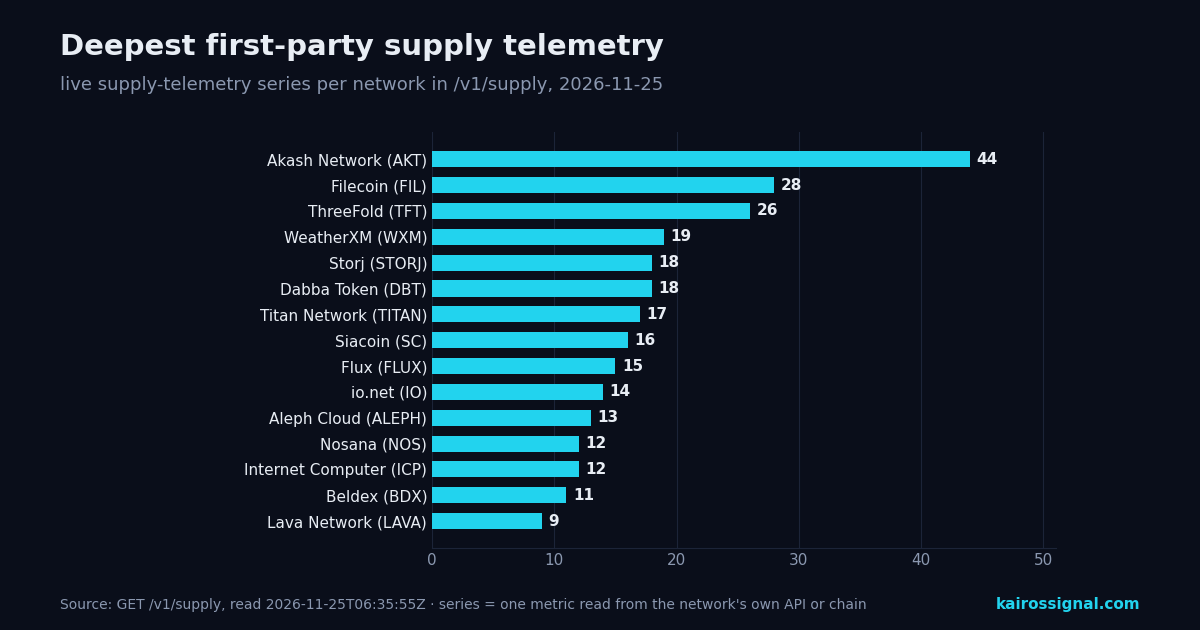
Live data: Akash Network (AKT) live telemetry · Arweave (AR) live telemetry · Pocket Network (POKT) live telemetry — every value with source, as_of and a verify URL. Get a free $5 API key · try without signup
Building your own DePIN data pipeline costs no licence fee, because the networks' endpoints are free. It costs engineering time, and the amount depends on how many networks you need and whether you need history. For Akash alone, the network and chain values we held on 2026-11-25 named 23 distinct upstream URLs on four hosts, before counting CoinGecko's and DefiLlama's figures. Buying starts at $0 for keyless reads and is $199/mo for all networks with 30 days of daily history.
We give no salary or hour estimates here. The sections below list what the work consists of, with real endpoints, so you can price your own time.
Key facts
- Akash network and chain values in our store on 2026-11-25 named 23 distinct upstream URLs, aggregator figures aside: 5 paths on
console-api.akash.network, 16 URLs onrest.cosmos.directory, 1 onrpc.cosmos.directoryand 1 onapi.akashnet.net. - Akash's
TOTAL_SUPPLYarrives as 300197474066037 uakt. It is 300M AKT only after dividing by 1,000,000 (source). - On 2026-11-25, 65 of the 337 market-tier rows in our Akash record were flagged stale; 60 of them were per-model GPU rows that had stopped refreshing.
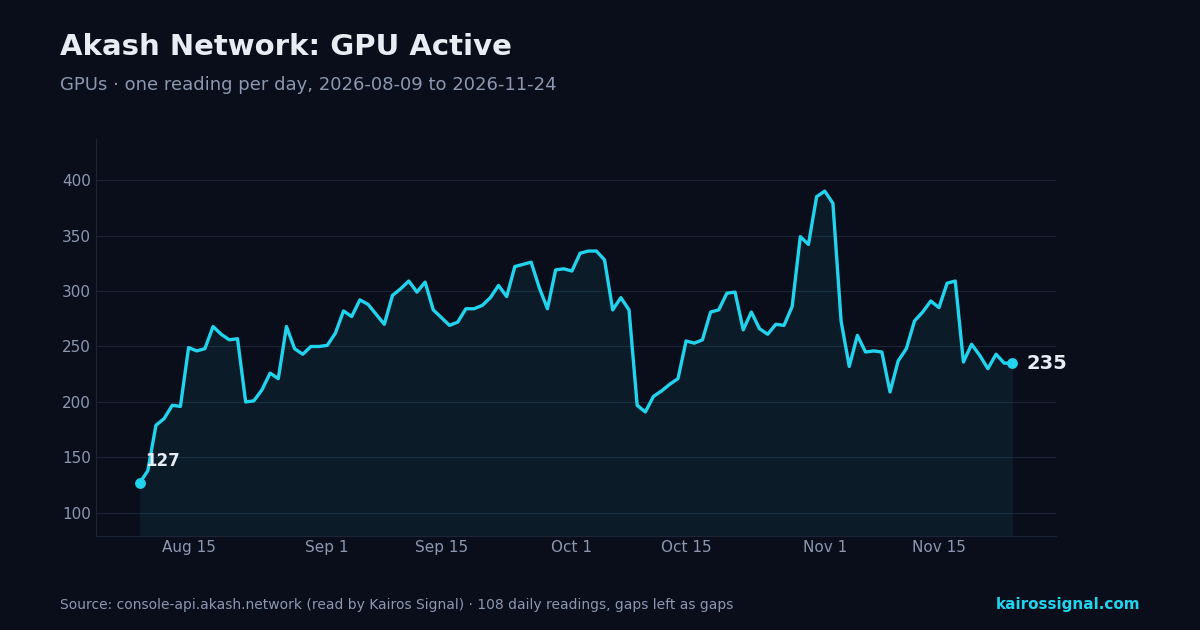
- Akash publishes two active-GPU counts:
GPU_ACTIVE241 (2026-11-25 06:23:04 UTC) andACTIVE_GPU248 (2026-11-25 06:32:40 UTC). They come from different endpoints and are not the same count. - Kairos Signal's free tier serves 7 days of daily history; the $199/mo tier serves 30 days. Prices are on the pricing page.
What building a DePIN data pipeline involves
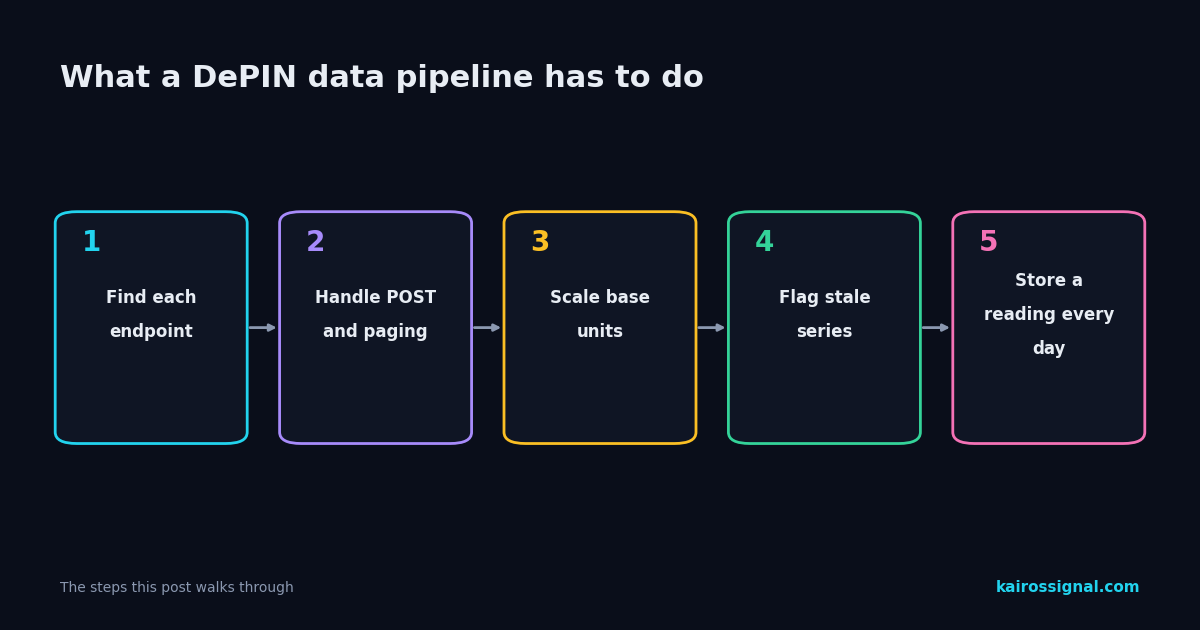
1. Many endpoints for one network
Akash is the best-documented case we have. Its console API alone has five paths we read:
Path on console-api.akash.network |
What we store from it |
|---|---|
/v1/network-capacity |
GPU, CPU, memory and storage capacity; ACTIVE_ |
/v1/dashboard-data |
Leases, spend totals, token supply, staking figures |
/v1/provider-regions |
PROVIDER_ |
/v1/gpu |
Per-model GPU counts |
/v1/gpu-prices |
Per-model hourly prices, for example GPU_ 2.76 USD/hr at 2026-11-25 05:44:01 UTC |
Chain state such as staking, minting and validators comes from 16 more URLs on a public Cosmos REST gateway (query strings counted, so the three validator-status calls are three URLs). The count of 23 is 5 + 16 + 1 + 1 across the four hosts. A simpler network needs far fewer: Helium's hotspot totals are two calls to one host. The endpoint comparison shows the range.
2. Endpoints that are not a single GET
Some figures cannot be reproduced with one request:
- Pagination. Our Akash escrow figures are aggregates over every active deployment and lease. The API's own note on those rows reads: "The URL shown is page 1 only, so a single GET will not reproduce the value." The collector pages through the list with
pagination.key. - POST. Bittensor's chain values are read by JSON-RPC over POST. Our API marks them with a
verify_methodnote that "a plain GET of this URL does not show the value". - GraphQL. DIMO's vehicle count (
VEHICLES158,978 at 2026-11-25 06:23:04 UTC) comes from a GraphQL endpoint,identity-api.dimo.zone/query, that needs a query document rather than a path.
3. Units in base denominations
Token amounts usually arrive in the chain's smallest unit. Each needs its own divisor, and a wrong one is off by many orders of magnitude without raising an error.
| Series | Raw value as read | Unit | Divide by | Readable | as_of (UTC) |
|---|---|---|---|---|---|
Akash TOTAL_ |
300197474066037 | uakt | 1,000,000 | 300M AKT | 2026-11-25 06:23:04 |
Akash DAILY_ |
9900300146.524414 | uusd | 1,000,000 | 9,900 USD | 2026-11-25 06:23:04 |
Arweave REWARD_ |
3.851129956113886e+17 | winston | 1e12 | 385,113 AR | 2026-11-25 06:23:04 |
Pocket TOTAL_ |
2058249617642883 | upokt | 1e6 | 2.06B POKT | 2026-11-25 05:53:04 |
Render TOTAL_ |
5.335364145626915e+26 | wei | 1e18 | 534M RENDER | 2026-11-25 00:43:04 |
The Render row has a second trap. It is the supply of the Ethereum token contract only, and the API's unit note says so: "Render now lives mainly on Solana, so this is that contract's figure, not the network total."
4. Series that go stale or freeze
Upstream lists change. Some of Akash's per-model GPU rows stop updating: GPU_MODEL_A10G_PRICE_MIN was last read on 2026-11-09 03:44:01 UTC and GPU_MODEL_RTX5070_ALLOCATABLE on 2026-09-19 01:44:01 UTC. A pipeline that keeps serving the last value presents a price last seen weeks ago as current. Ours flags a value stale when its age passes twice the source's cadence, which is how 65 of 337 rows came to be flagged on 2026-11-25: 60 per-model GPU rows and 5 series last written on 2026-08-09.
The opposite case is a value that never moves. PROVIDER_REGIONS read 38 on 2026-11-25 and had not changed since at least 2026-11-18. That may be a real constant or a frozen upstream, and you need a rule for telling them apart.
5. History cannot be collected later
Many stats endpoints return the current state only. Our daily history begins on 2026-08-06, and nothing we do now can add an earlier day. The same applies inside that window: Akash GPU_TOTAL has 108 daily readings from 2026-08-09, while STORAGE_TOTAL has 50, starting 2026-10-06.
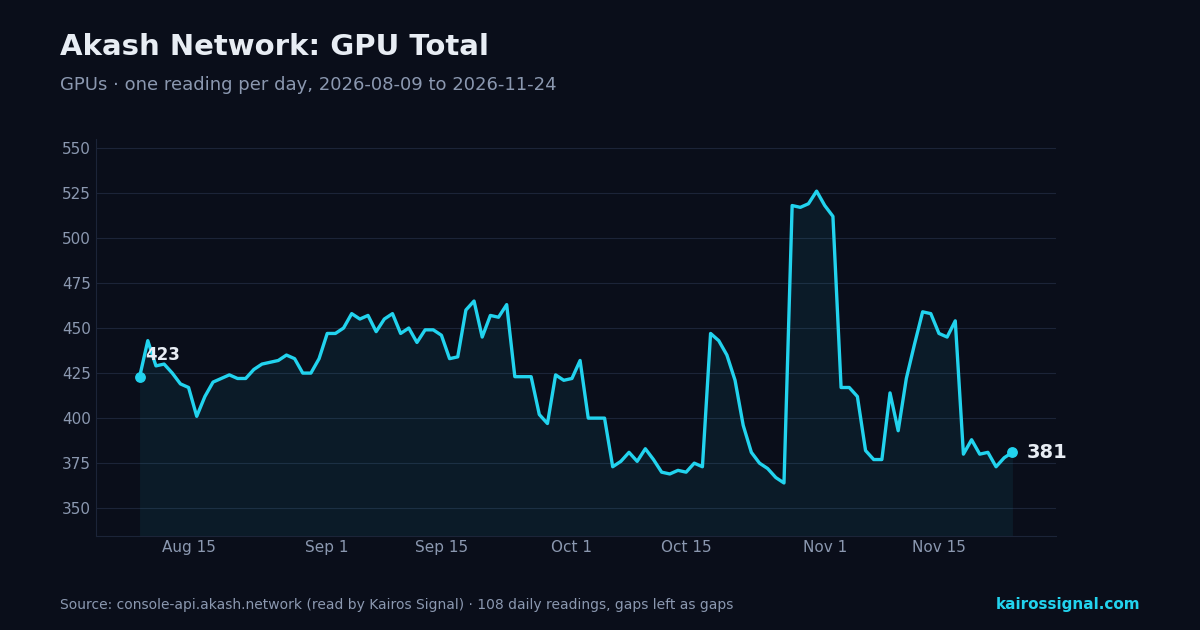
GPU_TOTAL, 108 daily readings: first 423 GPUs on 2026-08-09, last 381 GPUs on 2026-11-24, range 364 to 526 (read from console-api.akash.network).If your question is about a trend, the day you start collecting is the first day you can answer it for. Why temporal history cannot be bought goes further into this.
What buying DePIN data costs
Prices below are from our public llms.txt on 2026-11-25. The full product list, with what each excludes, is in the DePIN data API pricing post.
| Option | Price | History | Coverage |
|---|---|---|---|
| Keyless public routes | $0 | 7 days | /v1/network/<SYMBOL> for one network; /v1/supply shows a rotating sample |
| Free key | $0, with $5 in credits (first 3 keys per IP per 30 days) | 7 days | Same routes, plus credit-funded data products from $0.49 |
| Agent | $4.99/mo | Listed as starting at Design Partner | One API key, 2,000 calls/day on the rotating network sample |
| Design Partner | $199/mo (rate offered to the first 20 design partners) | 30 days of daily history | All networks, the engines and cross-network views; no Watchtower, bulk exports or alert webhooks |
| Institutional | From $2,000/mo | See the institutional page | The engine suite for research desks |
What you get for the money is the list in the previous section, already done: scaled units, stale flags and a stored reading per day. This is the same Akash supply figure from our API:
curl -s "https://api.kairossignal.com/v1/supply?network=AKT"
// trimmed
{
  "data": {
    "AKT": {
      "TOTAL_SUPPLY": {
        "value": 300197474066037.0,
        "source": "depin_first_party",
        "as_of": "2026-11-25 06:23:04.122",
        "freshness": "live",
        "verify_yourself": "https://console-api.akash.network/v1/dashboard-data",
        "unit": "uakt (micro-AKT; divide by 1,000,000 for AKT) — console dashboard-data chainStats.totalSupply",
        "decimals": 6,
        "value_decimal_adjusted": 300197474.066037
      }
    }
  }
}
What you do not get: networks with no public stats endpoint stay uncovered whoever collects them, and most networks carry only token-contract reads such as total supply and holders. Check the live network page for the network you care about before paying for anything.
Build, buy, or both
- One network, current values only. Call its API directly.
curl -s https://console-api.akash.network/v1/network-capacityneeds no key, and nothing we sell improves on the origin for a single live reading. - Several networks, or any trend. You need the five jobs above running every day. Either maintain them or buy the output.
- Both. Build for the network you know best, and use an API for the rest. Because every value we serve names its upstream URL, you can check ours against your own collector on the network you already read.
A provider is worth checking the same way you would check your own pipeline; how to evaluate a DePIN data provider has the list.
Frequently asked questions
Is it cheaper to build your own DePIN data pipeline?
The endpoints are free, so the cost is your time on the five jobs above. For one network and current values it is usually a short script. For many networks with history it is ongoing maintenance, and we publish no estimate of what that costs you.
How many API endpoints does one DePIN network need?
It varies. The network and chain values in our Akash record on 2026-11-25 named 23 distinct upstream URLs across four hosts, while Helium's hotspot totals come from two calls to one host.
What does the $199/mo tier include?
All networks, 30 days of daily history, the engines and cross-network views. Watchtower, bulk exports and alert webhooks are not included.
Can I get history for days I did not collect?
Only from someone who stored it. Our daily history begins on 2026-08-06; the free tier serves 7 days of it and the $199/mo tier 30 days.
Do I need a key to read Akash's API?
No. The Akash console endpoints in this post answered a GET with no key on 2026-11-25.
To reproduce the figures here, run curl -s "https://api.kairossignal.com/v1/network/AKT" and list the verify_url and verify_yourself values, or open any of them, such as Akash's network-capacity endpoint, to compare the raw response with ours.
This is a data product. Kairos Signal publishes measurements with their sources, not trading signals.