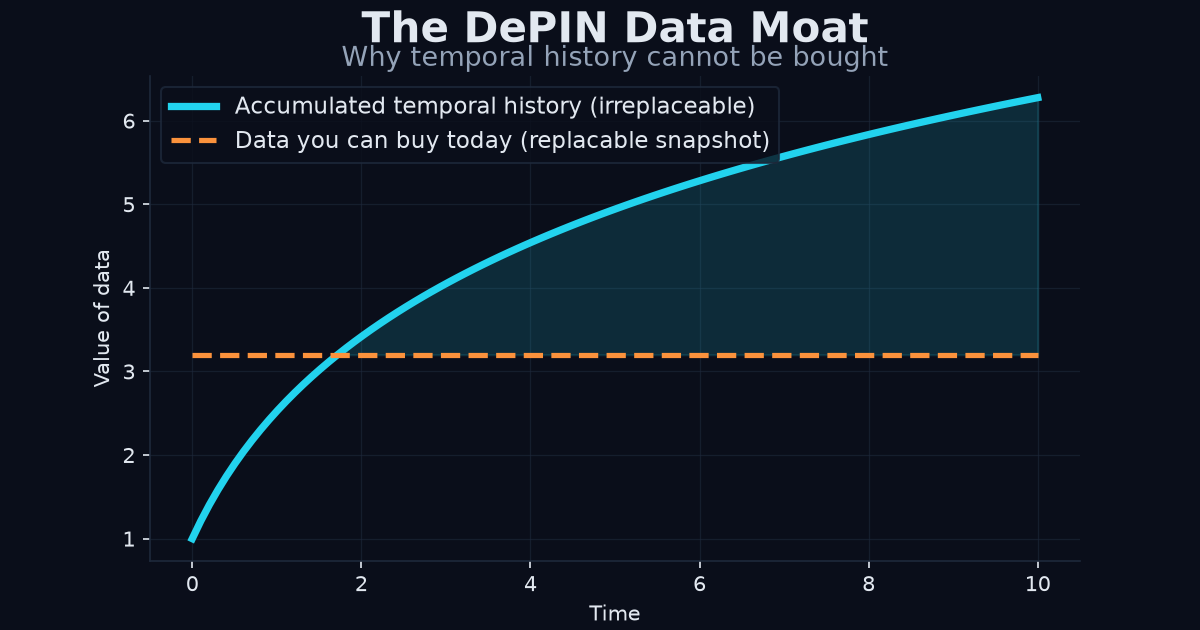
The DePIN Data Moat: Why Temporal History Cannot Be Bought
In the architecture of Decentralized Physical Infrastructure Networks (DePIN), a pervasive fallacy persists among late entrants: the assumption that capital can accelerate data parity. Teams raise substantial war chests, attempting to "buy" their way into competitive data products by deploying massive node fleets or scraping public block explorers. They fundamentally misunderstand the nature of temporal data.
Time is a strictly monotonic, non-decreasing dimension. A day of data not recorded is a day of data that cannot be re-captured. You cannot parallelize the passage of time. You cannot retroactively observe the state of a distributed sensor network at timestamp $t_0$ from the vantage point of $t_0 + \Delta$. In DePIN, the moat is not the current snapshot; the moat is the irreproducible temporal history.
The Impossibility of Temporal Acceleration
To understand why capital cannot bridge this moat, we must formalize the information loss. Let $S_t$ represent the physical state of a DePIN network at time $t$. An observer recording this state captures an observation $O_t = f(S_t) + \epsilon$, where $\epsilon$ represents measurement noise and $f$ is the sensing function.
If a competitor enters the market at time $T$, their dataset $D_{comp}$ is defined as:
$$ D_{comp} = \{O_t \mid t \ge T\} $$
No amount of capital expenditure can construct the set $D_{incumbent} = \{O_t \mid t < T\}$. The conditional entropy $H(S_{t-k} \mid D_{comp})$ remains strictly greater than zero, and without the prior observations, the joint probability distribution $P(S_{t-k}, S_t)$ is fundamentally inaccessible.
When a network state is unobserved, the transition matrix governing the system's evolution is permanently obfuscated. You cannot buy the past.
The 7-Day Banked Series: Compounding Lead Time
In quantitative signal processing, the utility of a data stream often relies on rolling statistical baselines. Consider the computation of a 7-day exponentially weighted moving average (EWMA) or a rolling standard deviation used for anomaly detection.
For an incumbent who began recording at $t=0$, the baseline at day 8 is fully resolved. A latecomer starting at day 8 must wait until day 15 to compute their first valid 7-day window. During that week, the latecomer is flying blind—either operating on noisy, un-smoothed signals, or relying on synthetic/padded data that lacks statistical rigor.
import
import numpy as np
A 7-day EWMA needs 7 full days of history to be defined.
The incumbent (started at t=0) resolves its baseline at day 8.
The latecomer (started at day 8) resolves it at day 15.
def days_until_valid_ewma(start_day, window=7):
    return start_day + window
incumbent_start, latecomer_start = 0, 8
print("Incumbent baseline resolves:", days_until_valid_ewma(incumbent_start))
print("Latecomer baseline resolves:", days_until_valid_ewma(latecomer_start))
Gap: one full week where the latecomer has no statistically valid signal.
The lead does not stop at the baseline — it compounds. Because the incumbent's history is longer, every rolling statistic they compute (volatility, Z-scores, seasonality) is defined over a richer window. The latecomer is permanently behind on the entire class of windowed analyses, not just the first one. And crucially, the incumbent's data is irreproducible: a competitor cannot go back and observe what the network did on the days before they arrived.
The 90-Day Statistical Necessity
A 7-day window is not enough for meaningful trend analysis. In practice, a robust anomaly-detection or seasonality baseline requires roughly 90 days of history. Consider the practical implications:
- A team starting today must wait three months before their data supports any defensible trend claim.
- During that window, they are competing against incumbents with months (or years) of accumulated signal.
- Every day they wait, the moat widens — because the incumbent's history is strictly longer.
The Semantic Data Knowledge Compounding
There is a second, subtler form of compounding: the incumbent does not just hold more data, they hold more understanding. When you have tracked a network for months, you know its schema quirks, its data-quality failures, its seasonal patterns, and its outlier regimes. This semantic knowledge is embedded in the pipeline and is even harder to transfer than the raw time-series.
Every week we run across 372 networks with live data and 11,857 live series, accumulating history the moment each source comes online. Because we began collecting early, our store now holds roughly 697K rows of temporal telemetry across 69 data sources. That history is a moat precisely because it cannot be recreated — a competitor starting today is missing every day we already have.
What This Means for Buyers
For anyone evaluating a DePIN data provider, the first question should not be "how many networks do you cover?" — that is a snapshot that can be copied. The question should be "how long is your history?" A provider that started collecting telemetry six months ago has a structural advantage over one that began last week, no matter how good their scraper is. Temporal history is the one asset in DePIN data that cannot be bought, parallelized, or backfilled.
This is why our design-partner tier is time-sensitive: the longer you wait, the more history you miss. Design-partner seats are capped at 20 at a lifetime-locked $199/mo, after which the price rises to $249/mo. Locking in early is not just a pricing decision — it is the only way to guarantee you are not permanently behind on the data you need.
Query the historical archive yourself:
# Pull historical telemetry for any network
curl "https://api.kairossignal.com/v1/supply?network=akash&from=2026-01-01" -H "X-API-Key: *"
Browse the live catalog
curl "https://api.kairossignal.com/v1/networks" -H "X-API-Key: *"
---
Try it yourself
Query the live catalog, supply telemetry, and provenance receipts directly: /v1/networks, /v1/supply on the REST API.
Related reading: DePIN Intelligence guide · DePIN network data: 372 networks, 138 sources · how we read supply telemetry from 296 networks · the DePIN developer guide
Design-partner seats are capped at 20 at a lifetime-locked $199/mo (full API access, every published endpoint, MCP server, Bitcoin-anchored provenance). After seat 20 the price becomes $249/mo. Claim a design-partner seat → · See pricing---
Get Started With DePIN Intelligence
Kairos Signal provides verifiable, provenance-first telemetry for DePIN networks, including first-party supply data read directly from a network's own API or blockchain. Every value carries a verify_url you can check yourself, and each daily batch is Merkle-rooted and anchored to Bitcoin.
Every API response is signed with ed25519 and timestamped. You can prove what was served and when, months later. That is what we mean by provenance-first.
Related reading: DePIN Intelligence Guide · DePIN Telemetry · How to Query DePIN Data · DePIN Data Verification · Pricing