The Scattering Problem
DePIN network data does not exist in one place. It is spread across dozens of wire formats — RPC endpoints, explorer APIs, GitHub repos, market feeds, and first-party stats endpoints — each with its own field names, units, and update cadence. To analyze DePIN at any scale, you need a single layer that unifies all of it.
That layer is what Kairos Signal provides: networks with live data, drawn from many distinct sources, served through one API. Every value carries provenance; every batch is anchored to Bitcoin.
The Source Mix
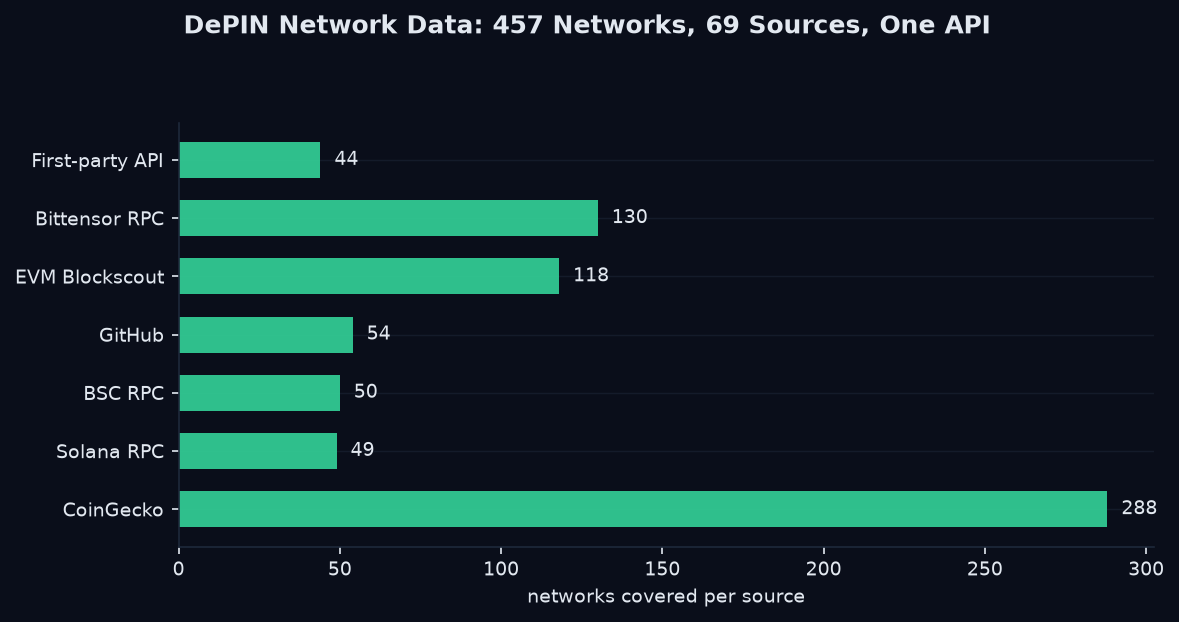
The sources are wildly unequal in coverage. Here are the top contributors by network count:
| Source | Networks | What it provides |
|---|---|---|
| CoinGecko | 288 | Market data (price, market cap) |
| Bittensor subtensor_rpc | 129 | Subnet telemetry, validators, TAO emission |
| evm_blockscout | 118 | Holders, transfers, gas |
| GitHub | 54 | Dev velocity, repo activity |
| bsc_rpc | 50 | BSC token supply |
| solana_rpc | 49 | Solana L1 + SPL tokens |
| first_party_api | 44 | Per-network stats APIs (supply, nodes, leases) |
| ethereum_rpc | 32 | Ethereum token supply |
The long tail — the 44 networks with dedicated first-party APIs, the RPC paths, the explorer feeds — is where the moat lives. Anyone can pull CoinGecko. Not everyone has built collectors for 44 first-party network APIs.
Coverage Tiers: The Honest Map
A network count only means something if you know what kind of data each carries:
| Tier | Networks | Meaning | |---|---|---| | First-party telemetry | 296 | Infrastructure metrics from the network's own API/chain | | On-chain market only | 78 | Token supply/price, no infra telemetry | | Catalog only | 339 | Directory entry, no public feed | | Live total | 327 | Everything with verifiable values |
We label the catalog-only entries explicitly so you can filter them in one line of code. Naming the gaps is part of being a data provider.
11,857 Live Series, ~697K Rows
Coverage breadth translates into series depth. The store holds 11,857 live series — the individual metric/time pairs that make trend analysis possible — backed by roughly 697K rows in ClickHouse. Columnar storage means time-range scans over specific metrics are fast, which is exactly the query pattern DePIN analytics needs.
One API to Rule Them
All of it is served through 19 live REST endpoints at https://api.kairossignal.com:
# Browse all 327 live networks with coverage tier
curl "https://api.kairossignal.com/v1/networks" \
  -H "X-API-Key: *"
A single network's telemetry
curl "https://api.kairossignal.com/v1/networks/akash"
Compare a canonical concept across networks
curl "https://api.kairossignal.com/v1/compare?concept=GPU_UTILIZATION"
Verify any value independently
curl "https://api.kairossignal.com/v1/verify/{value_id}"
Because fields are normalized into 38 canonical concepts, a query for GPU_ACTIVE returns a comparable number from any compute network. You never reverse-engineer schemas.
Why One API Wins
Stitching data from 20 vendors yourself means 20 rate limits, 20 schemas, 20 freshness contracts, and 20 trust relationships. A unified API collapses that to one. Add provenance — source, as_of, verify_url, freshness verdict, Bitcoin-anchored batches — and you have a data foundation you can build on.
A Worked Cross-Network Query
Say you want to know which compute network is tightest. You query the same canonical concept across Akash, io.net, and Render:
curl "https://api.kairossignal.com/v1/compare?concept=GPU_UTILIZATION&category=compute" \
  -H "X-API-Key: *"
Because all three normalize into the same concept, the response is directly comparable — no per-network schema work. That single query would take hours of manual archaeology if you were pulling from three different vendor APIs.
FAQ
Are all cataloged networks live? No. Only some carry live data; the others include catalog-only directory entries. We label them so you can filter, rather than discover the gap mid-build. Why is first-party sourcing valuable? It means the number traces to the network's own API or chain, with averify_url you can open. Secondhand data inherits the middleman's assumptions.
Can I compare across networks? Yes — fields are normalized into 38 canonical concepts, so the same metric is comparable across networks in a single compare query.
Explore the API → · Try it free →
The Long Tail Is the Moat
The sources are not created equal, and the ones that matter most are the least glamorous. CoinGecko is easy to wire up; a dedicated first_party_api collector for a network like Akash or Storj is not. The 44 first-party APIs, the RPC decoders, and the explorer integrations are the engineering that most teams never build — which is why they're the source of durable advantage.
This asymmetry shows up in the data itself. Market data is a commodity you can get anywhere. First-party infrastructure telemetry is scarce, and its scarcity is exactly what makes cross-network comparison valuable. When you can query the same canonical concept across networks, you're not paying for the commodity layer — you're paying for the normalized, verified, comparable layer on top of it.
Query Patterns That Matter
Two patterns cover most real use cases. First, the category sweep: pull one canonical concept across a category to see the competitive picture. Second, the network drill-down: pull one network's full telemetry to inspect its health. Both work because the schema is canonical and the provenance is uniform.
# Category sweep
curl "https://api.kairossignal.com/v1/compare?concept=GPU_UTILIZATION&category=compute" \
  -H "X-API-Key: *"
Network drill-down
curl "https://api.kairossignal.com/v1/networks/akash?fields=gpu_active,gpu_available"
Master those two patterns and you can analyze the entire DePIN landscape through one API.
Read more: DePIN Intelligence · DePIN Network Data Coverage Map · DePIN On-Chain Data
---
This is a data product. Kairos Signal publishes no trading signals, performance returns, win rates, or accuracy claims.Get Started With DePIN Intelligence
Kairos Signal provides verifiable, provenance-first telemetry for DePIN networks, including first-party supply data read directly from a network's own API or blockchain. Every value carries a verify_url you can check yourself, and each daily batch is Merkle-rooted and anchored to Bitcoin.
Every API response is signed with ed25519 and timestamped. You can prove what was served and when, months later. That is what we mean by provenance-first.
Related reading: DePIN Intelligence Guide · DePIN Telemetry · How to Query DePIN Data · DePIN Data Verification · Pricing Correction 2026-09-25: this post called our catalog entry count a count of DePIN networks; that count includes superseded rows and Bittensor subnet rows. It has been removed, together with some other present-tense coverage counts in this post. Current coverage figures: /v1/networks.