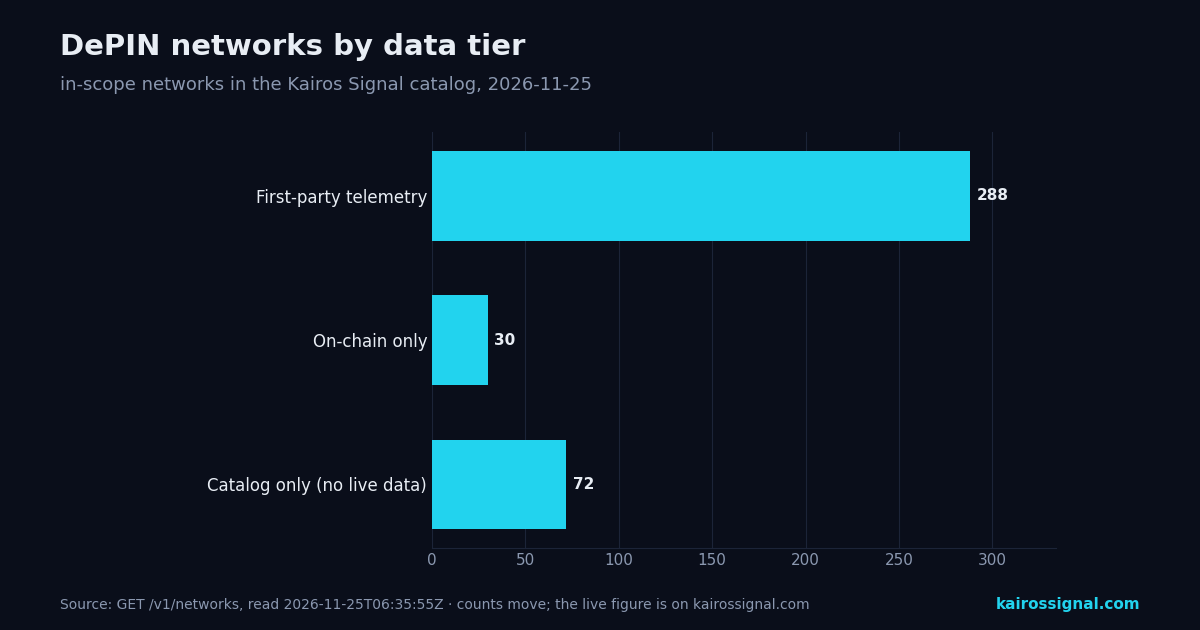
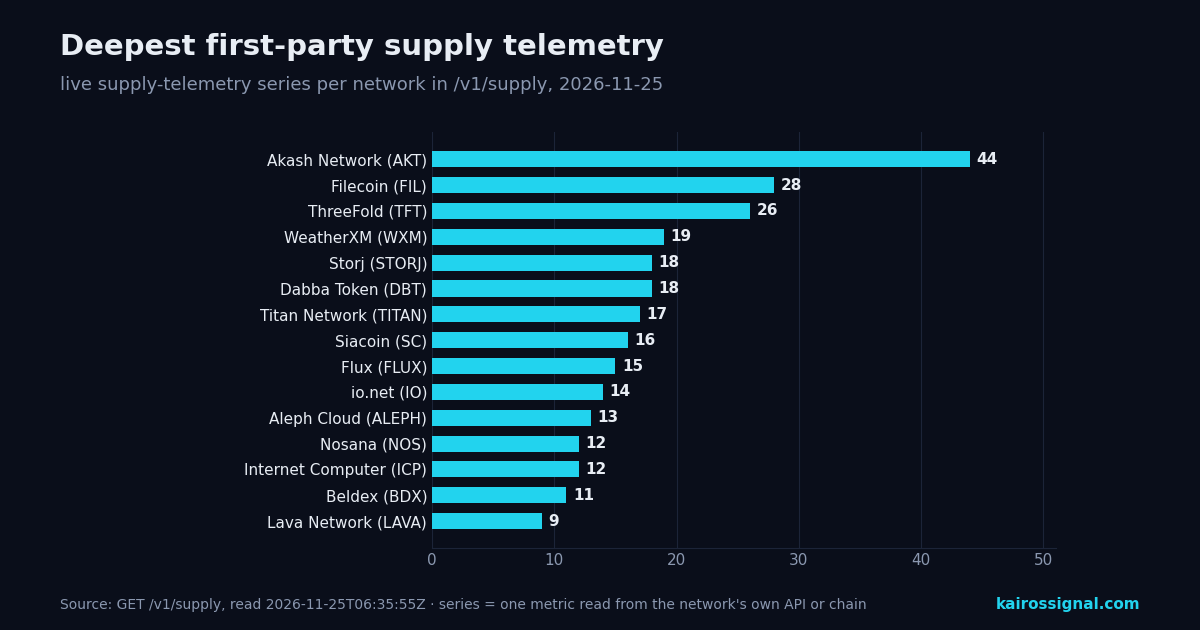
Free DePIN network data comes from four kinds of source: each network's own stats API, market aggregators such as CoinGecko, fee aggregators such as DefiLlama, and the Kairos Signal free tier, which stores readings from the other three with their origin attached. Each answers a different question. Akash's own API, for instance, reported 241 active GPUs out of 380 on 2026-11-25 06:23:04 UTC, a kind of figure the aggregator endpoints we read do not carry.
This post was first published on 2026-08-28. The comparison below follows the original, tightened and corrected; the section at the end records what changed by 2026-11-25 and which August statements we corrected.
Key facts
- Akash's console API is free and needs no key. It reported
GPU_ACTIVE241 andGPU_TOTAL380 at 2026-11-25 06:23:04 UTC (source). - CoinGecko's
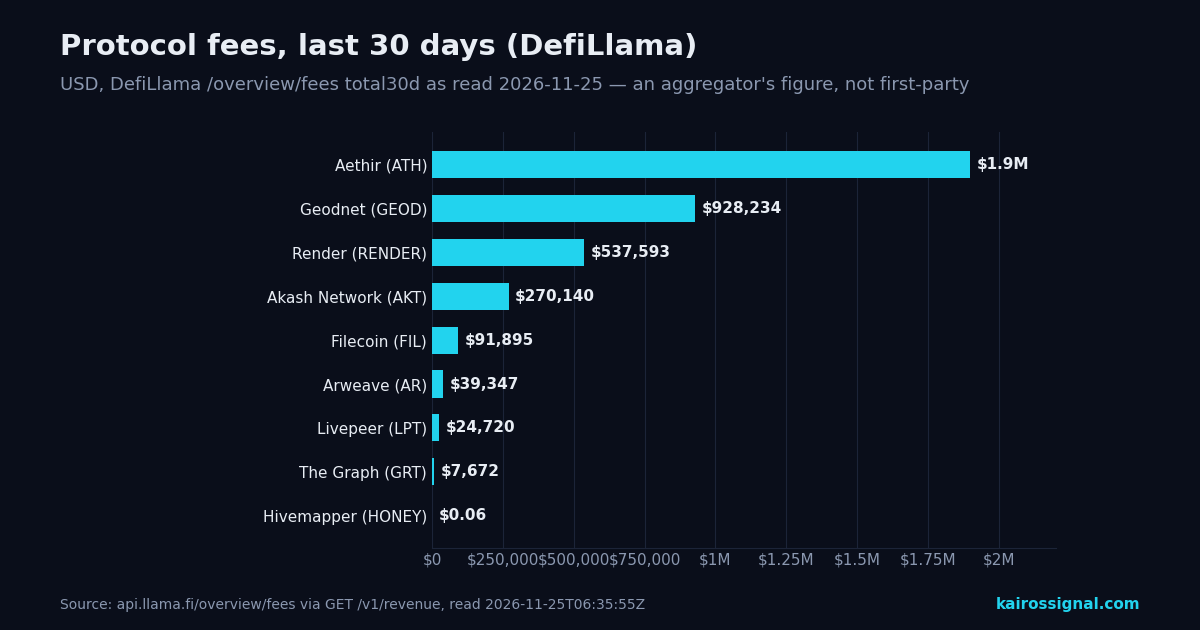
/coins/marketsendpoint returns market fields. Our stored copy of its AKT price was 0.460877 USD at 2026-11-25 05:51:48 UTC. - DefiLlama's API documentation says its free hosts "never read a key and are rate limited". Its fees total for Akash over 30 days was $270,140 when read on 2026-11-25 06:22:58 UTC.
- The Kairos Signal
/tryendpoint needs no key and no signup; registration adds $5 in free credits with no card (first 3 keys per IP per 30 days). Details are on the pricing page. - The Kairos Signal free tier serves 7 days of daily history.
1. Each DePIN network's own API: free, authoritative, unstandardised
If you are building on DePIN data, whether a dashboard, a bot or an AI agent, you hit the same wall as everyone else. Node counts, GPU supply and utilisation figures are scattered across network-specific APIs, each with its own schema, limits and definition of "active".
Akash, Helium, io.net and others publish their own stats endpoints. This is the ground truth, and that is also the difficulty:
- A different schema per network. Akash returns
resources.gpu.activefrom itsnetwork-capacitypath and a separatenow.activeGPUfromdashboard-data. Helium serves one hotspot total per call, selected withsubnetwork=iotorsubnetwork=mobile. ThreeFold needs a second call withstatus=upto get online counts. Joining them into one panel means one parser per endpoint. - Little or no history. Many stats endpoints return only the current state. Akash's
network-capacityanswers with today's figures and nothing else, so anything you did not store yourself is gone. - Definitions drift. When "active" changes meaning upstream, a panel built on it breaks without an error.
Which networks have such an endpoint, and which do not, is laid out in which DePIN networks have public data API endpoints.
2. Market aggregators such as CoinGecko: market data only
Market aggregators are the right source for price, market cap and fully diluted valuation. CoinGecko's documentation describes /coins/markets as the endpoint "to query all the supported coins with price, market cap, volume and market related data", and its documented fields are market fields such as current_price, market_cap and circulating_supply.
That is token data, not network data. The endpoint has no node count, GPU capacity or utilisation field. CoinMarketCap is the other place readers usually look for the same kind of figure; check its API documentation for current terms.
3. DefiLlama: free, fees and TVL, not node counts
DefiLlama's free API covers total value locked and protocol fees. We read its /overview/fees endpoint and serve the result under /v1/revenue, always labelled as DefiLlama's figure. A fee total is DefiLlama's own computed figure for a protocol. It is not physical supply: the /overview/fees response carries no nodes online, storage capacity or hotspot counts.
4. Kairos Signal free tier: no key needed to verify
The free /try endpoint returns 3 showcase networks with full supply telemetry, and needs no key. There is a browser version too. Every value in a response carries the fields you need to check it without trusting us:
source: which upstream the number came fromas_of: when it was readverify_yourself(orverify_url): the upstream endpoint itself, so you can fetch it again and compare
Beyond that, /v1/data-dictionary is a machine-readable coverage spec with freshness and history depth per feed, and /v1/derivation is the free index of the derivation ledger, which records raw upstream payloads and the collector code hash for the collector sources it lists. Registration is free. The full route list is in the API docs.
curl -s "https://api.kairossignal.com/v1/supply?network=AKT"
// trimmed
{
  "data": {
    "AKT": {
      "GPU_ACTIVE": {
        "value": 241.0,
        "source": "depin_first_party",
        "as_of": "2026-11-25 06:23:04.122",
        "freshness": "live",
        "verify_yourself": "https://console-api.akash.network/v1/network-capacity",
        "unit": "GPUs — provider-reported capacity: network-capacity resources.gpu.active (not the same count as ACTIVE_GPU)"
      }
    }
  }
}
Free DePIN data sources compared
| Need | Network's own API | CoinGecko | DefiLlama | Kairos Signal free tier |
|---|---|---|---|---|
| Node, GPU or hotspot counts | Yes, where the network publishes them | No (market fields) | No (fees and TVL) | Yes, read from the network's API |
| Price and market cap | Sometimes | Yes | No | Yes, labelled as CoinGecko's figure |
| Protocol fees | Sometimes | No | Yes | Yes, labelled as DefiLlama's figure |
| One schema across networks | No, one parser per endpoint | Yes, for tokens | Yes, for protocols | Yes |
| History | Usually current state only | Check their docs | Check their docs | 7 days of daily history on the free tier |
| Where the number came from | It is the source | Its own computed figure | Its own computed figure | Source, as_ and verify URL on every value |
| Key needed | No for the endpoints we read | Check their docs | No on the free hosts | No for /try and public GET routes |
| Cost | Free, plus your engineering time | Its docs name a "Demo / Keyless API" and a "Paid API"; see their pricing | Free hosts; see their pricing | Free to read and verify |
The CoinGecko and DefiLlama columns describe the two endpoints we read, /coins/markets and /overview/fees, not everything either service offers.
What to do next
- Call
curl -s https://kairossignal.com/try. There is nothing to set up. - Open any verify URL in the response and compare it with the origin.
- If the format works for you,
POST https://kairossignal.com/v1/credits/registerreturns an API key and the starting credits. No card, nothing to cancel.
Every number in our panels is measured, never modelled. Where a network publishes no data, we say so instead of estimating. Provenance or silence.
Update, 2026-11-25
The main finding of the August post still holds: none of the three upstream source types covers network supply, market data and fees together, and the network's own API is still the only origin for supply figures.
The Akash example now has a history behind it. GPU_ACTIVE read 241 on 2026-11-25 06:23:04 UTC. Across the 108 daily readings we hold from 2026-08-09 to 2026-11-24, it started at 127, ended at 235, and ranged from 127 to 390.
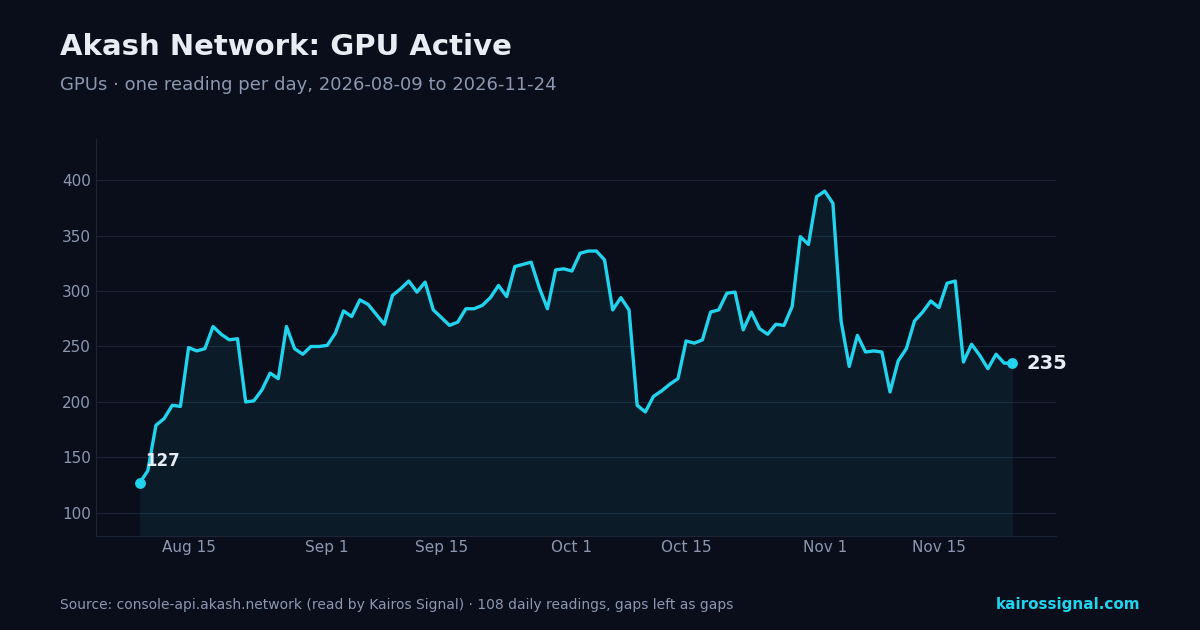
GPU_ACTIVE, 108 daily readings: first 127 GPUs on 2026-08-09, last 235 GPUs on 2026-11-24, range 127 to 390 (read from console-api.akash.network).That chart exists only because the endpoint was read and stored every day. The "definitions drift" point also has a concrete case now: Akash publishes two active-GPU counts, 241 from network-capacity and 248 from dashboard-data (read 2026-11-25 06:32:40 UTC), and they are different counts. The Akash API quick start covers both.
Corrections to the August text:
- It said aggregators such as DefiLlama offer TVL only. DefiLlama also publishes protocol fees, and we read them. Section 3 now says so.
- It gave Akash's field as
networkCapacity.activeGPU. The fields areresources.gpu.activeonnetwork-capacityandnow.activeGPUondashboard-data. - It said Render reports supply by tier. We could not source that, so Render is out of the list; the supply series we hold for Render are token-contract reads.
- It said the provenance fields were ones "no other aggregator provides". We cannot source that for every aggregator, so it is removed.
- It carried a symbol count and parser counts in the comparison table. Coverage counts change daily; the live count is at the top of this page and in
/v1/networks. - It said
/tryincluded an AI analysis preview, and that the derivation ledger covered every fetch. Neither matches the current public description of those endpoints, so both are reworded above.
For a fuller treatment of the four source types, with one worked example of each, see DePIN data sources compared. For how the checks behind each value work, see how we verify every DePIN number.
Frequently asked questions
Is there a free DePIN data API?
Yes, several. Many networks publish their own stats endpoints without a key, DefiLlama's free hosts need no key, and the Kairos Signal /try endpoint and public GET routes can be read without an account.
Does CoinGecko have DePIN node counts?
Not in the endpoint we read. CoinGecko's /coins/markets documentation lists market fields such as price, market cap and supply, and no node, GPU or hotspot counts.
Is DefiLlama data free?
DefiLlama's documentation says its free hosts "never read a key and are rate limited". It also describes a Pro API that takes a key; check their site for its price.
How much history can I get for free?
The Kairos Signal free tier serves 7 days of daily history. Many network stats endpoints return only the current state, so longer history has to be stored by someone.
Do I need an API key to read Akash GPU data?
No. console-api.akash.network/v1/network-capacity answered a GET with no key on 2026-11-25.
To reproduce the numbers here, run curl -s "https://api.kairossignal.com/v1/supply?network=AKT" and open the verify_yourself URL on GPU_ACTIVE; it is Akash's own endpoint. The market and fee figures carry CoinGecko and DefiLlama URLs in the same way on the Akash network page.
This is a data product. Kairos Signal publishes measurements with their sources, not trading signals.