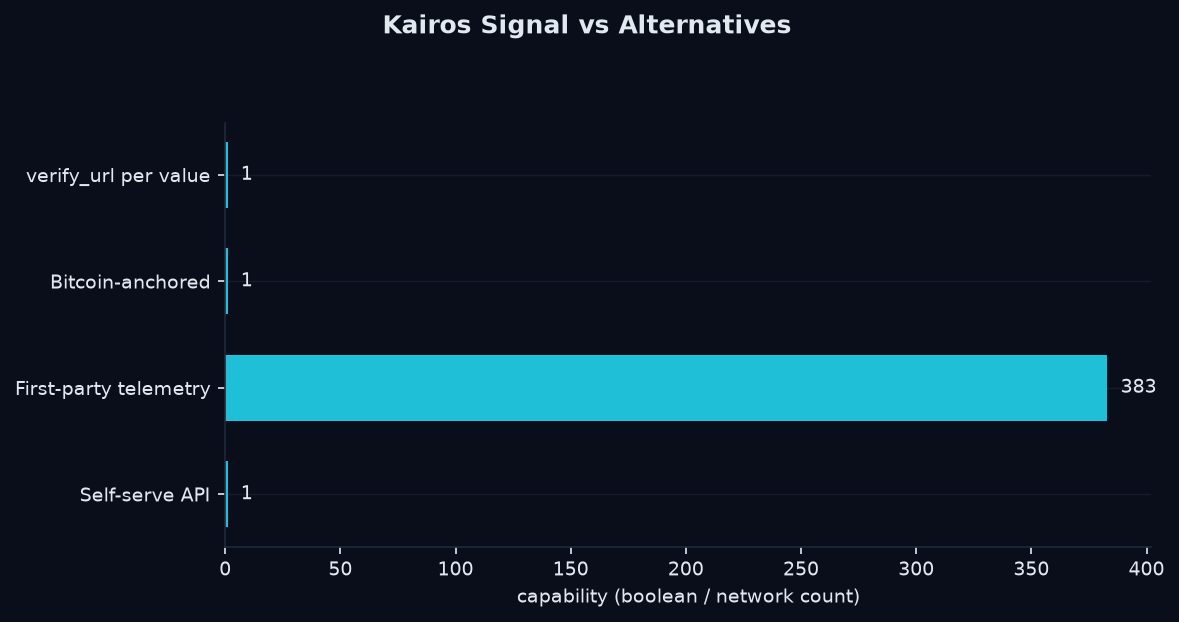
Comparing Data Providers on What Matters
Every DePIN data provider claims to be the best. The useful comparison is not who has the biggest number on their homepage — it's who wins on the dimensions that actually determine whether the data is trustworthy and usable. Here is how Kairos Signal stacks up against alternatives across five criteria.
1. Provenance (the differentiator)
| Capability | Kairos Signal | Typical aggregator |
|---|---|---|
| verify_url on every value | ✅ | Rarely |
| source + as_of per value | ✅ | Partial |
| Freshness verdict (fresh/stale/missing) | ✅ | Rarely |
| Never zero-fill missing values | ✅ | Often zero-fills |
Most aggregators serve derived or modeled estimates with no receipt. Kairos Signal's model — provenance or silence — attaches a verify_url to every value so you can confirm it at the source.
2. First-Party Coverage
| Coverage | Kairos Signal | |---|---| | Networks with live data | 327 | | First-party telemetry | 296 | | On-chain market only | 78 | | Catalog only (labeled) | 339 of 800 | | Data sources | 69 |
The honest part is the catalog-only row. We label gaps explicitly instead of inflating "coverage" with directory entries. Many providers count 800+ "networks" but only a fraction have verifiable live data.
3. Canonical Schema
We map 89 native field names into 38 canonical concepts with declared units. That means GPU_ACTIVE returns a comparable number across Akash, io.net, and Render in one query. Aggregators that pass through each network's native field names force you to reverse-engineer schemas yourself.
4. Agent Access
Kairos Signal is built agent-first:
- REST API — live endpoints at
https://api.kairossignal.com - MCP server — 10 tools for autonomous agents at https://kairossignal.com/mcp/
- Self-serve credits — USDC payments, no sales call
- verify_url — agents can confirm values before acting
5. Pricing
| Tier | Price | |---|---| | Free | $0 | | Design Partner | $199/mo (forever price lock) | | Pro | $499/mo | | Enterprise | $2000/mo |
Transparent tiers, with a $199 design partner forever price lock for early customers. The cheapest alternative is worthless if the data is wrong; you pay for verifiable, first-party telemetry.
The Zero-Fill Trap
One of the quietest ways data providers differ is how they handle missing values. Many return 0 for a missing node count — which downstream analytics reads as a real zero. We return a missing verdict instead. That single difference can corrupt or save an entire pipeline, and it's invisible unless you look for it. Ask any provider how they handle missing values.
Run the Comparison Yourself
# 1. Does the provider show coverage tiers, including gaps?
curl "https://api.kairossignal.com/v1/networks?tier=catalog_only"
2. Can you see provenance on a value?
curl "https://api.kairossignal.com/v1/verify/{value_id}"
3. Can you compare a canonical concept across networks?
curl "https://api.kairossignal.com/v1/compare?concept=GPU_UTILIZATION"
Run those three checks against any competitor. If they fail all three, you're buying a dashboard, not a data product.
FAQ
What is the biggest difference between providers? Provenance. Being able to open averify_url and confirm a value at its source is the difference between data and opinion.
Why does zero-filling matter? Returning 0 for a missing value corrupts analytics. We return a missing verdict so your pipeline can distinguish "zero" from "we don't have it."
Is a bigger network count better? Only if it's verifiable. A provider with 800 "networks" but few with live, first-party data is inflating coverage. We label the catalog-only entries honestly.
Evaluate us yourself → · Compare pricing →
The Comparison Beyond Headlines
Headline numbers — a network count, "lowest price" — are marketing. The comparison that matters is structural. Three questions expose the real differences between providers:
verify_url on every value is the dividing line between data and opinion.missing verdict is honesty.These three questions cut through the marketing faster than any feature list. Run them against any provider and you'll have a clearer picture of the actual product than their homepage provides.
The Agent-Economy Test
The newest differentiator is whether a provider's data can be consumed by autonomous agents. That requires four things: a standard discovery interface (MCP), a programmatic query surface, verifiable values (so an agent can trust what it acts on), and programmatic payment. A provider that nails all four is built for the agent economy; one that requires a sales call or a human-approval payment gate is not. As agents become the primary data consumers, this distinction will matter more than any other.
Read more: Why Kairos Signal Is the Leading Data Provider · DePIN Data Platform · DePIN Pricing
---
This is a data product. Kairos Signal publishes no trading signals, performance returns, win rates, or accuracy claims.Get Started With DePIN Intelligence
Kairos Signal provides verifiable, provenance-first telemetry for DePIN networks, with first-party supply data read directly from each network's own API or blockchain. Current counts are published live at /v1/networks. Every value carries a verify_url you can check yourself, and each daily batch is Merkle-rooted and anchored to Bitcoin.
Every API response is signed with ed25519 and timestamped. You can prove what was served and when, months later. That is what we mean by provenance-first.
Related reading: DePIN Intelligence Guide · DePIN Telemetry · How to Query DePIN Data · DePIN Data Verification · Pricing Correction 2026-09-25: this post used our catalog entry count as its example of a headline network count; that count includes superseded rows and Bittensor subnet rows, so the example no longer carries a number. Current coverage figures: /v1/networks.