The DePIN Data Platform Problem
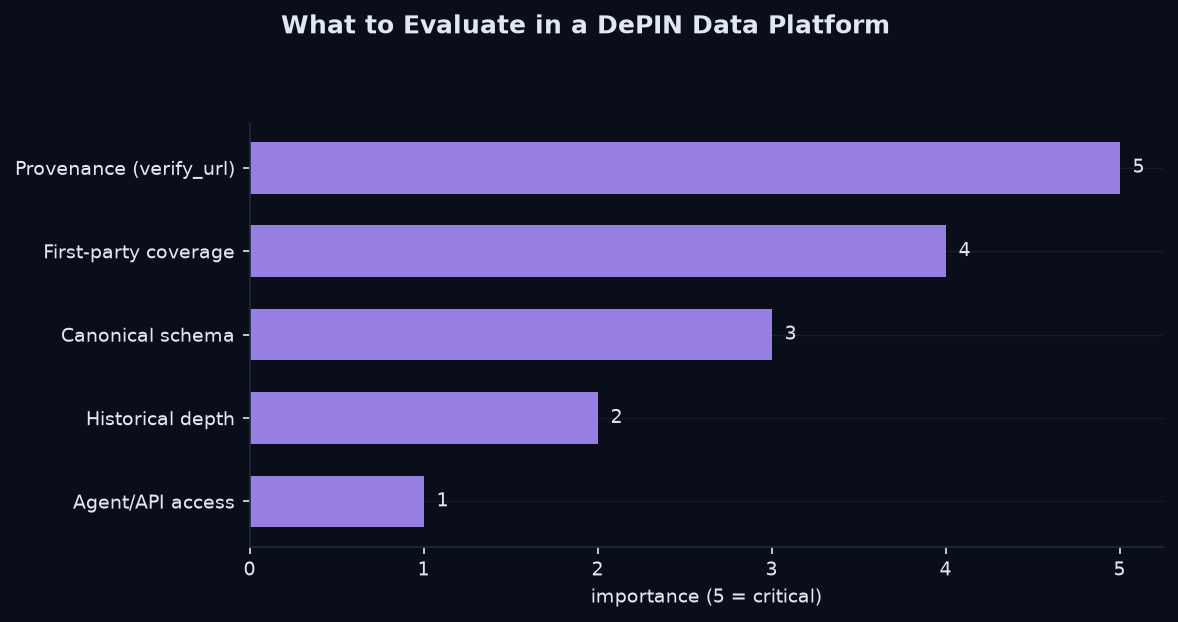
The DePIN data space has exploded with platforms, and most of them differentiate on the wrong things. A beautiful dashboard is not data quality. A low price is not data quality. When you are choosing a platform to power analytics, a backtest, or an autonomous agent, a handful of properties decide whether the platform is useful or a liability.
Here is what actually matters — and what you should ignore.
What Matters Most
1. Provenance (the non-negotiable)
Can you verify a single number? Every value should carry a source, an as_of timestamp, a verify_url you can open, and a freshness_verdict. If a platform cannot tell you where a number came from, it is asking you to trust a model's estimate. Provenance is the difference between data and opinion.
At Kairos Signal, on top of per-value verify_url, every daily batch is Merkle-rooted and anchored to Bitcoin via OpenTimestamps. Any historical value is cryptographically provable.
2. First-Party Coverage
Is the platform reading networks directly, or re-publishing other aggregators? First-party telemetry — read from the network's own API or chain — is fundamentally more trustworthy. Look for platforms that read RPC paths, network stats APIs, and first-party endpoints directly. We read 296 networks' first-party telemetry across 44 first_party_api sources plus RPC and explorer paths.
3. Coverage Breadth
Does the platform cover the networks you care about? Coverage is not just the big names. The full map matters: which networks carry live data, which of those are first-party or on-chain market only, and what the catalog holds in total. A platform that can't cover the long tail forces you to stitch multiple vendors together.
4. Canonical Schema
Can you compare across networks? If each network returns its own field names, cross-network comparison is manual archaeology. Look for a platform that maps native fields into canonical concepts with declared units — the foundation for comparing Akash, io.net, and Render in one query.
What Doesn't Matter
- Dashboard polish — a pretty UI is not data. You'll probably query the API directly anyway.
- "Free" tiers with asterisks — free that excludes the data you need is a lead-gen trap, not a tier.
- Number-of-networks marketing — a catalog where only some entries have live data and many are directory-only is coverage with a gap. What matters is how many have verifiable live data.
- Pricing gimmicks — the cheapest API is worthless if the data is wrong.
The Honest Coverage Question
A good platform tells you where it doesn't have data. We explicitly label the catalog-only networks so you can filter them in one line of code. If a platform only ever shows you what it covers, you'll discover the gaps mid-build.
A Concrete Evaluation
# 1. Does the platform show coverage tiers, including gaps?
curl "https://api.kairossignal.com/v1/networks?tier=catalog_only"
2. Can you see provenance on a single value?
curl "https://api.kairossignal.com/v1/verify/{value_id}"
3. Can you compare a canonical concept across networks?
curl "https://api.kairossignal.com/v1/compare?concept=GPU_UTILIZATION"
Run those three checks against any platform before you commit. If it fails all three, you're buying a dashboard.
The Evaluation Checklist
FAQ
Do I need a platform or just an API? You need a platform if you want normalized, comparable, verified data across many networks. A raw API to one network gives you that network's native, unnormalized fields — and nothing to compare it against. How do I know if a platform zero-fills missing data? Ask, or test it. Zero-filling missing values corrupts analytics. Look for afreshness_verdict that distinguishes fresh, stale, and missing.
Is an MCP server important? Increasingly yes — if you plan to feed autonomous agents, an MCP server at a documented endpoint is the standard way to let them discover and query your data.
Evaluate Kairos Signal yourself → · Read the docs →
A Deeper Look at the Schema Question
The canonical schema is the most underrated differentiator between platforms. Without it, comparing two networks means reverse-engineering two incompatible field systems by hand — a task that doesn't scale past a handful of networks.
A platform with a real canonical schema gives you three things:
- Comparability. The same concept (e.g.
GPU_ACTIVE) is comparable across every network that reports it. - Unit integrity. Every concept declares its unit, so you never accidentally compare GPUs against cores against nodes.
- A same-question guarantee. A query returns a unit-consistent answer across the catalog, enforced by tests — not by hope.
The Freshness Contract Is a Trust Contract
A platform's freshness model is a direct statement of how much it trusts its own data. Zero-filling says "we'd rather fake a number than admit a gap." A missing verdict says "we'll tell you the truth and let you decide." These are fundamentally different data products hiding behind similar-looking APIs. Check the freshness contract before you commit — it tells you more about the platform's integrity than its homepage ever will.
Read more: DePIN Data Comparison · Why Kairos Signal Is the Leading Data Provider · DePIN Pricing
---
This is a data product. Kairos Signal publishes no trading signals, performance returns, win rates, or accuracy claims.Get Started With DePIN Intelligence
Kairos Signal provides verifiable, provenance-first telemetry for DePIN networks, including first-party supply data read directly from a network's own API or blockchain. Every value carries a verify_url you can check yourself, and each daily batch is Merkle-rooted and anchored to Bitcoin.
Every API response is signed with ed25519 and timestamped. You can prove what was served and when, months later. That is what we mean by provenance-first.
Related reading: DePIN Intelligence Guide · DePIN Telemetry · How to Query DePIN Data · DePIN Data Verification · Pricing Correction 2026-09-25: this post called our catalog entry count a count of DePIN networks; that count includes superseded rows and Bittensor subnet rows. It has been removed, together with some present-tense coverage counts written beside it. Current coverage figures: /v1/networks.