Three Ways to Integrate DePIN Data
Kairos Signal exposes DePIN intelligence through three surfaces, each suited to a different consumer. This guide helps you pick the right one and wire it up.
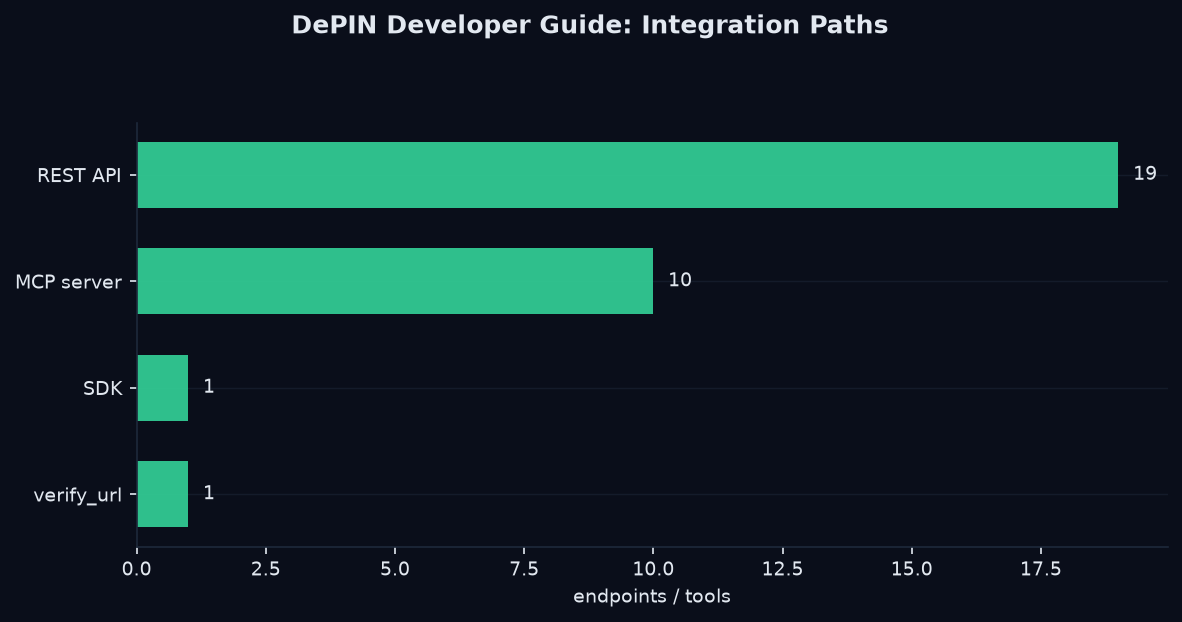
| Surface | Best for | Count | |---|---|---| | REST API | Applications, dashboards, batch jobs | 19 endpoints | | MCP server | Autonomous AI agents | 10 tools | | verify_url | Independent confirmation | every value |
1. REST API — For Applications
The REST API at https://api.kairossignal.com is the workhorse. It serves 372 networks and 11,857 live series through 19 endpoints:
GET /v1/networks— catalog with coverage tiersGET /v1/networks/{id}— network telemetryGET /v1/supply— supply series over timeGET /v1/compare— cross-network canonical comparisonGET /v1/verify/{id}— provenance inspection
curl "https://api.kairossignal.com/v1/networks/akash?fields=gpu_active" \
  -H "X-API-Key: *"
Every response carries source, as_of, verify_url, and a freshness verdict.
2. MCP Server — For Autonomous Agents
The MCP server at https://kairossignal.com/mcp/ exposes 10 tools so agents can discover, query, verify, and buy data without a human. If your consumer is an agent, MCP is the path — it's self-describing and protocol-standardized.
{"tool": "get_network", "args": {"network": "filecoin"}}
3. verify_url — For Trust
Every value's verify_url is itself an integration surface. You can fetch it to independently confirm the value at the source. Agents encode this into policy; applications use it for audits.
Choosing Your Path
- Building a dashboard or batch job? Use the REST API.
- Building an agent? Use the MCP server.
- Auditing or verifying data? Use
verify_url.
verify_url for the trust layer.
The Canonical Schema Advantage
All three surfaces return data normalized into 38 canonical concepts with declared units. That means a query for GPU_ACTIVE returns a comparable number across Akash, io.net, and Render — no per-network schema reverse-engineering. The integration cost is the same whether you're consuming one network or 457.
A Worked Integration: A Multi-Network Dashboard
Say you're building a compute-network dashboard. You use the REST API to pull gpu_active, gpu_available, and protocol_fee for Akash, io.net, and Render on a schedule. Because all three normalize into the same canonical concepts, a single query shape covers all three networks — you never write network-specific parsing. Each response's verify_url lets you audit the dashboard's numbers, and the freshness verdict tells you when to warn the user that a value is stale.
Error Handling: The Freshness Check
The most important integration pattern is checking freshness_verdict on every value. Never assume a response is current. If a value is stale, your dashboard should say so or exclude it; if missing, never treat it as zero. This one habit prevents the most common data-integrity bugs.
Getting Started
FAQ
Which integration should I use? REST for applications, MCP for agents, verify_url for trust/audit. Most serious integrations combine all three. Do I need to parse each network's schema? No — data normalizes into 38 canonical concepts, so one query shape covers every network. How do I avoid data-corruption bugs? Checkfreshness_verdict on every value and never treat missing as zero.
Get a free key → · Full API reference →
The Verification-First Integration Habit
The single most important habit in integrating DePIN data is checking freshness_verdict on every value and never treating missing as zero. A value that's stale should be flagged or excluded; a missing value must never be imputed as 0, because zero is a real number that would corrupt your analytics. Encode these checks into your ingestion layer and you prevent the most common class of data-integrity bugs before they reach your application.
A Complete Integration Checklist
A production integration should verify four things:
X-API-Key header.verify_url confirmed for any value driving a decision.Walk that checklist and your integration is not just functional — it's trustworthy. That's the difference between wiring up an API and building a data layer you can defend.
Read more: How to Query DePIN Data · DePIN Data Documentation · DePIN MCP Server
---
This is a data product. Kairos Signal publishes no trading signals, performance returns, win rates, or accuracy claims.---
Try it yourself
Query the live catalog, supply telemetry, and provenance receipts directly: /v1/provenance on the REST API.
Related reading: how to query DePIN data with curl · depin data documentation · DePIN RPC endpoints across chains
Design-partner seats are capped at 20 at a lifetime-locked $199/mo (full API access, every published endpoint, MCP server, Bitcoin-anchored provenance). After seat 20 the price becomes $249/mo. Claim a design-partner seat → · See pricing---
Get Started With DePIN Intelligence
Kairos Signal provides verifiable, provenance-first telemetry for DePIN networks, including first-party supply data read directly from a network's own API or blockchain. Every value carries a verify_url you can check yourself, and each daily batch is Merkle-rooted and anchored to Bitcoin.
Every API response is signed with ed25519 and timestamped. You can prove what was served and when, months later. That is what we mean by provenance-first.
Related reading: DePIN Intelligence Guide · DePIN Telemetry · How to Query DePIN Data · DePIN Data Verification · Pricing