The DePIN Data API at a Glance
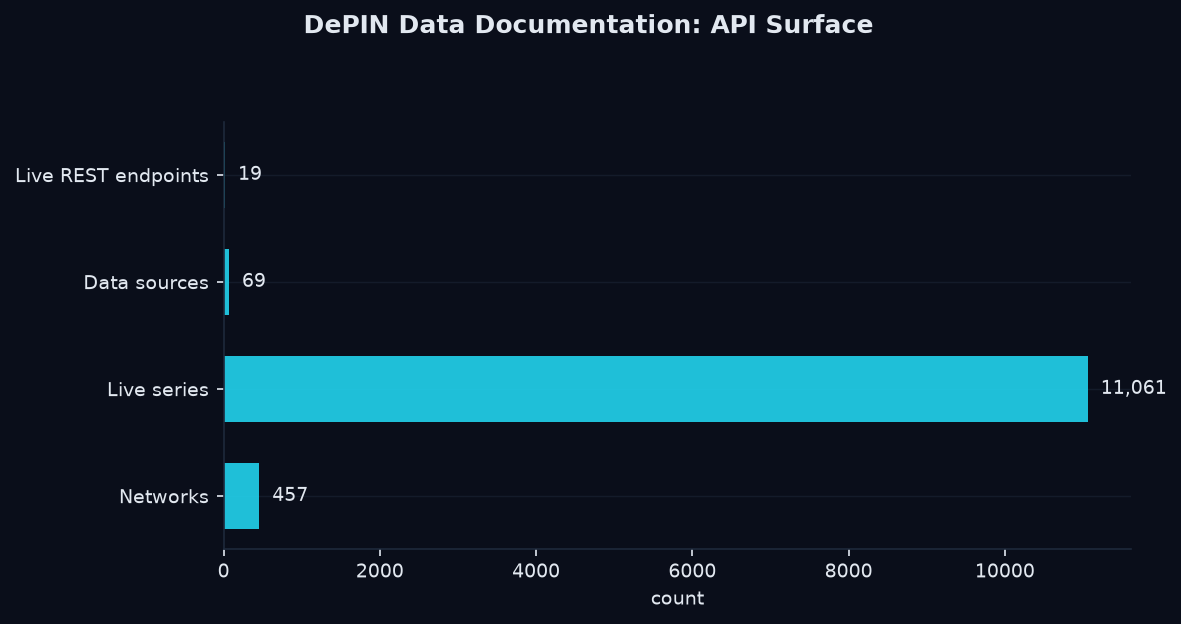
The Kairos Signal DePIN API serves verifiable telemetry across 372 networks from 138 sources, through 19 live REST endpoints at https://api.kairossignal.com. This is the reference map — the full schema lives in the online docs.
Coverage Model
Every network carries a tier that tells you what kind of data to expect:
| Tier | Networks | Data | |---|---|---| | First-party telemetry | 296 | Infrastructure metrics from the network's own API/chain | | On-chain market only | 78 | Token supply, price, holders | | Catalog only | 339 | Directory entry, no feed |
Core Endpoints
| Endpoint | Purpose |
|---|---|
| GET /v1/networks | Catalog with coverage tiers |
| GET /v1/networks/{id} | Telemetry for one network |
| GET /v1/supply | Supply series over a window |
| GET /v1/compare | Cross-network canonical comparison |
| GET /v1/verify/{id} | Provenance inspection |
| GET /v1/credits/balance | Account balance |
| POST /v1/credits/register | Self-serve registration |
The Canonical Schema
Raw network fields are normalized into 38 canonical concepts with declared units. Instead of learning each network's field names, you query a single concept:
# One concept, any network
curl "https://api.kairossignal.com/v1/networks/akash?fields=gpu_active" \
  -H "X-API-Key: *"
The same concept, comparable across networks
curl "https://api.kairossignal.com/v1/compare?concept=GPU_UTILIZATION&category=compute"
Examples of canonical concepts: GPU_ACTIVE, NODES_ACTIVE, STORAGE_POWER, PROTOCOL_FEE, TVL, SUPPLY. Each carries a declared unit.
The Provenance Contract
Every value in every response carries:
{
  "value": 3500,
  "source": "first_party_api",
  "as_of": "2026-08-25T12:00:01Z",
  "verify_url": "https://...",
  "freshness_verdict": "fresh"
}
source— the upstream endpointas_of— when it was readverify_url— a URL to confirm the valuefreshness_verdict— fresh, stale, or missing (never zero-filled)
Freshness Verdict Semantics
The freshness_verdict is part of the schema and must be handled explicitly:
fresh— safe to use as current.stale— historical or uncertain; use with caution.missing— the value is excluded, not zero. Never impute zero.
Source Taxonomy
The source field names the upstream. The main values you'll see:
first_party_api— 44 networks with dedicated stats APIssubtensor_rpc— Bittensor (129 subnets)evm_blockscout— 118 networksbsc_rpc— 50,solana_rpc— 49,ethereum_rpc— 32coingecko— 288 networks (market data)github— 54 networks (dev velocity)
Batch Integrity
Daily batches are Merkle-rooted and anchored to Bitcoin via OpenTimestamps. Any historical value is cryptographically provable — see Merkle Root Data Integrity.
Data Volume
The store holds roughly 697K rows across 11,857 live series — the temporal history that makes trend analysis and backtesting possible.
Authentication
Browsing needs no key at all: /v1/networks, /v1/network/, /v1/supply, /v1/market, /v1/revenue, /v1/provenance and /v1/history are keyless. Register for a free key at https://kairossignal.com/free-key for the account surfaces — balance, purchases, top-ups — and send the key in the X-API-Key header on those requests (bearer tokens are not used).
Pagination and Filtering
List endpoints support filtering by tier (first_party, onchain_market, catalog_only) and category (compute, storage, wireless, AI, sensors). Large catalogs are paginated; each page carries the coverage tier so you can filter server-side without pulling everything.
Full Reference
This page is the overview. The complete, current endpoint reference and schema are always live at:
Full API reference → · Get a free key →Reading the Schema: A Reference Walkthrough
When you query a network, you get canonical concepts plus the provenance contract. Understanding the shape of a response is the key to using the API well. A network telemetry response returns the network's canonical fields (like gpu_active or nodes_active), each carrying its source, as_of, verify_url, and freshness_verdict. A supply endpoint returns a time-indexed series with the same provenance per point. A compare endpoint returns a canonical concept across multiple networks, directly comparable.
The Unit Discipline
Every canonical concept declares its unit, and that discipline is what makes comparison safe. GPU_ACTIVE is a count of GPUs; STORAGE_POWER is in bytes (EiB); PROTOCOL_FEE is in the network's fee asset. Never assume a unit — read the declared one. Unit discipline is the quiet foundation of the whole schema, and it's what prevents cross-network comparisons from comparing apples to oranges.
Read more: DePIN Technical Manual · DePIN Developer Guide · How to Query DePIN Data
---
This is a data product. Kairos Signal publishes no trading signals, performance returns, win rates, or accuracy claims.---
Try it yourself
Query the live catalog, supply telemetry, and provenance receipts directly: /v1/provenance on the REST API.
Related reading: DePIN Intelligence guide · DePIN network data: 372 networks, 138 sources · how we read supply telemetry from 296 networks · the DePIN developer guide
Design-partner seats are capped at 20 at a lifetime-locked $199/mo (full API access, every published endpoint, MCP server, Bitcoin-anchored provenance). After seat 20 the price becomes $249/mo. Claim a design-partner seat → · See pricing---
Get Started With DePIN Intelligence
Kairos Signal provides verifiable, provenance-first telemetry for DePIN networks, including first-party supply data read directly from a network's own API or blockchain. Every value carries a verify_url you can check yourself, and each daily batch is Merkle-rooted and anchored to Bitcoin.
Every API response is signed with ed25519 and timestamped. You can prove what was served and when, months later. That is what we mean by provenance-first.
Related reading: DePIN Intelligence Guide · DePIN Telemetry · How to Query DePIN Data · DePIN Data Verification · Pricing