The Batch Integrity Problem
A single verify_url tells you where a value came from. But how do you know a historical value wasn't altered after the fact? How do you know a batch was created when it says it was, and not backdated? That's the integrity problem, and it's where Merkle roots come in.
A Merkle root is the cryptographic digest of an entire batch. It commits to every value in the batch at once — change any leaf and the root changes. For DePIN telemetry, where backtests and diligence depend on accurate history, batch integrity is not optional.
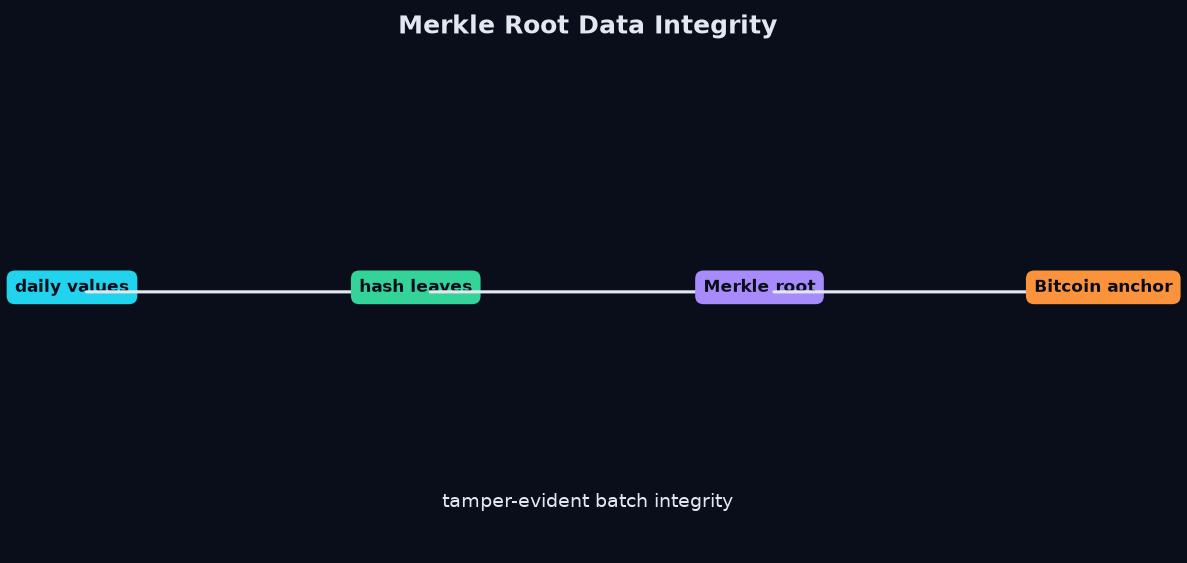
How the Mechanism Works
Because Bitcoin is a decentralized, tamper-evident ledger, the anchored root is a permanent, public proof of what the batch contained and when it existed.
Why Bitcoin Anchoring Is the Right Anchor
Not all anchors are equal. Anchoring to a central server's database just moves the trust problem — you're trusting the server. Bitcoin is decentralized and tamper-evident: no single party can rewrite its history. OpenTimestamps leverages that to create a timestamp that is publicly, independently verifiable. That's the trust-free guarantee DePIN data needs.
What Merkle Integrity Proves
- Nothing was altered. If any value in a batch changed, the recomputed root wouldn't match the anchored one.
- The batch existed at a time. The Bitcoin timestamp is proof the batch existed at that point — it cannot be backdated or restated later.
- No trust required. You don't have to trust Kairos Signal; you can verify the math against the public anchor.
Why It Matters for DePIN
DePIN analysis leans on historical telemetry: utilization trends, supply divergence, fee growth. All of that is worthless if history can be rewritten. Restated numbers are a real problem in this market — a network's "current" supply is often quietly different from what it was yesterday.
Bitcoin-anchored Merkle roots make restatement impossible without detection. A backtest built on this data uses the values that were actually true on each date.
A Worked Integrity Check
You pull a 30-day-old supply value. To verify: fetch the batch's Merkle root, recompute the root from the served leaf values, and confirm it matches the Bitcoin-anchored root. If it matches, the batch is intact and the value is exactly what was recorded that day. This is verification a script or an agent can run automatically — no human, no trust.
Verify It Yourself
# Pull a value and its provenance receipt
curl "https://api.kairossignal.com/v1/networks/akash?fields=gpu_active" \
  -H "X-API-Key: *"
Inspect the verification / provenance endpoint
curl "https://api.kairossignal.com/v1/verify/{value_id}"
Confirm coverage and source for any value
curl "https://api.kairossignal.com/v1/networks?source=first_party_api"
Across 372 networks, 138 sources, and ~697K rows, the Merkle-anchoring model applies uniformly to every daily batch.
FAQ
What is a Merkle root? The cryptographic digest of an entire batch of values. Change any value and the root changes, so a buyer can confirm the batch is intact. Why anchor to Bitcoin? Bitcoin is a decentralized, tamper-evident ledger. Anchoring the root there creates a timestamp that is publicly verifiable without trusting the provider. How do I verify a historical value? Recompute the Merkle root from the served values and confirm it matches the Bitcoin-anchored root. Scripts and agents can do this automatically. Read the docs → · Get a free key →Recomputing the Root: The Mechanics
Verifying a batch is straightforward for a script or agent. You take the served leaf values for a batch, hash each one, combine the hashes up the tree exactly as the batch was built, and compare the result to the anchored Merkle root. If the recomputed root matches, the batch is intact — no value was altered after the anchor. This is a deterministic, automatable check that requires no trust in the provider.
Because it's automatable, it scales. A monitoring agent can verify every batch it consumes, flagging any mismatch immediately. That turns integrity checking from a manual audit into a continuous process.
The Backdating Problem and Bitcoin
A Merkle root alone proves internal consistency — it does not prove when a batch was created. A malicious actor could construct a self-consistent batch for a date it was never actually produced. Bitcoin anchoring closes that gap: submitting the root to Bitcoin via OpenTimestamps produces a decentralized timestamp that is publicly verifiable and effectively impossible to backdate. That's why the anchor matters — it's what turns "consistent" into "provably existed when claimed."
Read more: DePIN Data Provenance: verify_url, Merkle Roots, Bitcoin · DePIN Data Verification · DePIN verify_url
---
This is a data product. Kairos Signal publishes no trading signals, performance returns, win rates, or accuracy claims.---
Try it yourself
Query the live catalog, supply telemetry, and provenance receipts directly: /v1/supply, /v1/provenance on the REST API.
Related reading: DePIN data provenance · how verify_url works · how we verify every DePIN number
Design-partner seats are capped at 20 at a lifetime-locked $199/mo (full API access, every published endpoint, MCP server, Bitcoin-anchored provenance). After seat 20 the price becomes $249/mo. Claim a design-partner seat → · See pricing---
Get Started With DePIN Intelligence
Kairos Signal provides verifiable, provenance-first telemetry for DePIN networks, including first-party supply data read directly from a network's own API or blockchain. Every value carries a verify_url you can check yourself, and each daily batch is Merkle-rooted and anchored to Bitcoin.
Every API response is signed with ed25519 and timestamped. You can prove what was served and when, months later. That is what we mean by provenance-first.
Related reading: DePIN Intelligence Guide · DePIN Telemetry · How to Query DePIN Data · DePIN Data Verification · Pricing