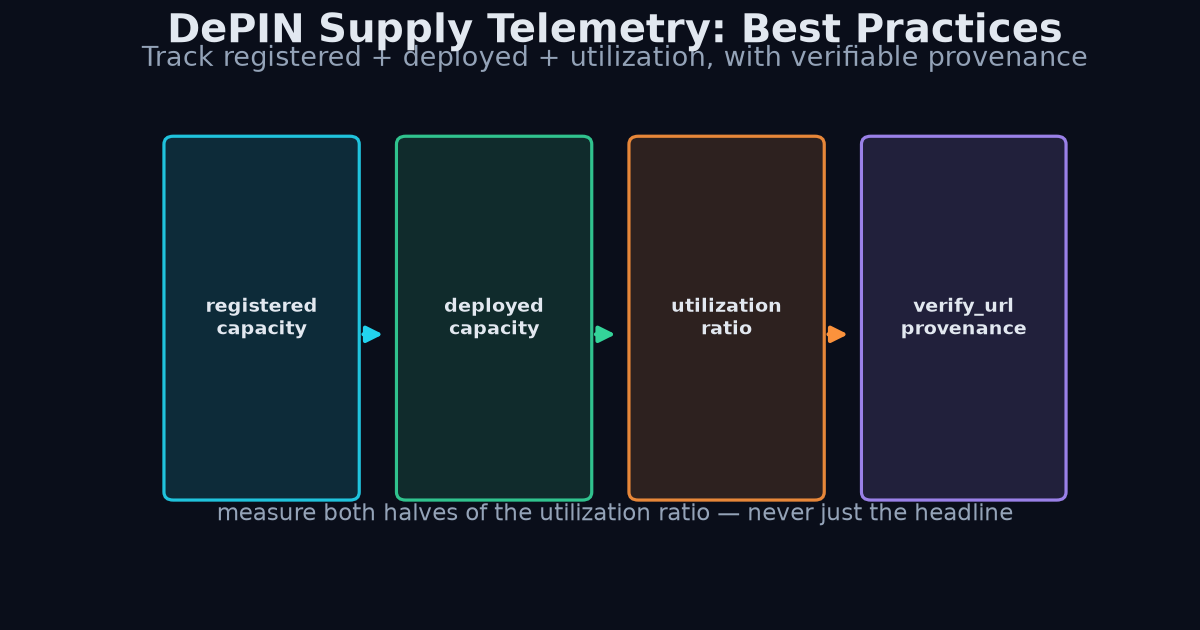
Building on DePIN Supply Telemetry
The Core Principle: Registered Is Not Deployed
The single most important best practice when consuming DePIN supply telemetry is to never treat a registered count as deployed capacity. The supply funnel has at least three stages — registered, active, and busy — and each answers a different question:
- Registered — what the network claims to have onboarded.
- Active — what is connected and reporting a heartbeat.
- Busy — what is actually serving demand right now.
Handle Missing Values Correctly
The second most important best practice: never zero-fill. A missing value and a zero value are different propositions. A zero is a measurement ("we counted zero"); a missing value is an assertion ("we cannot count"). Silently converting missing to zero poisons downstream analytics — utilization looks artificially low, supply looks artificially real. Our API returns a freshness_verdict of missing rather than fabricating a number, and best practice is to handle that case explicitly rather than treating it as zero.
DePIN supply telemetry — registered capacity, active capacity, utilization — is the ground truth for network health. But building production software on it requires more than a single API call. Here are the best practices that separate robust integrations from fragile ones.
1. Cache for Freshness, Not to Save Money
The single biggest mistake developers make is polling supply telemetry too aggressively — or not caching at all. Supply data changes on a cadence (Kairos Signal batches daily and Merkle-roots each batch), so hammering the endpoint every minute gives you stale data at unnecessary cost.
Do: cache with a TTL that matches the data cadence, and refresh from the API on that schedule. Don't: poll live telemetry as if it were a price ticker.2. Verify Sources Before You Trust a Number
Every Kairos Signal value returns with a verify_url pointing to the upstream source. In production, that's a feature, not an afterthought.
verify_urls for critical values before they enter a decision or settlement.
Don't: treat a single response as ground truth without knowing where it came from.
3. Normalize Units and Definitions
Networks report capacity in different units (PiB vs. EiB for storage, CPU cores vs. vCPU for compute) and different definitions (registered vs. active). Mixing them corrupts comparisons.
Do: use canonical, unit-declared concepts — Kairos Signal normalizes across 327 live networks sostorage_active or gpu_active means the same thing everywhere.
Don't: compare raw fields across networks without a normalization layer.
4. Design for Agents, Not Just Humans
Increasingly, your API consumers are autonomous agents. That changes the contract.
Do: return machine-readable, self-describing JSON with declared units, freshness, andverify_urls — so an agent can check its inputs.
Don't: build endpoints that require human context to interpret correctly.
5. Plan Costs Around the Data You Actually Need
Per-query pricing means you control spend — but only if you plan it. A $0.005–$0.02/query API is cheap, yet a misconfigured polling loop can still add up.
Do: budget a ceiling, cache aggressively, and request only the fields you need via field selection. Don't: request full network payloads when you only need two fields.Build It Right
Follow these practices and your DePIN integration will be cheaper, more accurate, and more trustworthy — whether it's a dashboard for humans or a decision loop for agents.
Get a free API key and start building → — $5 in free credits on signup. See the API docs and pricing. Explore design-partner support for production integrations →---
This is a data product. Kairos Signal publishes no trading signals or accuracy claims. All values are measured facts with verifiable provenance.---
Try it yourself
Query the live catalog, supply telemetry, and provenance receipts directly: /v1/networks, /v1/supply on the REST API.
Related reading: the DePIN developer guide · how to query DePIN data with curl · depin data documentation · DePIN RPC endpoints across chains
Start with a free API key — $5 in credits, no credit card — and query the live networks, their series, and the MCP server. Try the API free → · See pricing
---
Get Started With DePIN Intelligence
Kairos Signal provides verifiable, provenance-first telemetry for DePIN networks, including first-party supply data read directly from a network's own API or blockchain. Every value carries a verify_url you can check yourself, and each daily batch is Merkle-rooted and anchored to Bitcoin.
Every API response is signed with ed25519 and timestamped. You can prove what was served and when, months later. That is what we mean by provenance-first.
Related reading: DePIN Intelligence Guide · DePIN Telemetry · How to Query DePIN Data · DePIN Data Verification · Pricing