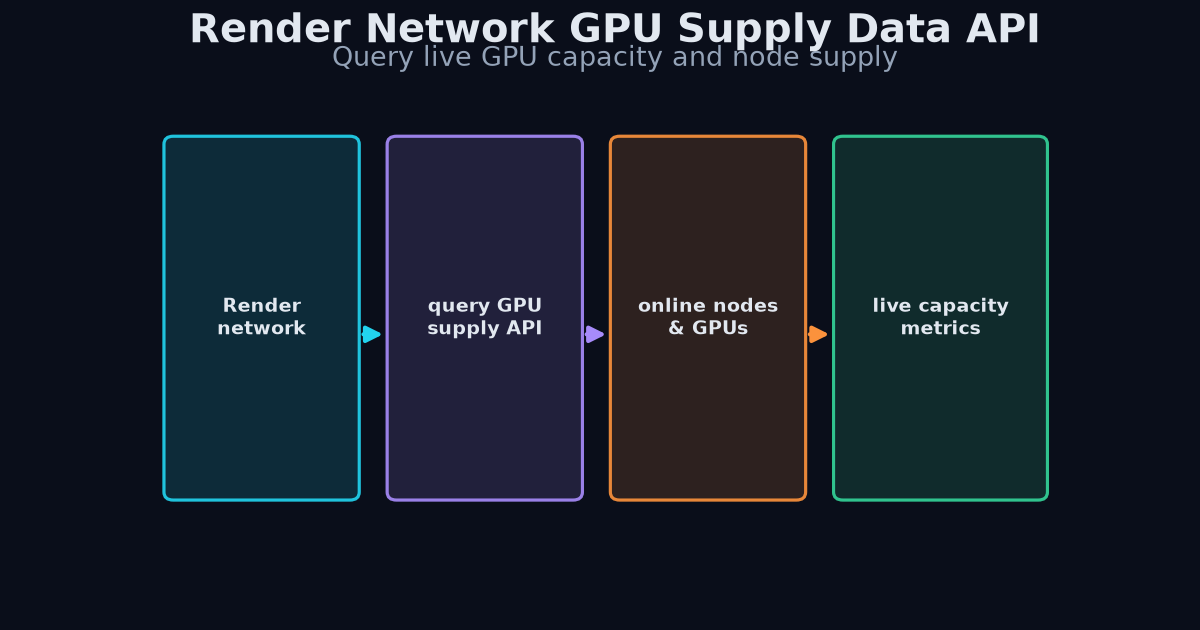
The Render GPU Supply Data Problem
What the Metrics Tell You
Render's metrics — registered GPU count, GPU type distribution, active capacity, and utilization — answer the questions that matter for a rendering or compute buyer:
- Registered vs. active reveals how much of the fleet is genuinely online and usable.
- GPU type distribution determines whether the network can serve your workload at all (a rendering job needs specific hardware, not just "a GPU").
- Utilization tells you whether capacity is scarce (hard to get a slot, higher prices) or abundant.
Render Network is a leading GPU compute DePIN, but GPU supply data is surprisingly hard to get programmatically. The number that gets quoted everywhere — "how many GPUs are on Render" — comes from sources that vary wildly in definition and freshness. Some count registered GPUs, some count online GPUs, and some report modeled estimates that have nothing to do with the network's own telemetry.
To build on Render, or to assess its true compute capacity, you need live, first-party GPU supply data.
The Render Metrics That Matter
- Registered GPU count — the GPUs the network has onboarded
- GPU types and model distribution — which cards (e.g., NVIDIA A100, H100, consumer RTX) are actually available
- Active/online GPU capacity — what's actually serving jobs right now
- Utilization — active GPU time as a fraction of available capacity
Querying Render GPU Data
With a Kairos Signal API key, Render GPU supply is a single call:
# Render supply + market data
curl "https://kairossignal.com/v1/networks/render" \
  -H "X-API-Key: YOUR_API_KEY"
GPU-specific supply telemetry
curl "https://kairossignal.com/v1/networks/render?fields=gpus_registered,gpus_active,gpu_utilization"
Compare GPU supply across compute networks
curl "https://kairossignal.com/v1/compare?network=render&concept=GPU_ACTIVE"
Each value returns with declared units and a verify_url pointing to Render's own API or explorer. You can check the source before you provision a job based on it.
Registered vs. Active: The GPU Supply Funnel
The distinction between registered and active GPU supply is the whole ballgame. A network can advertise a large fleet while only a fraction is online and usable. If your app provisions jobs based on registered counts, you'll over-allocate and hit availability walls.
The full funnel on any GPU DePIN looks like this:
- Registered — GPUs the network has onboarded and advertised.
- Active — GPUs currently connected and reporting a heartbeat.
- Busy — the subset of active GPUs running a job right now.
GPU Type Distribution
A raw GPU count also hides the mix. A fleet of 40,000 consumer RTX cards is not the same market as 4,000 A100/H100 data-center accelerators. For a rendering workload — Render's core use case — GPU type and VRAM determine whether a job is feasible at all.
We track GPU supply by model class, so you can answer "does Render have H100s available right now, and how many?" rather than "how many GPUs total." This is the difference between a capacity dashboard and a decision tool.
Why Verifiable GPU Data Matters
For developers building job schedulers or capacity dashboards, the registered-vs-active distinction is operationally critical — it's the difference between a scheduler that fails on live jobs and one that places work on real capacity. For AI/ML teams renting GPUs, accurate supply data means better provisioning decisions. For investors, it reveals whether Render's compute is actually being used.
Because every daily batch is Merkle-rooted and timestamped to Bitcoin, the GPU count you read today is provably today's value.
Query Render GPU data with a free API key → — get $5 in free credits on signup. See the API docs and pricing. Explore design-partner support for production GPU provisioning →---
This is a data product. Kairos Signal publishes no trading signals or accuracy claims. All values are measured facts with verifiable provenance.Get Started With DePIN Intelligence
Kairos Signal provides verifiable, provenance-first telemetry for DePIN networks, including first-party supply data read directly from a network's own API or blockchain. Every value carries a verify_url you can check yourself, and each daily batch is Merkle-rooted and anchored to Bitcoin.
Every API response is signed with ed25519 and timestamped. You can prove what was served and when, months later. That is what we mean by provenance-first.
Related reading: DePIN Intelligence Guide · DePIN Telemetry · How to Query DePIN Data · DePIN Data Verification · Pricing