The Receipt Principle
When you buy data, you are buying a claim about the world. Most data products ask you to take that claim on faith. Provenance is the practice of attaching a receipt to every value so you never have to.
The principle is simple: provenance or silence. If we cannot point you to the exact endpoint a number came from, we do not serve it. We would rather omit a metric than present something we cannot verify.
The Four Fields of a Receipt
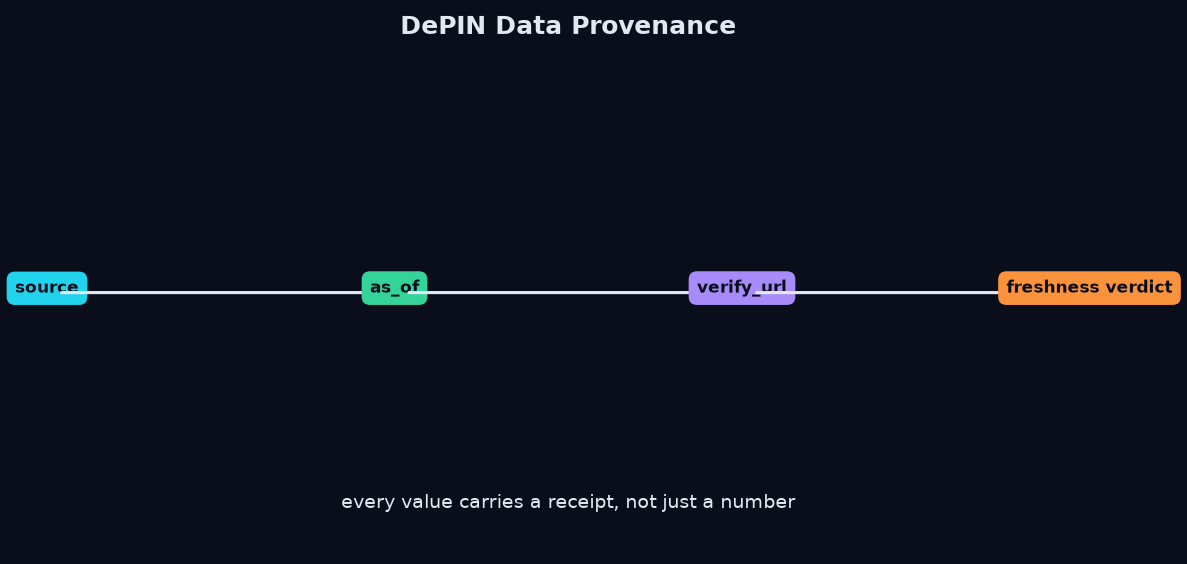
Every value we serve carries four fields:
source— the upstream API or chain that produced itas_of— the exact time we read itverify_url— a public URL you can open to confirm the numberfreshness_verdict— whether the value is fresh, stale, or missing (never zero-filled)
verify_url and confirm the value against the upstream source yourself.
Why It Matters for DePIN Specifically
DePIN is the sector where provenance is most critical and most absent. Node counts are inflated, supply figures are restated, and utilization is guessed. A market that runs on unverifiable numbers is a market where the most dishonest claims win. Provenance is the correction:
- Node counts carry a
verify_urlto the network's own telemetry. - Supply figures carry a
verify_urlto the chain explorer. - Protocol fees carry a
verify_urlto the chain state.
A Worked Verification
Suppose you're served gpu_active: 3500 for Akash. The receipt says source: first_party_api, as_of: 2026-08-25T12:00:01Z, and a verify_url pointing at Akash's console. You open the URL, see 3500, and you're done — the number checks out at its source. If the source disagreed, you'd have caught a data-integrity problem before it reached your analytics.
Beyond the Receipt: Batch Integrity
A single verify_url proves a value's source, but not its history. For that, daily batches are hashed into a Merkle root and anchored to Bitcoin via OpenTimestamps. This creates a tamper-evident record: any historical value can be cryptographically proven to have existed at a specific time, without trusting anyone.
The two layers together are the provenance model:
Query Provenance
# Pull a value with its full receipt
curl "https://api.kairossignal.com/v1/networks/akash?fields=gpu_active" \
  -H "X-API-Key: *"
Inspect provenance for a specific value
curl "https://api.kairossignal.com/v1/verify/{value_id}"
See the provenance / coverage model
curl "https://api.kairossignal.com/v1/networks?tier=first_party"
Open the verify_url in any response and confirm the number at the source. That is the provenance promise.
FAQ
What does "provenance or silence" mean? We only serve a value if we can point to its exact source. Otherwise we omit it rather than model an estimate. Honest absence beats fabricated presence. Can I verify data without trusting the provider? Yes. Open theverify_url to confirm at the source; check the Merkle root and Bitcoin timestamp for historical integrity.
What is a freshness verdict? It tells you whether a value is fresh, stale, or missing — and critically, it never zero-fills missing values.
Read the docs → · Get a free key →
Provenance as a Data-Quality Signal
Provenance isn't just a trust feature — it's a data-quality signal in its own right. A value with a verify_url you can open has passed a bar that a value without one hasn't. A value with a freshness_verdict of missing is telling you the truth about its absence, whereas a zero-fill is lying about it. The presence of provenance metadata is itself evidence about how carefully the data was produced.
This is why provenance separates data products from dashboards. A dashboard shows you numbers; a data product shows you numbers and their receipts. When you're building on a data product, you can audit every input to your analysis. When you're building on a dashboard, you're trusting an opaque pipeline.
The Auditing Workflow
A provenance-first pipeline makes auditing a routine operation rather than a forensic exercise:
verify_url and confirm the source.Each step is a small query, and together they let you confirm — not assume — that the data you're acting on is real, current, and unaltered. That's the practical payoff of the provenance model.
Read more: DePIN Data Provenance: verify_url, Merkle Roots, Bitcoin · DePIN verify_url · DePIN Data Verification
---
This is a data product. Kairos Signal publishes no trading signals, performance returns, win rates, or accuracy claims.---
Try it yourself
Query the live catalog, supply telemetry, and provenance receipts directly: /v1/supply, /v1/provenance on the REST API.
Related reading: DePIN data provenance · Merkle-rooted batch integrity · how verify_url works · how we verify every DePIN number
Design-partner seats are capped at 20 at a lifetime-locked $199/mo (full API access, every published endpoint, MCP server, Bitcoin-anchored provenance). After seat 20 the price becomes $249/mo. Claim a design-partner seat → · See pricing---
Get Started With DePIN Intelligence
Kairos Signal provides verifiable, provenance-first telemetry for DePIN networks, including first-party supply data read directly from a network's own API or blockchain. Every value carries a verify_url you can check yourself, and each daily batch is Merkle-rooted and anchored to Bitcoin.
Every API response is signed with ed25519 and timestamped. You can prove what was served and when, months later. That is what we mean by provenance-first.
Related reading: DePIN Intelligence Guide · DePIN Telemetry · How to Query DePIN Data · DePIN Data Verification · Pricing