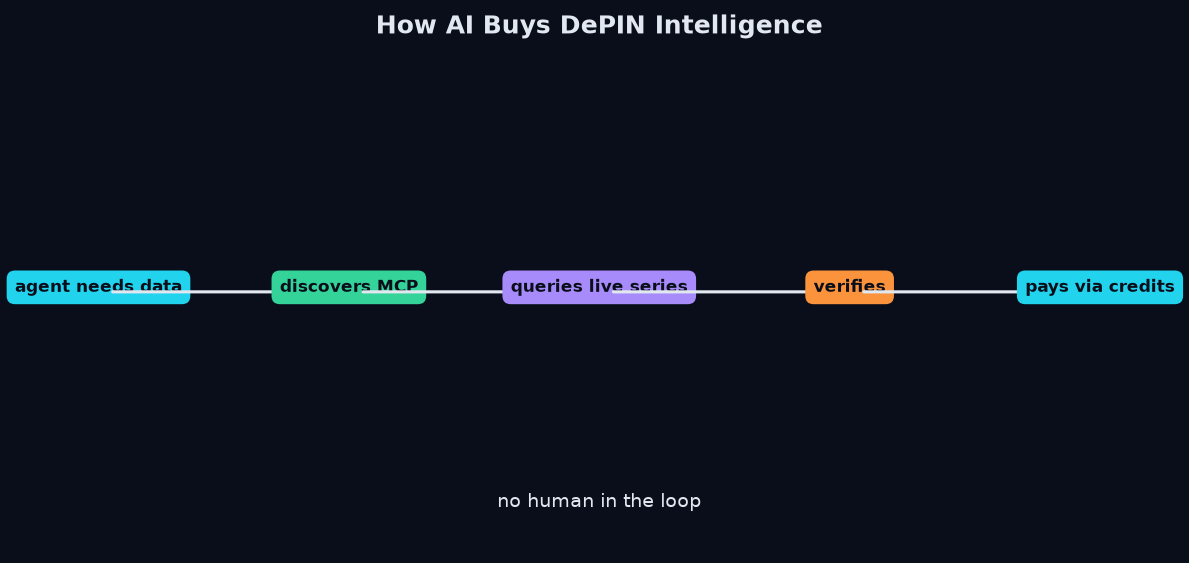
The No-Human Data Loop
The most important shift in data commerce is that machines now buy data. Autonomous agents — not humans — are becoming the primary consumers of DePIN intelligence. The loop has four stages, and at every stage a human is optional.
Stage 1: Discover
An agent connects to the DePIN MCP server at https://kairossignal.com/mcp/ and lists the tools. It sees list_networks, get_network, query_supply, compare, verify, and the commerce tools — a self-describing surface of what's available.
Stage 2: Query
The agent calls a tool for live telemetry. It can pull GPU supply for a compute network, compare utilization across the category, or rank networks by active nodes — all programmatically.
# The human-equivalent REST call
curl "https://api.kairossignal.com/v1/networks/akash?fields=gpu_active" \
  -H "X-API-Key: *"
Stage 3: Verify
This is what separates trustworthy agents from reckless ones. Before acting on a value, the agent checks its verify_url — fetching the upstream source and confirming the number. Every value carries source, as_of, and verify_url, so the agent can encode a policy: only act on values whose source I've confirmed.
Stage 4: Pay
The agent funds itself with self-serve credits via USDC — no credit card, no sales call, no human approval. It checks its balance, buys what it needs, and moves on.
Why Provenance Is the Enabler
Autonomous commerce only works if agents can trust what they buy. Without provenance, an agent is acting on unverifiable claims at scale. With a verify_url on every value, a Merkle root on every batch, and a Bitcoin timestamp on every root, the agent has cryptographic guarantees it can encode into its own policy.
A Worked Autonomous Decision
An agent is tasked with finding where to deploy a GPU workload. It connects to the MCP server, lists networks, and pulls gpu_active and gpu_available for the compute category. For each candidate it fetches the verify_url, confirms the numbers, checks the freshness verdict, and only then ranks them by utilization. If a value is stale or its source disagrees, the agent rejects that candidate automatically. The whole decision — discovery, verification, ranking — runs with no human.
What This Unlocks
- Autonomous infrastructure deployment — an agent checks GPU supply and deploys where capacity is real.
- Automated diligence — agents continuously monitor node counts, fees, and utilization.
- Self-serve data economy — agents buy exactly what they need, when they need it.
The Trust Requirements for Autonomous Data
For an agent to buy data, the data must be: (1) discoverable, (2) programmatically queryable, (3) verifiable, and (4) programmatically payable. Missing any one of those and the loop breaks and a human is needed. The DePIN Agent API and MCP server deliver all four, which is what makes genuinely autonomous consumption possible.
FAQ
Can agents really buy data without a human? Yes. Discovery (MCP), query (REST/MCP), verification (verify_url), and payment (USDC credits) are all programmatic. How does an agent trust the data? It fetches theverify_url, confirms the value at the source, and only acts when it matches. Provenance is encoded into its policy.
What breaks the autonomous loop? Any friction — a sales form, a manual payment, or unverifiable data. We removed all of them.
The End State
When an agent can discover, verify, and buy data without a human, DePIN intelligence becomes a resource the agent economy consumes the way applications consume APIs. That's the data layer the autonomous economy runs on.
Explore the MCP server → · Read the docs →The Four Requirements for Autonomous Data
For an agent to buy data without a human, four things must be true, and all four are required:
Missing any one of these breaks the loop and reintroduces a human. The DePIN Agent API and MCP server deliver all four, which is what makes genuinely autonomous consumption possible — and it's why the agent economy will favor data sources designed this way.
The Scaling Risk of Unverified Agents
An unverified agent is dangerous at scale: it acts automatically on whatever data it's given, magnifying any error. The provenance layer is the correction. When an agent fetches the verify_url, confirms the value, and only acts on confirmed data, it stops being a blind executor and becomes a verifier. Encoding that discipline into agent policy is the difference between autonomous systems that work and ones that silently corrupt themselves.
Read more: DePIN Agent API · MCP for DePIN · DePIN verify_url
---
This is a data product. Kairos Signal publishes no trading signals, performance returns, win rates, or accuracy claims.---
Try it yourself
Query the live catalog, supply telemetry, and provenance receipts directly: /v1/supply, /v1/provenance on the REST API.
Related reading: the DePIN MCP server · the 10 MCP tools · how ai agents discover and use mcp servers · the DePIN agent API
Start with a free API key — $5 in credits, no credit card — and query the live networks, their series, and the MCP server. Try the API free → · See pricing
---
Get Started With DePIN Intelligence
Kairos Signal provides verifiable, provenance-first telemetry for DePIN networks, including first-party supply data read directly from a network's own API or blockchain. Every value carries a verify_url you can check yourself, and each daily batch is Merkle-rooted and anchored to Bitcoin.
Every API response is signed with ed25519 and timestamped. You can prove what was served and when, months later. That is what we mean by provenance-first.
Related reading: DePIN Intelligence Guide · DePIN Telemetry · How to Query DePIN Data · DePIN Data Verification · Pricing