An API Designed for Machines, Not Just People
Most APIs are designed for developers who will read the docs and write code. The DePIN Agent API is designed for a different user: the autonomous agent that calls it programmatically, pays programmatically, and consumes data programmatically. The result is an API with self-serve credits, USDC payments, and zero friction.
The Zero-Friction Onboarding
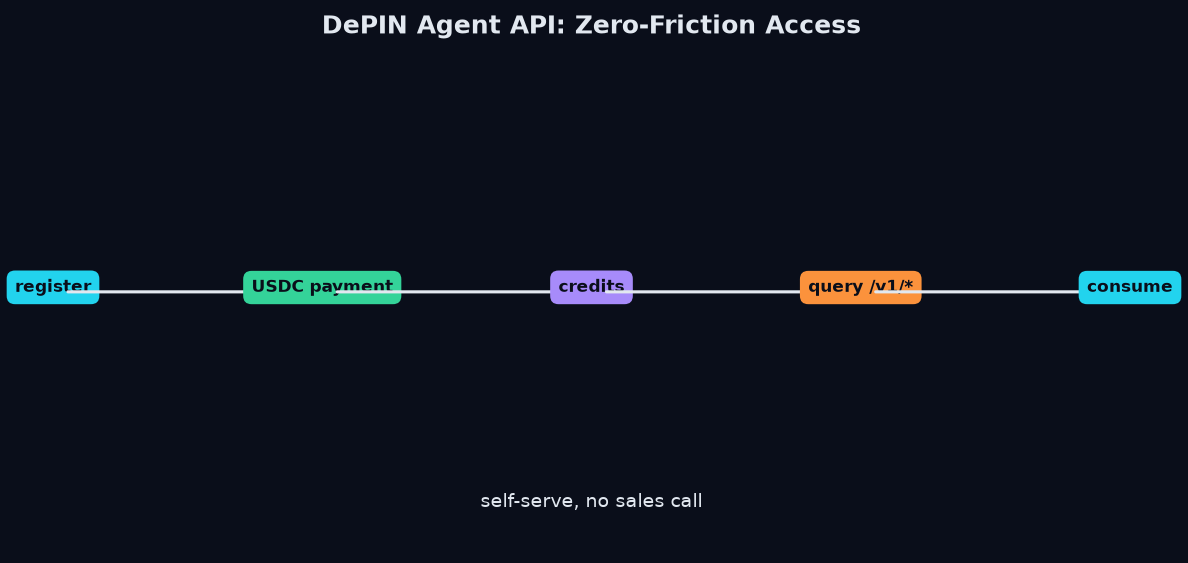
For a human, onboarding is a form. For an agent, onboarding has to be a few calls. The Agent API keeps it that way:
https://api.kairossignal.com/v1/* endpoints.verify_url on every value before acting.No account manager. No "talk to sales." A machine can onboard itself in under a minute.
Self-Serve Credits
Credits are the unit of commerce. An agent tops up, spends on queries, and monitors its balance — all through the API. Because the pricing is transparent, an agent (or its operator) can budget precisely:
| Tier | Price | |---|---| | Free | $0 | | Design Partner | $199/mo (forever price lock) | | Pro | $499/mo | | Enterprise | $2000/mo |
USDC Payments
USDC is the natural settlement layer for autonomous commerce — fast, programmatic, and on-chain. An agent can move value without needing a human to approve a credit card transaction. The Agent API treats payments as first-class API calls, not afterthoughts.
A Programmatic Session
# 1. Register / get credentials
curl -X POST "https://api.kairossignal.com/v1/credits/register" \
  -H "Content-Type: application/json" -d '{"email":"[email protected]"}'
2. Fund with USDC
curl -X POST "https://api.kairossignal.com/v1/credits/topup" \
  -H "X-API-Key: *" -d '{"amount_usdc": 50}'
3. Query live telemetry
curl "https://api.kairossignal.com/v1/networks/akash?fields=gpu_active" \
  -H "X-API-Key: *"
4. Check balance
curl "https://api.kairossignal.com/v1/credits/balance" \
  -H "X-API-Key: *"
Every value carries source, as_of, verify_url, and a freshness verdict, so the agent can verify before it acts.
Why Zero Friction Matters
Friction is the enemy of autonomous commerce. A single "contact sales" form in the middle of an agent's workflow turns a fully automated system into one that needs a human. The Agent API removes every such gate: registration, funding, querying, and verification are all programmatic. A machine can go from nothing to verified data consumption with no human touchpoint.
The Machine-to-Machine Trust Model
For machine-to-machine commerce to work, trust must be encoded in the API itself. Every value carries provenance the agent can check; every payment is auditable on-chain. The Agent API isn't just an API with a payment field — it's a trust model where an agent can verify what it buys before it acts.
Why This Matters
The agent economy is arriving, and it will buy data the way applications buy compute — programmatically, at scale, with zero friction. A DePIN Agent API with self-serve credits and USDC payments is the infrastructure that makes autonomous access to infrastructure telemetry possible. When an agent can onboard, pay, query, and verify itself, DePIN intelligence becomes a resource the agent economy can actually consume.
FAQ
Can an agent onboard itself? Yes — registration, funding, and querying are all programmatic. No sales call, no credit card, no human approval. How does payment work? Self-serve credits funded by USDC, processed as API calls. Settlement is fast, programmatic, and on-chain. How does the agent trust the data? Every value carriessource, as_of, verify_url, and a freshness verdict, so the agent verifies before it acts.
Read the docs → · Explore the MCP server →
The Trust Model for Machine-to-Machine Data
Machine-to-machine commerce fails unless the machine can verify what it buys. The Agent API encodes that trust in two ways. First, every value carries source, as_of, verify_url, and a freshness verdict, so an agent can confirm a number before acting. Second, payments are auditable on-chain via USDC, so the financial side is as verifiable as the data side. When both the data and the payment are provable, autonomous commerce becomes viable.
The Cost of Friction in Perspective
It's easy to underestimate how much friction breaks an autonomous loop. A single "contact sales" form in the middle of an agent's workflow turns a fully automated system into one that stalls waiting for a human. Registration, funding, querying, and verification must all be programmatic or the loop isn't autonomous. The Agent API was designed with that constraint in mind: every step is an API call, and no step requires a human.
Read more: Autonomous Agent Data · DePIN MCP Server · MCP for DePIN
---
This is a data product. Kairos Signal publishes no trading signals, performance returns, win rates, or accuracy claims.---
Try it yourself
Query the live catalog, supply telemetry, and provenance receipts directly: /v1/supply, /v1/provenance on the REST API.
Related reading: the DePIN MCP server · the 10 MCP tools · how ai agents discover and use mcp servers · how AI agents buy DePIN data
Start with a free API key — $5 in credits, no credit card — and query the live networks, their series, and the MCP server. Try the API free → · See pricing
---
Get Started With DePIN Intelligence
Kairos Signal provides verifiable, provenance-first telemetry for DePIN networks, including first-party supply data read directly from a network's own API or blockchain. Every value carries a verify_url you can check yourself, and each daily batch is Merkle-rooted and anchored to Bitcoin.
Every API response is signed with ed25519 and timestamped. You can prove what was served and when, months later. That is what we mean by provenance-first.
Related reading: DePIN Intelligence Guide · DePIN Telemetry · How to Query DePIN Data · DePIN Data Verification · Pricing