Why MCP Is the New Agent Data Interface
Why MCP Matters for the Data Economy
MCP is the standard that lets any AI agent talk to any tool without custom integration per provider. For the DePIN data economy, that is transformative: an agent that speaks MCP can discover and query the same verifiable data a human developer would use, across the same canonical schema. No bespoke API glue, no per-network parsers.
The result is that data products become directly consumable by autonomous agents — the fastest-growing class of consumer. When discovery, verification, and purchase are all exposed as MCP tools, an agent can integrate a data source as a reliable dependency rather than a fragile scrape. That is the direction the market is moving, and it is why we expose our full catalog through an MCP server.
What an Agent Actually Does with MCP
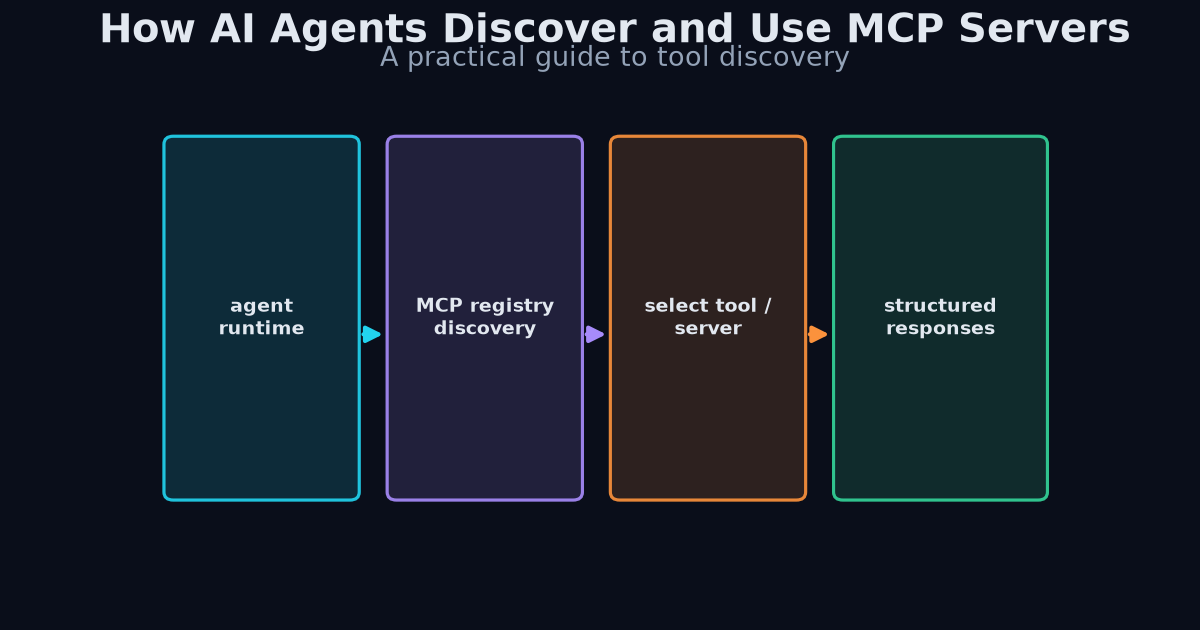
Model Context Protocol (MCP) gives an autonomous agent a structured way to discover and call tools. For DePIN data, the flow is:
list_networks, query_supply, verify_value).verify_url on any value before acting on it.The MCP surface mirrors our REST API, so the canonical schema is identical whether a human or an agent is querying. This is what makes autonomous DePIN intelligence possible: an agent can discover, validate, and transact on the same verifiable data a developer would use.
The Model Context Protocol (MCP) has become the standard way for AI agents to connect to tools and data. Instead of hand-rolled function-calling schemas, MCP servers expose discoverable, self-describing capabilities that agents can find, inspect, and call at runtime. For DePIN data, that means an agent can autonomously discover and pull verifiable supply telemetry without a human wiring up a custom integration.
Here's how discovery and usage actually work.
How Agents Discover MCP Servers
1. Well-Known Endpoints
The most reliable discovery mechanism is a stable, well-known endpoint. Kairos Signal exposes its data via an MCP server at /mcp with 10 tools covering network catalog, supply telemetry, market data, revenue, and provenance. An agent pointed at this endpoint can immediately enumerate the available tools.
2. Tool Listing and Capability Advertisement
Once connected, the agent lists the server's tools and their input/output schemas. Good MCP servers advertise capabilities clearly — a tool that returns supply_circulating, storage_active, or gpu_active tells the agent exactly what it can query. This capability advertisement is what turns "an endpoint" into "a discoverable resource."
3. Registry and Directory Lookup
Increasingly, agents consult registries of MCP servers to find capabilities across the ecosystem. Listing your MCP server in public directories makes it discoverable by agents that start from a catalog rather than a known URL.
How Agents Use MCP Servers
Once discovered, usage follows a standard flow:
verify_url before acting.The key advantage for DePIN is verifiability. When an agent calls Kairos Signal's MCP tools, every value returns with a verify_url and the batch is Merkle-rooted to Bitcoin — so an autonomous agent can ground its decisions in data it can independently check, rather than trusting a static payload.
Build Agents That Trust Their Data
If you're building agents that make infrastructure or allocation decisions on DePIN data, MCP gives you a clean, standardized integration path — and verifiable provenance keeps your agents honest.
Try the MCP server with a free API key → — get $5 in free credits. See the API docs for MCP endpoints and tool schemas. Explore design-partner support for agent integrations → and pricing.---
This is a data product. Kairos Signal publishes no trading signals or accuracy claims. All values are measured facts with verifiable provenance.---
Try it yourself
Query the live catalog, supply telemetry, and provenance receipts directly: /v1/networks, /v1/supply on the REST API.
Related reading: the DePIN MCP server · the 10 MCP tools · how AI agents buy DePIN data · the DePIN agent API
Start with a free API key — $5 in credits, no credit card — and query the live networks, their series, and the MCP server. Try the API free → · See pricing
---
Get Started With DePIN Intelligence
Kairos Signal provides verifiable, provenance-first telemetry for DePIN networks, including first-party supply data read directly from a network's own API or blockchain. Every value carries a verify_url you can check yourself, and each daily batch is Merkle-rooted and anchored to Bitcoin.
Every API response is signed with ed25519 and timestamped. You can prove what was served and when, months later. That is what we mean by provenance-first.
Related reading: DePIN Intelligence Guide · DePIN Telemetry · How to Query DePIN Data · DePIN Data Verification · Pricing