Why Supply, Not Price, Is the Diligence Signal
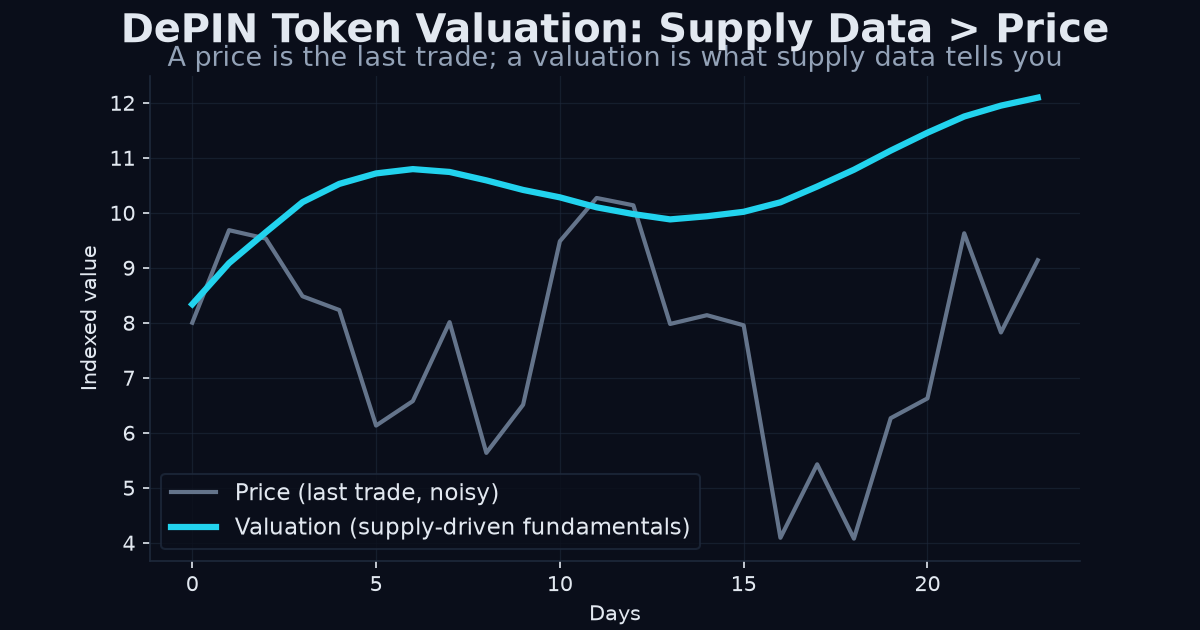
Token price is the market's opinion; supply is the network's fact. A rising token price with flat or shrinking active supply is a narrative decoupled from fundamentals. Conversely, a network growing its deployed capacity while its token consolidates may be building real usage that the market has not yet priced. For anyone doing diligence — an investor, a research desk, or an agent — the supply curve is the ground truth that price volatility obscures.
The Two-Denominator Problem
A second trap hides in how supply is counted. "Total supply" and "active supply" answer different questions. Registered supply reflects what a network claims; active or deployed supply reflects what is actually working. The gap between them is idle capacity, and it is routinely conflated in valuation models.
- A high registered supply with low active supply is a network carrying idle inventory.
- A tight active-to-registered ratio signals genuine demand absorption.
The DePIN Data Problem
DePIN tokens get priced every second. They get valued almost never. The difference is supply data. A price is just the last trade — a valuation is what you get when you multiply, divide, and reason over supply, utilization, and revenue. And in DePIN, the supply side is where nearly everyone gets it wrong.
At Kairos Signal, we catalog DePIN networks and read first-party supply telemetry from many of them. The reason we obsess over supply data is simple: it's the difference between watching a ticker and understanding a network.
Why Supply Data Beats Price
A price tells you what the market last agreed to pay for one token. It tells you nothing about:
- How many tokens exist — circulating vs. total vs. max. Two networks at the same price can be valued 10x apart depending on unlocked supply.
- What the network actually does — the utilization of real infrastructure, which is DePIN's closest thing to a fundamentals report.
- Whether usage generates revenue — protocol fees, or for a network like Helium, DC burn.
The FDV Trap in DePIN Valuation
The single most common valuation error is treating fully-diluted valuation (price × max supply) as if it were market cap (price × circulating supply). On networks with large locked unlocks — io.net, with an 800M max supply sitting far above its circulating figure, is a textbook case — the two can differ by 2x or more. Neither number is "wrong"; they answer different questions. Supply data tells you which question each one answers, and lets you compute the ratio that reveals how a network values its own future.
Query Supply Data for Valuation
# Circulating and max supply for a DePIN token, plus market data
curl "https://kairossignal.com/v1/networks/io.net" \
  -H "X-API-Key: $KS_API_KEY"
Compute FDV-to-market-cap ratio across many networks
curl "https://kairossignal.com/v1/compare?concept=CIRCULATING_SUPPLY"
Supply + protocol fees (revenue proxy) in one call
curl "https://kairossignal.com/v1/compare?concept=PROTOCOL_FEES_30D"
Every supply and fee value carries a verify_url — supply points at the chain explorer or network API, fees at DefiLlama. You can recompute any ratio from the raw inputs, because we never bake our judgment into a single opaque number.
Why Provenance Wins
Because the daily batch is Merkle-rooted and timestamped to Bitcoin via OpenTimestamps, the supply figure you value the token against today is provably the figure published today. A backtest of DePIN fundamentals uses point-in-time supply — never a restated value that would silently change your conclusions.
Price is a rumor. Supply data is the ledger. Value the token on the ledger. Get a free API key →---
This is a data product. Kairos Signal publishes no trading signals, performance returns, win rates, or accuracy claims.---
Try it yourself
Query the live catalog, supply telemetry, and provenance receipts directly: /v1/supply, /v1/provenance on the REST API.
Related reading: DePIN data pricing tiers · DePIN API pricing comparison · data-product pricing psychology · calculating true network value
Design-partner seats are capped at 20 at a lifetime-locked $199/mo (full API access, every published endpoint, MCP server, Bitcoin-anchored provenance). After seat 20 the price becomes $249/mo. Claim a design-partner seat → · See pricing---
Get Started With DePIN Intelligence
Kairos Signal provides verifiable, provenance-first telemetry for DePIN networks, including first-party supply data read directly from a network's own API or blockchain. Every value carries a verify_url you can check yourself, and each daily batch is Merkle-rooted and anchored to Bitcoin.
Every API response is signed with ed25519 and timestamped. You can prove what was served and when, months later. That is what we mean by provenance-first.
Related reading: DePIN Intelligence Guide · DePIN Telemetry · How to Query DePIN Data · DePIN Data Verification · Pricing Correction 2026-09-25: this post called our catalog entry count a count of DePIN networks; that count includes superseded rows and Bittensor subnet rows. It has been removed, together with some present-tense coverage counts written beside it. Current coverage figures: /v1/networks.