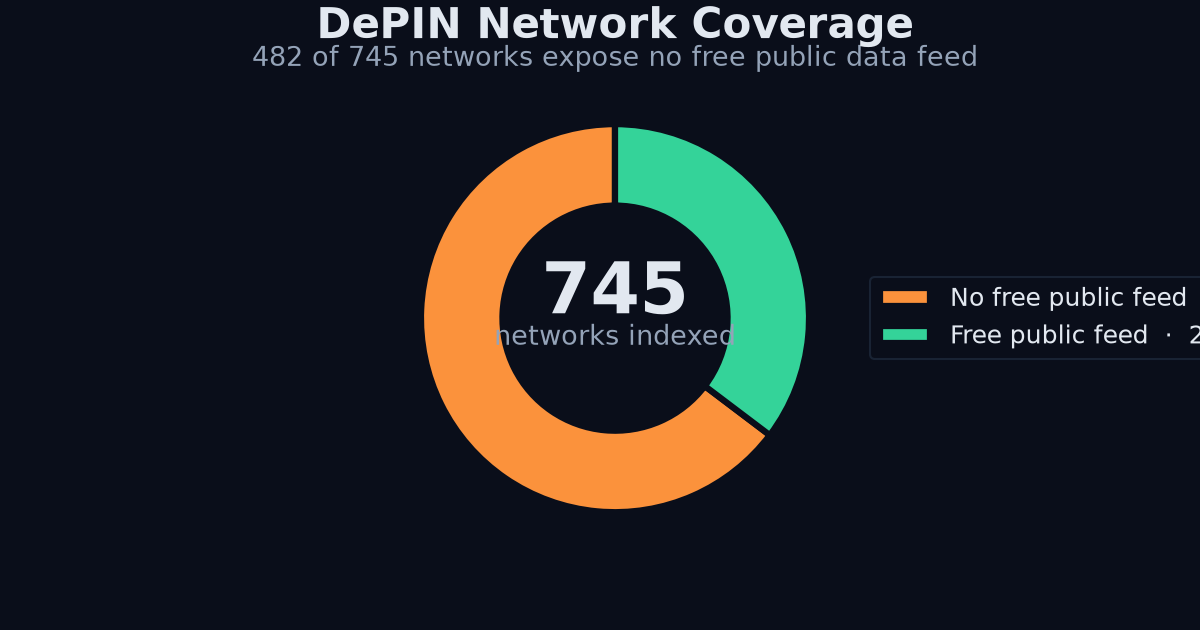
DePIN Network Coverage: The 482 Networks With No Free Public Feed
At Kairos Signal, we index Decentralized Physical Infrastructure Networks (DePINs) for a living. As of this post's date (2026-08-17), our ingestion pipeline cataloged 745 distinct DePIN networks across compute, storage, wireless, sensor, and energy verticals. That number sounds impressive on a pitch deck. The reality beneath it is far less so.
Of those 745 networks:
| Category | Count | Share | |---|---|---| | Networks with live, accessible data feeds | 263 | 35.3% | | Networks with first-party supply telemetry (node counts, geographic distribution, uptime) | 171 | 22.9% | | Networks with no free public feed of any kind | 482 | 64.7% |
This post is about that last row—the 482 networks that are, from a data perspective, dark matter. We cannot see them. We cannot verify them. We refuse to pretend otherwise.
---
The Coverage Function
Let us define the problem formally. A DePIN network $N_i$ is a tuple:
$$N_i = \langle \mathcal{S}_i, \mathcal{D}_i, \mathcal{A}_i, \mathcal{T}_i \rangle$$
Where:
- $\mathcal{S}_i$ is the set of supply-side nodes (physical infrastructure operators)
- $\mathcal{D}_i$ is the set of demand-side consumers
- $\mathcal{A}_i$ is the protocol-level accounting mechanism (token flows, staking, slashing)
- $\mathcal{T}_i$ is the telemetry interface—how external observers access state
For 171 of those, we can additionally access first-party supply telemetry—meaning the protocol itself exposes node-level metadata (geolocation, hardware type, version, uptime ratio) through official APIs or on-chain registries. These are the gold standard.
For the remaining 482:
$$\mathcal{T}_i = \emptyset$$
No public RPC that returns node registries. No subgraph indexing operator state. No REST endpoint. No WebSocket stream. No CSV dump on a governance forum. Nothing.
---
Why We Do Not Estimate
The industry temptation is to fill these gaps with models. Given partial data from the 263 observable networks, one could train a regressor—say, a gradient-boosted model over protocol type, token market cap, chain, and age—to predict node counts for the networks with no feed.
We refuse. Here is the mathematical argument.
The Estimation Trap
Let $\hat{n}_i$ be the estimated node count for network $N_i$ where $\mathcal{T}_i = \emptyset$. The estimator is trained on observable networks:
$$\hat{n}_i = f(N_i \mid \theta), \quad \theta^* = \arg\min_\theta \sum_{j \in \mathcal{O}} \mathcal{L}(n_j, f(N_j \mid \theta))$$
Where $\mathcal{O}$ is the set of observable networks and $\mathcal{L}$ is some loss function. This is standard supervised learning. The problem is distribution shift: the observable set $\mathcal{O}$ is not drawn iid from the population $\mathcal{P}$ of all DePIN networks. Networks that expose telemetry are systematically different from those that do not.
Specifically, networks with $\mathcal{T}_i = \emptyset$ are more likely to be:
- Early-stage (no engineering resources for public APIs)
- Opaque by design (competitive moat through information asymmetry)
- Inactive or abandoned (no live infrastructure to expose)
- Running on private chains with no public RPC
$$\text{Bias}(\hat{n}_i) = \mathbb{E}[\hat{n}_i] - n_i, \quad i \in \mathcal{P} \setminus \mathcal{O}$$
This bias is unbounded because we have no ground truth for $n_i$ in the dark set. Cross-validation on $\mathcal{O}$ tells us nothing about generalization to $\mathcal{P} \setminus \mathcal{O}$.
Publishing $\hat{n}_i$ as if it were data creates a category error: it conflates observation with interpolation across a distributional chasm. Downstream consumers—researchers, investors, regulators—will treat these estimates as measurements, and decisions made on fictional precision are worse than decisions made on acknowledged ignorance.
---
The not_covered Map
Instead of estimation, we build a not_covered map: a formal, machine-readable specification of what our data does NOT contain.
Schema
# not_covered.toml — Kairos Signal Coverage Boundary Specification
Each entry represents a network where T_i = ∅
[[not_covered]]
network_id = "depin-00417"
name = "Helium IoT (legacy chain, pre-migration)"
chain = "solana"
category = "wireless_iot"
reason = "no_public_rpc"
last_attempted = "2025-01-08T14:32:00Z"
attempt_method = "rpc_node_registry"
notes = "Legacy Helium IoT entity registry inaccessible; migration to Solana incomplete for historical data"
[[not_covered]]
network_id = "depin-00582"
name = "Xnet WiFi"
chain = "ethereum"
category = "wireless_wifi"
reason = "no_telemetry_endpoint"
last_attempted = "2025-01-10T09:17:00Z"
attempt_method = "subgraph_query, rest_api_probe"
notes = "Token contract exists; no operator registry or supply API found"
[[not_covered]]
network_id = "depin-00691"
name = "WeatherXM"
chain = "polygon"
category = "sensor_weather"
reason = "gated_api"
last_attempted = "2025-01-12T16:45:00Z"
attempt_method = "api_docs_review, swagger_probe"
notes = "API requires API key; free tier does not expose node-level supply data"
Each entry is an assertion of ignorance with metadata about the attempt to resolve it. This is not a bug tracker; it is an epistemic boundary.
The Coverage Set Formalization
We define the coverage set $\mathcal{C}$ and its complement $\bar{\mathcal{C}}$:
$$\mathcal{C} = \{N_i \in \mathcal{P} : \mathcal{T}_i \neq \emptyset \land \text{staleness}(\mathcal{T}_i) \leq \delta_t\}$$
$$\bar{\mathcal{C}} = \mathcal{P} \setminus \mathcal{C} = \{N_i \in \mathcal{P} : \mathcal{T}_i = \emptyset \lor \text{staleness}(\mathcal{T}_i) > \delta_t\}$$
Our data products carry an explicit coverage_mask:
from dataclasses import dataclass
from enum import Enum
from typing import Optional
from datetime import datetime
class CoverageReason(Enum):
    NO_PUBLIC_RPC = "no_public_rpc"
    NO_TELEMETRY_ENDPOINT = "no_telemetry_endpoint"
    GATED_API = "gated_api"
    PRIVATE_CHAIN = "private_chain"
    ABANDONED = "abandoned"
    STALE_DATA = "stale_data"
    RATE_LIMITED = "rate_limited"
@dataclass
class CoverageBoundary:
    network_id: str
    reason: CoverageReason
    last_attempt: datetime
    attempt_method: str
    notes: Optional[str] = None
def to_null_marker(self) -> dict:
        """Convert to a null marker for downstream pipeline filtering."""
        return {
            "network_id": self.network_id,
            "node_count": None,  # Explicitly NULL, not 0
            "node_count_ci_lower": None,
            "node_count_ci_upper": None,
            "coverage_status": "not_covered",
            "reason": self.reason.value,
            "epistemic_type": "null_observation"  # NOT "missing_data"
        }
Note the distinction: node_count is None, not 0. A zero count is a measurement ("we counted zero nodes"). A None is an assertion ("we cannot count"). These are fundamentally different propositions, and conflating them is the most common data sin in DePIN analytics.
---
Why not_covered Is More Useful Than Estimates
For Researchers
A researcher studying DePIN geographic distribution needs to know where data infrastructure is missing, not where we have fabricated numbers. Consider a study mapping wireless coverage density across Sub-Saharan Africa:
-- WRONG: Includes estimates that conflate observation with interpolation
SELECT
    region,
    SUM(node_count) AS total_nodes,
    COUNT(*) AS network_count
FROM depin_supply_estimates
WHERE category = 'wireless'
GROUP BY region;
-- RIGHT: Separates observed from unobserved
SELECT
    region,
    SUM(CASE WHEN coverage_status = 'covered' THEN node_count ELSE 0 END) AS observed_nodes,
    SUM(CASE WHEN coverage_status = 'covered' THEN 1 ELSE 0 END) AS observable_networks,
    SUM(CASE WHEN coverage_status = 'not_covered' THEN 1 ELSE 0 END) AS dark_networks,
    COUNT(*) AS total_networks,
    ROUND(
        SUM(CASE WHEN coverage_status = 'not_covered' THEN 1 ELSE 0 END)::FLOAT /
        COUNT(*)::FLOAT,
        3
    ) AS darkness_ratio
FROM depin_supply_with_coverage_mask
WHERE category = 'wireless'
GROUP BY region;
The second query tells you something of the form: "In West Africa, we observe N nodes across M networks, but K more networks are in the dark zone." Without the not_covered mask you cannot tell which is which — you would multiply fabricated coverage across the whole continent. With the mask, the epistemic boundary is explicit.
For Investors
Investors assessing a DePIN network's health need to distinguish "the network is small" from "the network hides its size." A token price that is a multiple of an unverifiable node count is a fragile valuation. The not_covered map lets a diligence team bound the range of possible fundamentals before committing capital, instead of trusting a single modeled estimate from a dashboard.
For Builders
A developer choosing which network to build on needs to know whether a supply claim is first-party, on-chain-derived, or fabricated. First-party telemetry is ground truth; everything else is a claim. Our coverage tiers make that distinction automatic and machine-readable, so an agent can gate on it.
Summary
- On 2026-08-17 our catalog held 745 DePIN networks; only 263 carried live, verifiable data, and 171 exposed first-party supply telemetry.
- The remaining 482 had no free public feed. We label them
catalog_onlyand never estimate their metrics. - Explicitly mapping data absence (
not_covered) is mathematically and architecturally superior to imputing estimates, because DePIN telemetry gaps are Missing Not At Random. - Every value we serve carries a
verify_url; every gap we acknowledge is labeled. That combination is what makes the data trustworthy for researchers, investors, and agents.
Try it yourself
Query the live catalog, supply telemetry, and provenance receipts directly: /v1/networks, /v1/supply on the REST API.
Related reading: DePIN infrastructure data · how we read supply telemetry · DePIN network data · DePIN Intelligence guide
Start with a free API key — $5 in credits, no credit card — and query live network data and the MCP server. Try the API free → · See pricing
---
Get Started With DePIN Intelligence
Kairos Signal provides verifiable, provenance-first telemetry for DePIN networks, with first-party supply data read directly from each network's own API or blockchain. Current counts are published live at /v1/networks. Every value carries a verify_url you can check yourself, and each daily batch is Merkle-rooted and anchored to Bitcoin.
Every API response is signed with ed25519 and timestamped. You can prove what was served and when, months later. That is what we mean by provenance-first.
Related reading: DePIN Intelligence Guide · DePIN Telemetry · How to Query DePIN Data · DePIN Data Verification · Pricing