The DePIN Data Problem
Why Resource Class Matters
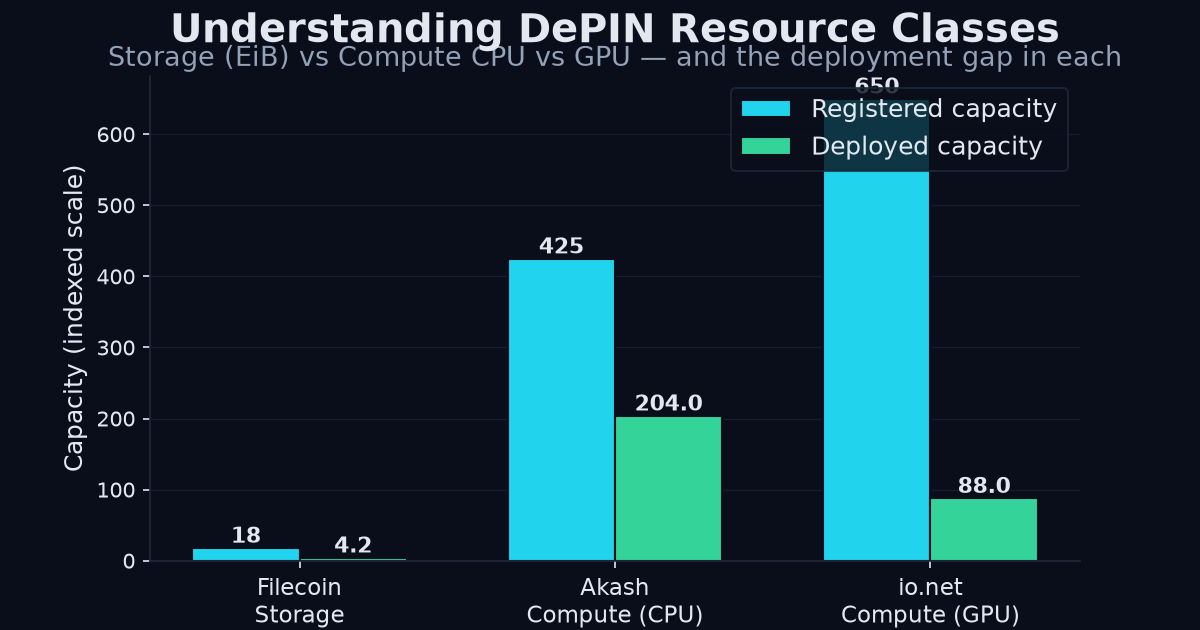
The three headline DePIN categories — storage, compute, and GPU compute — are not interchangeable, and treating them as one "DePIN sector" hides what each actually does:
- Storage (Filecoin): sells durable capacity. Its health metric is utilization — active deals over registered capacity.
- General compute (Akash): sells CPU/GPU compute on a marketplace. Its health metric is lease-matching and utilization.
- GPU compute (io.net): sells specialized accelerators for AI/ML. Its health metric is registered-vs-active GPU supply and fill rate.
Decentralized Physical Infrastructure Networks (DePIN) represent one of the fastest-growing sectors in crypto, but the data infrastructure supporting them remains fragmented and unreliable. Most DePIN dashboards and aggregators present derived or modeled estimates without verifiable provenance — making it impossible for researchers, investors, and AI agents to trust the numbers.
At Kairos Signal, we catalog DePIN networks and label which carry live data and which have first-party supply telemetry we read directly from their own API endpoints. Every value we publish carries a verify_url pointing to the exact upstream source, so any data point can be independently checked.
What We Found
Supply Telemetry Coverage
Our catalog separates:
- networks that expose first-party supply telemetry (registered capacity, active capacity, utilization)
- networks with on-chain data only (revenue, TVL, market data)
- networks with on-chain market data (price, market cap, liquidity)
- catalog-only networks — no public data feed exists
The Verification Gap
Most DePIN data aggregators present numbers without any way to verify them. When a dashboard says "io.net has 50,000 GPUs," there's no link to the source. When a report claims "Filecoin has 18 EiB of storage," you can't check when that was measured or where it came from.
We solve this by attaching a verify_url to every single value. For io.net supply data, the verify_url points to io.net's own API. For Filecoin storage metrics, it points to the Filecoin chain explorer. For market data, it points to CoinGecko or DefiLlama.
Bitcoin-Anchored Provenance
Each daily data batch is Merkle-rooted and timestamped to Bitcoin via OpenTimestamps. This creates a cryptographic proof that a specific set of data existed at a specific time — without trusting us or any third party. The Merkle root is embedded in a Bitcoin transaction, and anyone can verify that a specific data point was part of a specific batch.
Why This Matters
For AI agents: Autonomous agents need machine-readable, verifiable data to make decisions. Without verify_urls, an agent has no way to assess data quality. With them, an agent can programmatically check any value before acting on it.
For investors: DePIN investment decisions based on unverified supply metrics are speculative. Verifiable, timestamped data reduces information asymmetry and enables evidence-based allocation.
For developers: Building on a DePIN network requires understanding its actual capacity and utilization. First-party telemetry is the ground truth; everything else is hearsay.
Try It
Query our API directly:
# Full network catalog
curl https://kairossignal.com/try
Supply telemetry (free sample)
curl https://kairossignal.com/samples/depin-sample-pack.json
New registrants get $5 in free credits — no credit card required. Full API access starts at $0.99 for the network catalog and $4.99 for complete supply telemetry across every network with first-party supply data.
Get a free API key →---
This is a data product. Kairos Signal publishes no trading signals, performance returns, win rates, or accuracy claims. All values are measured facts with verifiable provenance. Measured 2026-08-17.---
Try it yourself
Query the live catalog, supply telemetry, and provenance receipts directly: /v1/networks, /v1/supply on the REST API.
Related reading: Akash network data · akash api · akash network compute pricing api how to query · compute supply across Akash, io.net, Aethir
Design-partner seats are capped at 20 at a lifetime-locked $199/mo (full API access, every published endpoint, MCP server, Bitcoin-anchored provenance). After seat 20 the price becomes $249/mo. Claim a design-partner seat → · See pricing---
Get Started With DePIN Intelligence
Kairos Signal provides verifiable, provenance-first telemetry for DePIN networks, with first-party supply data read directly from each network's own API or blockchain. Current counts are published live at /v1/networks. Every value carries a verify_url you can check yourself, and each daily batch is Merkle-rooted and anchored to Bitcoin.
Every API response is signed with ed25519 and timestamped. You can prove what was served and when, months later. That is what we mean by provenance-first.
Related reading: DePIN Intelligence Guide · DePIN Telemetry · How to Query DePIN Data · DePIN Data Verification · Pricing Correction 2026-09-25: this post called our catalog entry count a count of DePIN networks; that count includes superseded rows and Bittensor subnet rows. It has been removed, together with some present-tense coverage counts written beside it. Current coverage figures: /v1/networks.