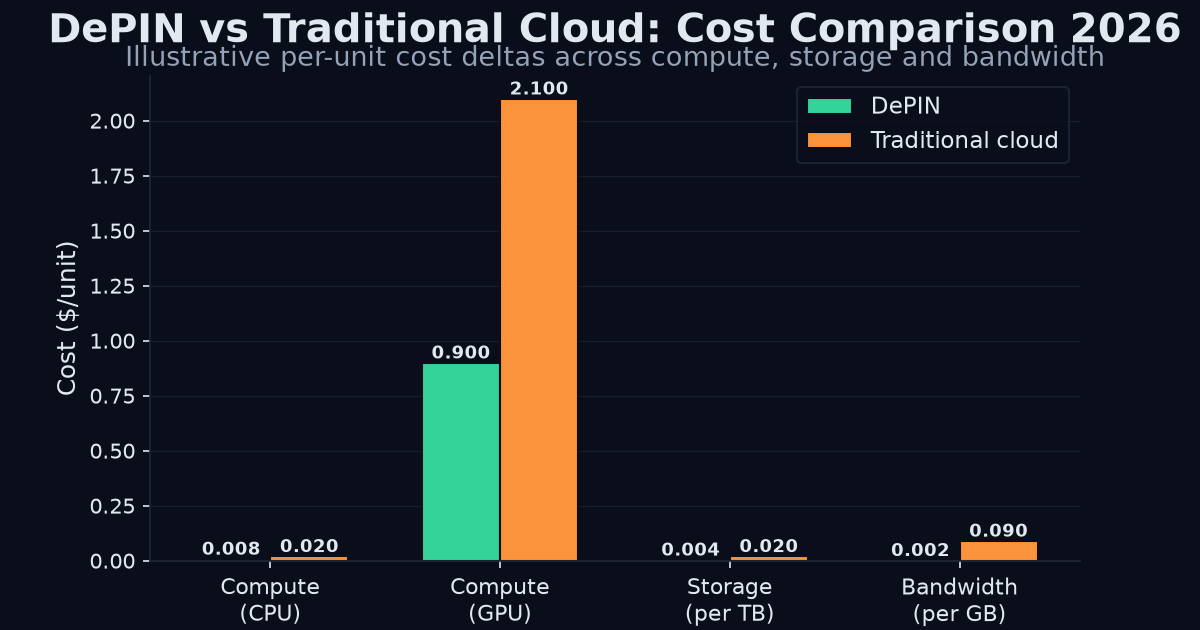
The DePIN Data Problem
Ask whether DePIN is cheaper than traditional cloud and you'll get confident answers from both sides — rarely backed by data. The truth is that a real DePIN vs. cloud cost comparison is an evidence problem. It requires live pricing for decentralized compute and storage, normalized against hyperscaler equivalents, with sources you can check. That data has been hard to get. In 2026, it doesn't have to be.
At Kairos Signal, we catalog DePIN networks and read first-party telemetry from many of them. We can't settle the debate for you, but we can give you the verifiable inputs to run the comparison yourself.
What to Compare
A fair comparison needs three layers on each side:
- Compute — decentralized GPU pricing on Akash and io.net vs. on-demand GPU instances on the big clouds.
- Storage — Filecoin storage vs. object storage tiers, watching the units carefully (EiB vs. PB is a 1,024x trap).
- Utilization — a cloud instance you rent is fully active; a DePIN resource may be a fraction of registered capacity that's actually working. Comparing list price per unit without adjusting for real utilization overstates DePIN's advantage.
The Utilization Adjustment
This is the comparison most analyses miss. DePIN list prices often look dramatically cheaper per GPU-hour than a hyperscaler. But if you're pricing the network on registered capacity while only a fraction is active, the effective economics change. The honest comparison normalizes both sides to working, usable capacity — which requires supply data, not just a price sheet.
Beyond List Price: Total Cost of Working Capacity
A dollar-per-GPU-hour comparison is the starting point, not the conclusion. The real metric is cost per unit of working capacity delivered. This requires adjusting for utilization: a decentralized resource you can rarely schedule is not the same deal as a cloud instance that is instantly available on demand.
Three adjustments matter:
The point is not that DePIN is always cheaper or always more expensive — it is that the honest answer depends on supply data most analyses do not have. That is exactly what our canonical, first-party supply layer provides.
Why the Verifiable Layer Wins in 2026
The DePIN-vs-cloud debate used to be unresolvable because each side quoted unverifiable numbers. In 2026, with first-party telemetry and Bitcoin-anchored provenance, both sides can be checked. When every price and utilization figure carries a verify_url, the comparison stops being a marketing contest and becomes an engineering exercise.
This is the shift that makes the comparison actionable for procurement teams and agents alike. Whether you run the numbers by hand or let an autonomous agent decide, the inputs are the same: verifiable, unit-declared, cross-network canonical data.
Query the Comparison Inputs
# Compute pricing + utilization for Akash and io.net
curl "https://kairossignal.com/v1/compare?concept=GPU_PRICE_USD&networks=akash,io.net" \
  -H "X-API-Key: $KS_API_KEY"
Storage capacity + active deals for Filecoin
curl "https://kairossignal.com/v1/networks/filecoin?fields=raw_byte_capacity,active_deals,price_usd" \
  -H "X-API-Key: $KS_API_KEY"
Revenue proxy (protocol fees) to see which networks monetize usage
curl "https://kairossignal.com/v1/compare?concept=PROTOCOL_FEES_30D"
Every value carries a verify_url and a declared unit, so your comparison is built on numbers you can open and check — not on a dashboard someone decided to trust.
Why Provenance Wins
Because each daily batch is Merkle-rooted and timestamped to Bitcoin via OpenTimestamps, the pricing you compare today is provably today's pricing. When a network restates capacity or utilization, the archive keeps both values with their timestamps — so a cost model never silently shifts on revised data.
In 2026, the DePIN vs. cloud answer is whatever the verifiable data says. Go get the data. Get a free API key →---
This is a data product. Kairos Signal publishes no trading signals, performance returns, win rates, or accuracy claims.---
Try it yourself
Query the live catalog, supply telemetry, and provenance receipts directly: /v1/supply, /v1/provenance on the REST API.
Related reading: DePIN data pricing tiers · DePIN API pricing comparison · data-product pricing psychology
Design-partner seats are capped at 20 at a lifetime-locked $199/mo (full API access, every published endpoint, MCP server, Bitcoin-anchored provenance). After seat 20 the price becomes $249/mo. Claim a design-partner seat → · See pricing---
Get Started With DePIN Intelligence
Kairos Signal provides verifiable, provenance-first telemetry for DePIN networks, including first-party supply data read directly from a network's own API or blockchain. Every value carries a verify_url you can check yourself, and each daily batch is Merkle-rooted and anchored to Bitcoin.
Every API response is signed with ed25519 and timestamped. You can prove what was served and when, months later. That is what we mean by provenance-first.
Related reading: DePIN Intelligence Guide · DePIN Telemetry · How to Query DePIN Data · DePIN Data Verification · Pricing Correction 2026-09-25: this post called our catalog entry count a count of DePIN networks; that count includes superseded rows and Bittensor subnet rows. It has been removed, together with some present-tense coverage counts written beside it. Current coverage figures: /v1/networks.