The DePIN Data Problem
Why the Unit Is Half the Story
Getting Filecoin's unit right is necessary but not sufficient — you also need the right metric. "Storage capacity" can mean raw byte power, quality-adjusted power, active deal capacity, or pledged capacity. These answer different questions:
- Raw power — total physical capacity.
- Quality power — capacity weighted for useful, verified deals; determines consensus and rewards.
- Active deal capacity — capacity actually under a live storage deal.
The PiB/EiB Conversion Trap
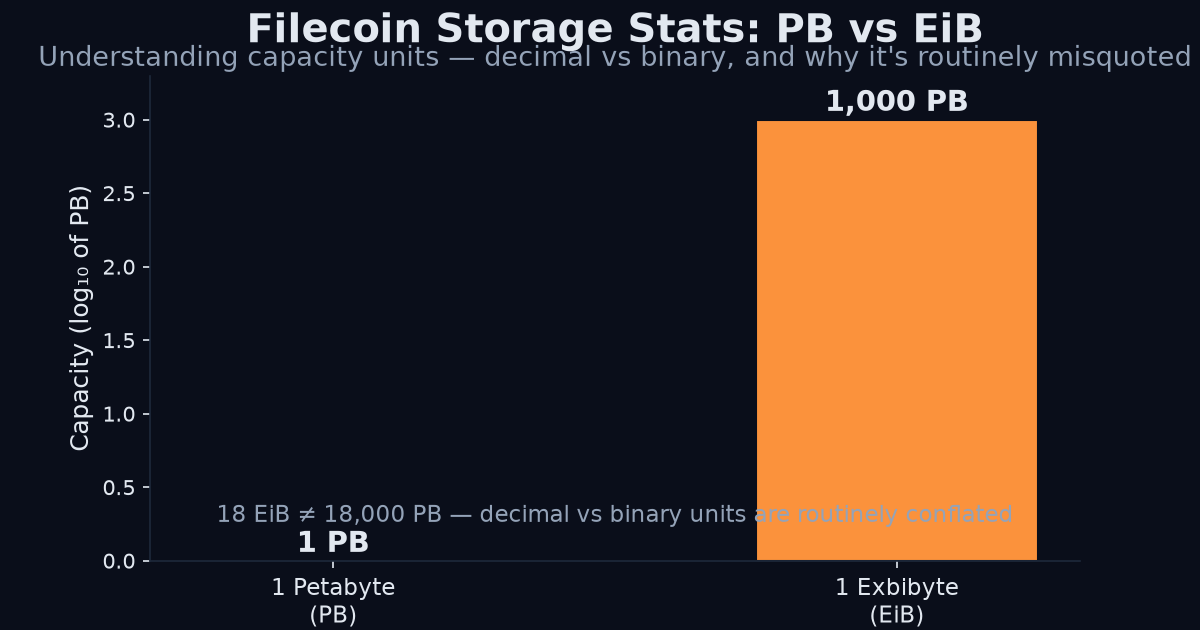
One EiB equals 1024 PiB. A dashboard that reads raw power in EiB and displays it as petabytes is off by three orders of magnitude. When we normalize Filecoin's native fields, we carry the declared unit through the entire pipeline — so a consumer never has to guess whether a number is PiB or EiB, and never silently corrupts a downstream comparison.
Filecoin storage stats are some of the most-misquoted numbers in all of DePIN. A headline says "Filecoin has 18 EiB of storage" and the next post repeats it as "18,000 PB" — or worse, drops the unit entirely and says "18" as if that were meaningful. The units aren't decorative. Getting them wrong is not a rounding error; it's a 1,024x mistake.
Filecoin's scale is part of why this keeps happening. An exbibyte (EiB) is 1,024 pebibytes (PiB), which is 1,024 tebibytes (TiB). When a network stores multiple EiB of data, it's natural to want to write it in smaller units to make the numbers look relatable — and that's exactly where the confusion begins.
The Unit Trap in Filecoin Storage Stats
There are two systems in play, and mixing them is the classic error:
- Decimal (SI): PB = 10¹⁵ bytes. GB, TB, PB, EB.
- Binary (IEC): PiB = 2⁵⁰ bytes. GiB, TiB, PiB, EiB.
Reading Filecoin Capacity Correctly
The Filecoin stats that matter, each with its unit declared:
- Raw byte capacity — the total pledged storage, in EiB or PiB.
- Active deals — storage actually committed to clients, in PiB/TiB.
- Network storage power — the quality-adjusted power that governs rewards.
Query Filecoin Storage Stats Yourself
# Filecoin supply + storage telemetry
curl "https://kairossignal.com/v1/networks/filecoin" \
  -H "X-API-Key: $KS_API_KEY"
Capacity fields with declared units
curl "https://kairossignal.com/v1/networks/filecoin?fields=raw_byte_capacity,active_deals,network_power"
Cross-network storage comparison (Filecoin vs. Storj vs. Arweave)
curl "https://kairossignal.com/v1/compare?concept=STORAGE_CAPACITY&networks=filecoin,storj,arweave"
Every field carries a verify_url pointing at the Filecoin chain explorer or the network's own API — and a declared unit so "PiB" never silently becomes "PB" in your pipeline.
Why It Matters
For developers sizing storage workloads, the unit error translates directly into an infrastructure decision made on a wrong number. For investors, capacity is the headline metric for storage DePIN — and it's worthless without the correct unit and source. Because each daily batch is Merkle-rooted and timestamped to Bitcoin via OpenTimestamps, the capacity figure you read is provably the figure published that day.
Filecoin storage stats are only trustworthy when every number carries a unit and a source. Get a free API key →---
This is a data product. Kairos Signal publishes no trading signals, performance returns, win rates, or accuracy claims.---
Try it yourself
Query the live catalog, supply telemetry, and provenance receipts directly: /v1/supply, /v1/provenance on the REST API.
Related reading: Filecoin data API · filecoin storage capacity api how to query petabytes · DePIN infrastructure data · DePIN Intelligence guide
Design-partner seats are capped at 20 at a lifetime-locked $199/mo (full API access, every published endpoint, MCP server, Bitcoin-anchored provenance). After seat 20 the price becomes $249/mo. Claim a design-partner seat → · See pricing---
Get Started With DePIN Intelligence
Kairos Signal provides verifiable, provenance-first telemetry for DePIN networks, including first-party supply data read directly from a network's own API or blockchain. Every value carries a verify_url you can check yourself, and each daily batch is Merkle-rooted and anchored to Bitcoin.
Every API response is signed with ed25519 and timestamped. You can prove what was served and when, months later. That is what we mean by provenance-first.
Related reading: DePIN Intelligence Guide · DePIN Telemetry · How to Query DePIN Data · DePIN Data Verification · Pricing