The DePIN Data Problem
The Three Layers of Any DePIN
For a developer, a DePIN is best understood as three layers that need to be integrated separately:
Most DePIN tooling stops at layer two — token prices, market caps, transfer volume. The hardest part is layer three: turning the physical network's telemetry into comparable, verifiable data. That is where the real engineering lives, and it is the layer a data API exists to solve.
Why Developers Should Care
If you are building on a DePIN — a job scheduler, a storage client, a coverage map, an analytics dashboard — you need layer-three data that you can trust. A supply figure with no source is a claim; a node count that conflates registered and active is misleading; a zero-filled missing value is a lie. The difference between a hobby project and a production integration is whether your data layer is canonical, verifiable, and honest about its gaps.
If you're a developer encountering DePIN for the first time, the biggest obstacle isn't the technology — it's figuring out what's real. Decentralized Physical Infrastructure Networks (DePIN) use crypto tokens to incentivize people to build physical infrastructure: wireless networks, storage arrays, GPU compute, sensors. That part is straightforward. What's confusing is the data: every network claims huge capacity, and none of the claims are easy to verify.
Let's clear that up. Here's what DePIN actually is, how the major networks work, and the one thing every developer should understand before building on top of it.
What DePIN Is
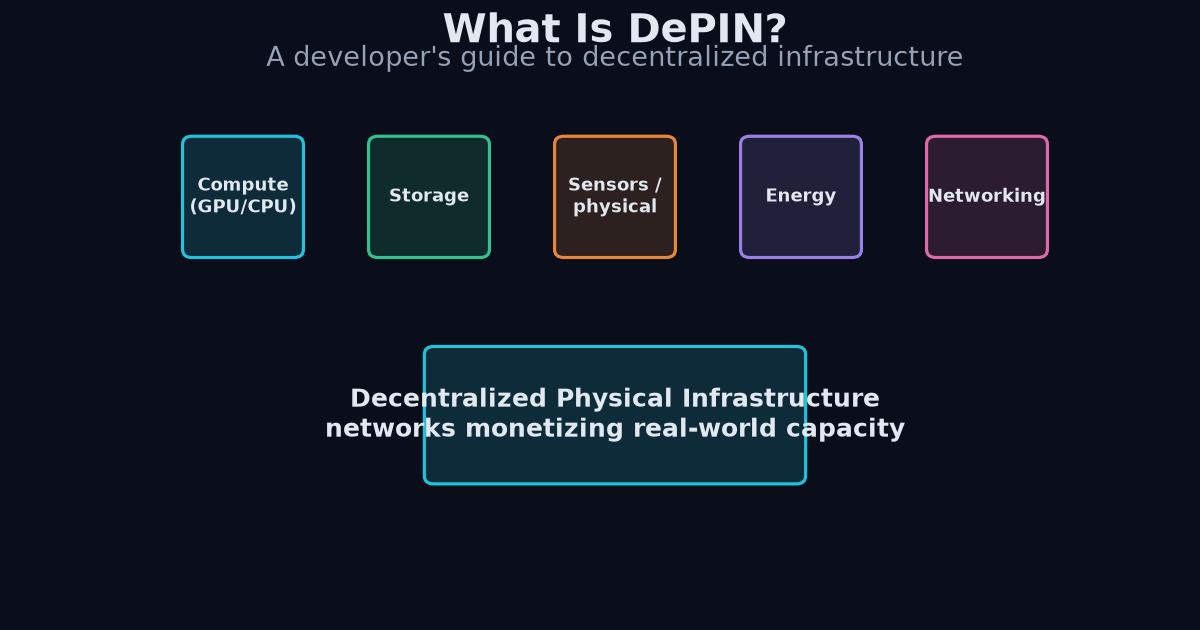
DePIN replaces a centralized owner of infrastructure with a token-incentivized crowd. Instead of one company deploying millions of hotspots, DePIN pays individuals to deploy them. Instead of one cloud provider building data centers, DePIN pays anyone to connect GPUs or disk. The network coordinates supply through an open ledger, and the token is both the incentive and the accounting.
The four big resource classes:
- Compute — Akash (decentralized cloud), io.net and Render (GPU networks for AI and rendering), Aethir (GPU-as-a-service).
- Storage — Filecoin (archival storage), Storj (object storage), Arweave (permanent storage).
- Wireless — Helium (IoT and mobile coverage from user hotspots).
- Sensors — crowdsourced physical data networks.
What Every Developer Should Understand: Supply Data
Here's the core concept: a DePIN's health is measured by its supply — how much capacity exists, and how much is actually active. But the number a network advertises is usually registered capacity, which is not the same as what's working. The gap between registered and active supply is the single most important metric in DePIN, and it's almost never in the headline.
That's why developers who build on DePIN — whether to rent GPUs, store data, or integrate with a network's API — need supply data that separates registered from active, declares its units, and points at a source.
Query DePIN Data Like a Developer
# Explore the network catalog (free sample)
curl https://kairossignal.com/samples/depin-sample-pack.json
Compare compute supply across Akash, io.net, and Render
curl "https://kairossignal.com/v1/compare?concept=GPU_ACTIVE&networks=akash,io.net,render" \
  -H "X-API-Key: $KS_API_KEY"
Check storage capacity for Filecoin with declared units
curl "https://kairossignal.com/v1/networks/filecoin?fields=raw_byte_capacity,active_deals" \
  -H "X-API-Key: $KS_API_KEY"
Every value carries a verify_url to its upstream source and a declared unit. We catalog DePIN networks and label which carry live data and which carry first-party supply telemetry.
Why Provenance Matters to a Developer
When you build on DePIN, you inherit its data. A supply figure without a source and a unit is a bug waiting to happen. Because we Merkle-root each daily batch and timestamp it to Bitcoin via OpenTimestamps, the number you build against today is provably the number published today — and the archive holds point-in-time values you can backtest against honestly.
DePIN is infrastructure you can rent from a crowd. Start by understanding its supply data, and you'll build on something you can trust. Get a free API key →---
This is a data product. Kairos Signal publishes no trading signals, performance returns, win rates, or accuracy claims.---
Try it yourself
Query the live catalog, supply telemetry, and provenance receipts directly: /v1/supply, /v1/provenance on the REST API.
Related reading: the DePIN developer guide · how to query DePIN data with curl · depin data documentation · DePIN RPC endpoints across chains
Design-partner seats are capped at 20 at a lifetime-locked $199/mo (full API access, every published endpoint, MCP server, Bitcoin-anchored provenance). After seat 20 the price becomes $249/mo. Claim a design-partner seat → · See pricing---
Get Started With DePIN Intelligence
Kairos Signal provides verifiable, provenance-first telemetry for DePIN networks, including first-party supply data read directly from a network's own API or blockchain. Every value carries a verify_url you can check yourself, and each daily batch is Merkle-rooted and anchored to Bitcoin.
Every API response is signed with ed25519 and timestamped. You can prove what was served and when, months later. That is what we mean by provenance-first.
Related reading: DePIN Intelligence Guide · DePIN Telemetry · How to Query DePIN Data · DePIN Data Verification · Pricing Correction 2026-09-25: this post called our catalog entry count a count of DePIN networks; that count includes superseded rows and Bittensor subnet rows. It has been removed, together with some present-tense coverage counts written beside it. Current coverage figures: /v1/networks.