The DePIN Data Problem
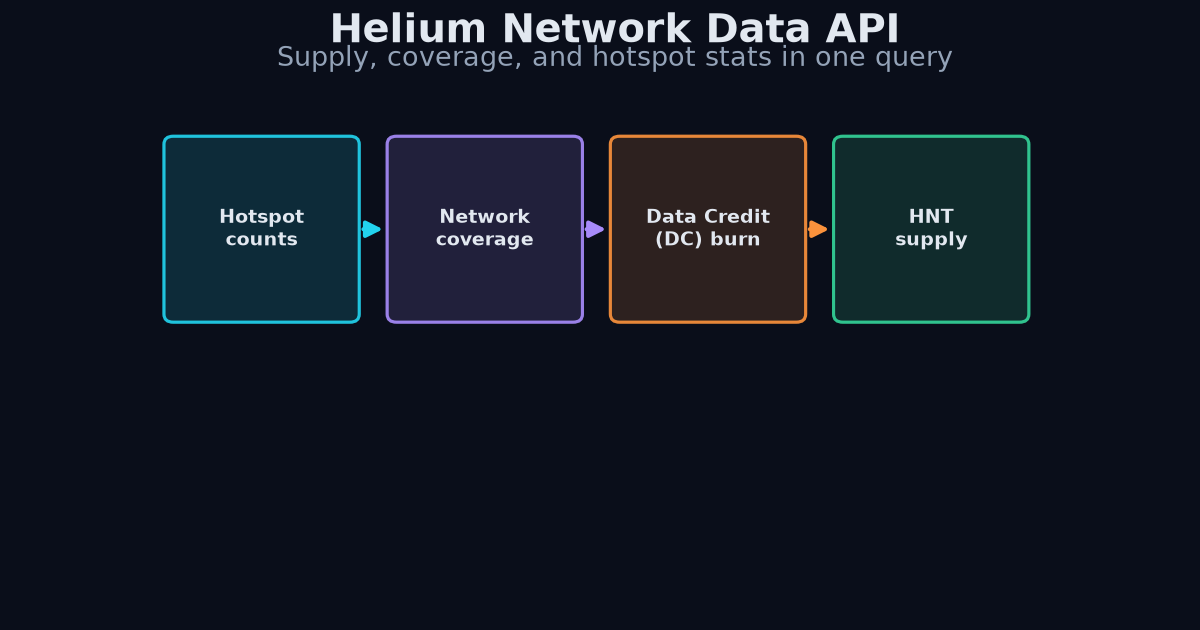
Helium is the oldest and most mature DePIN network, yet reliable Helium network data is surprisingly hard to get programmatically. Hotspot counts, coverage, Data Credits (DC) burn, and token supply live on different endpoints with different field names and different freshness. Pull them all together yourself and you spend your day writing parsers instead of building on the network.
The goal of a Helium network data API should be simple: give a developer the supply, coverage, and hotspot stats they need in one canonical, verifiable response.
What to Track on Helium
The metrics that matter for assessing Helium split into three layers:
- Supply — HNT circulating and max supply, plus DC minted/burned. DC burn is the closest thing Helium has to revenue, because DC represents actual usage of the network.
- Coverage — the geographic footprint of hotspots and the proof-of-coverage (PoC) receipts that attest they're honestly placed.
- Hotspot stats — total hotspots, online vs. offline, and reward scales per hotspot.
Normalizing Helium Data
We map Helium's native fields into canonical concepts with declared units and comparability grades. HOTSPOTS_TOTAL, HOTSPOTS_ONLINE, and DC_BURN_24H become concepts an agent can compare across networks — even though the raw field names and sources differ. Every cell carries a verify_url so you can jump to the exact upstream record.
Why Coverage Data Is the Hardest Part
Coverage is the layer where most Helium data products quietly fail. A hotspot's location is self-reported, which means raw hotspot coordinates are a claim, not a measurement. Proof-of-coverage (PoC) receipts — the attestations that a hotspot is honestly placed and not gaming rewards — are the closest thing Helium has to ground truth, and they are the right denominator for any serious coverage analysis.
If you map hotspots purely by self-reported location, you inherit whatever gaming and misplacement exists in the network. If you weight by PoC receipts and reward scales, you get a coverage picture that reflects actual participation. The difference is material for anyone building coverage maps, market-entry analysis, or agent-driven deployment decisions.
At Kairos Signal we surface both — raw hotspot coordinates and the PoC/reward context — so your tooling can decide which denominator is appropriate, rather than baking a single assumption into your pipeline.
Comparing Helium to Other DePINs
Because Helium's native fields (HOTSPOTS_TOTAL, HOTSPOTS_ONLINE, DC_BURN_24H) map into the same canonical concepts used across other networks, you can compare Helium's supply and utilization against, say, a storage network or a weather-sensor network in a single query. The same devices_total, nodes_online, and liveness_ratio concepts apply. This cross-network comparability is what turns Helium from an island of data into one node in a unified DePIN intelligence layer.
Query It Yourself
# Helium supply + market data
curl "https://kairossignal.com/v1/networks/helium" \
  -H "X-API-Key: $KS_API_KEY"
Hotspot and coverage telemetry from first-party sources
curl "https://kairossignal.com/v1/networks/helium?fields=hotspots_total,hotspots_online,dc_burn_24h"
Cross-network comparison of supply and revenue concepts
curl "https://kairossignal.com/v1/compare?network=helium&concept=DC_BURN_24H"
Each response field carries a verify_url pointing to the Helium explorer or the network's own API. You never have to take our word for a number — you can open the source and compare.
Why It Matters
For developers building location-verification or IoT tooling on Helium, coverage data is ground truth. For investors, DC burn is the closest proxy to real demand. And for AI agents, canonical, verifiable Helium network data means a decision loop that checks its inputs instead of trusting a scraped dashboard.
Because every daily batch is Merkle-rooted and timestamped to Bitcoin via OpenTimestamps, the hotspot count you read today is provably the count published today — and tomorrow's archive still holds today's value.
Get a free API key →---
This is a data product. Kairos Signal publishes no trading signals, performance returns, win rates, or accuracy claims.---
Try it yourself
Query the live catalog, supply telemetry, and provenance receipts directly: /v1/supply, /v1/provenance on the REST API.
Related reading: how to access helium network supply data programmatically · how we read supply telemetry from 296 networks · the DePIN developer guide · how to query DePIN data with curl
Design-partner seats are capped at 20 at a lifetime-locked $199/mo (full API access, every published endpoint, MCP server, Bitcoin-anchored provenance). After seat 20 the price becomes $249/mo. Claim a design-partner seat → · See pricing---
Get Started With DePIN Intelligence
Kairos Signal provides verifiable, provenance-first telemetry for DePIN networks, including first-party supply data read directly from a network's own API or blockchain. Every value carries a verify_url you can check yourself, and each daily batch is Merkle-rooted and anchored to Bitcoin.
Every API response is signed with ed25519 and timestamped. You can prove what was served and when, months later. That is what we mean by provenance-first.
Related reading: DePIN Intelligence Guide · DePIN Telemetry · How to Query DePIN Data · DePIN Data Verification · Pricing