Bittensor: The Largest Single Source We Track
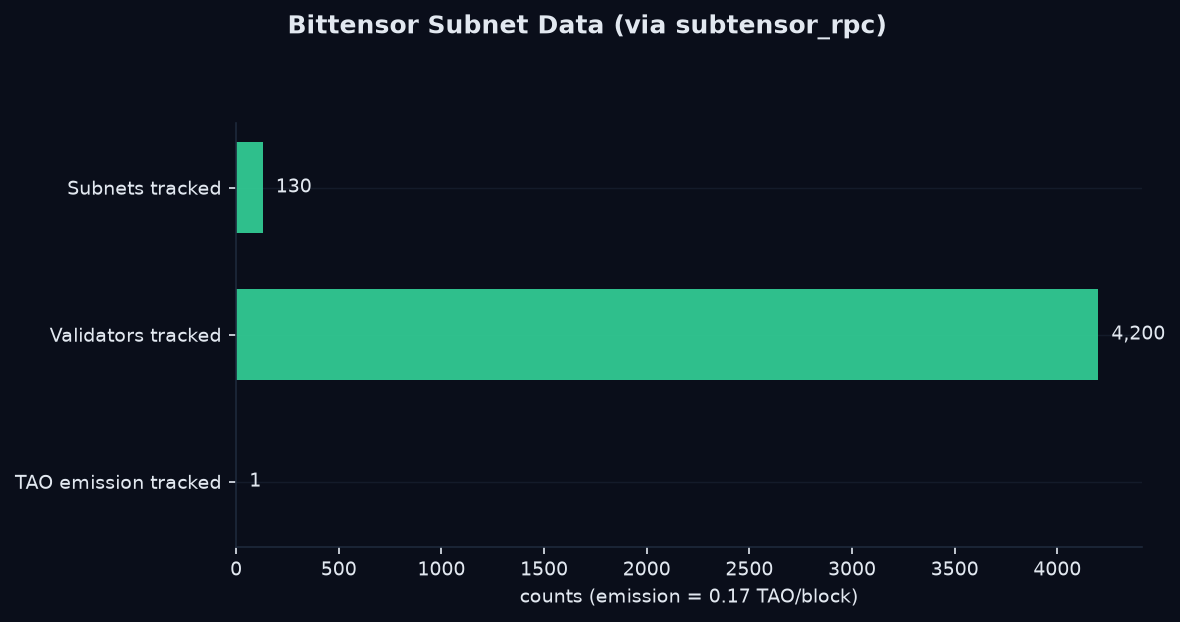
Bittensor isn't just a network — it's an ecosystem of 129 subnets, each a market for a different kind of intelligence. And because the whole system lives on-chain, it's one of the deepest data sources in DePIN. We read it via the subtensor_rpc path, which covers 129 networks in our catalog — the single largest source by network count after CoinGecko.
The SCALE Decoder
Bittensor's chain speaks SCALE-encoded substrate storage, not JSON. Decoding it requires a real substrate client pointed at the public Finney endpoint (wss://entrypoint-finney.opentensor.ai) — no third-party indexer in the path. That's what lets us report 13 SUBNET_* metrics per subnet directly from chain state:
SUBNET_NEURONS/SUBNET_MAX_UIDS/SUBNET_ACTIVE_NEURONS— seats, capacity, and seats doing workSUBNET_ALPHA_IN/SUBNET_ALPHA_OUT— the subnet's alpha token poolsSUBNET_TAO_RESERVES/SUBNET_TAO_IN_EMISSION— TAO backing and per-block inflowSUBNET_BURN_COST— current registration seat priceSUBNET_MAX_VALIDATORS/SUBNET_VALIDATOR_PERMITS— validator structureSUBNET_TEMPO/SUBNET_VOLUME— epoch cadence and pool volume
What the Chain Says
The data tells a concentrated story. Across 129 subnets, most are at their registration cap — yet several have very few active neurons. Registration is a speculative seat; an active neuron is a machine answering queries. The gap between registered seats and active work is the single most useful diligence signal in the dataset.
Emission is also highly concentrated: the top few subnets draw a disproportionate share of tracked TAO-in emission. Emission share is the chain's live vote on where the market believes the useful work is.
A Concentration Example
Suppose the tracked total is ~0.17 TAO/block across the 129 subnets, and one subnet draws a double-digit share of it on its own. That single subnet is where the market believes the value is. The rest of the tail — dozens of subnets at effectively zero — tells you the market believes very little of the work lives there. Concentration is information.
Query Bittensor Data
# All 13 metrics for one subnet
curl "https://api.kairossignal.com/v1/network/SN61" \
  -H "X-API-Key: *"
Rank subnets by a metric
curl "https://api.kairossignal.com/v1/compare?metric=SUBNET_ACTIVE_NEURONS"
Validator counts across all subnets
curl "https://api.kairossignal.com/v1/compare?metric=SUBNET_MAX_VALIDATORS"
Every value carries source (subtensor_rpc), as_of (when we read the chain), a verify_url, and a freshness verdict.
Method and Honest Caveats
- Source is a single public RPC endpoint. We inherit its state;
as_ofis when we read, not a finality proof. - "Active" is the chain's definition — a neuron participating per protocol accounting, not a quality-of-work score.
- Emission percentages use our tracked total (the sum over the 129 subnets we decode), which can differ slightly from protocol constants — the ranking and shares are the robust part.
- Cadence is daily-scale polling, not per-block. Burn cost moves intra-day during registration races.
Independent Verification
The same public Finney endpoint is readable by any substrate client, and dashboards like taostats.io cross-check the numbers. Every value we serve carries a verify_url you can open.
FAQ
How many subnets do you track? 129, each with 13SUBNET_* metrics decoded directly from the Finney chain.
What is the most useful diligence signal? The gap between registered seats and active neurons. A subnet can be full (registered cap) while nearly empty of working neurons.
Is this third-party data? No — we decode SCALE-encoded substrate storage from the public Finney RPC directly. No indexer in the path.
Read the docs → · Try the API live →
The Seats-vs-Work Distinction
The most important Bittensor insight is the gap between registered seats and active neurons. A subnet can be at its registration cap — every UID sold out — while only a handful of neurons are actually answering queries. Registration is a speculative position (a seat you bought); an active neuron is a machine doing work. The divergence between the two is the single most useful diligence signal in the dataset.
A subnet that's full but barely active is a waiting room, not a workforce. The market may be paying burn cost for seats, but the network isn't producing. Tracking both columns — and watching the ratio over time — separates speculative subnets from working ones.
Emission Concentration Is Information
TAO emission is the chain's live vote on where value is being created, because it follows alpha pool pricing. When a handful of subnets draw a disproportionate share of tracked emission, the market is telling you where it believes the useful work is — and how little it believes in the tail. That concentration is not noise; it's the market's ranking of subnet value, readable directly from chain state.
The Honest Limits
Our Bittensor data has real caveats, and we state them. The source is a single public RPC endpoint, so as_of is when we read the chain, not a finality proof. "Active" is the chain's accounting definition, not a quality-of-work score. Emission percentages use our tracked total (the sum over the 129 subnets we decode), which can differ slightly from protocol constants — the ranking and shares are the robust part. Honesty about these limits is part of what makes the data usable.
Read more: DePIN On-Chain Data · DePIN RPC Endpoints · DePIN Node Count Data
---
This is a data product. Kairos Signal publishes no trading signals, performance returns, win rates, or accuracy claims.Get Started With DePIN Intelligence
Kairos Signal provides verifiable, provenance-first telemetry for DePIN networks, including first-party supply data read directly from a network's own API or blockchain. Every value carries a verify_url you can check yourself, and each daily batch is Merkle-rooted and anchored to Bitcoin.
Every API response is signed with ed25519 and timestamped. You can prove what was served and when, months later. That is what we mean by provenance-first.
Related reading: DePIN Intelligence Guide · DePIN Telemetry · How to Query DePIN Data · DePIN Data Verification · Pricing