Node Count: The Most Abused Metric in DePIN
Every DePIN network quotes a node count, and nearly all of them quote the number that makes them look biggest. The result is a market awash in inflated, unverifiable node claims. The whole point of node count data is to cut through that with numbers you can check.
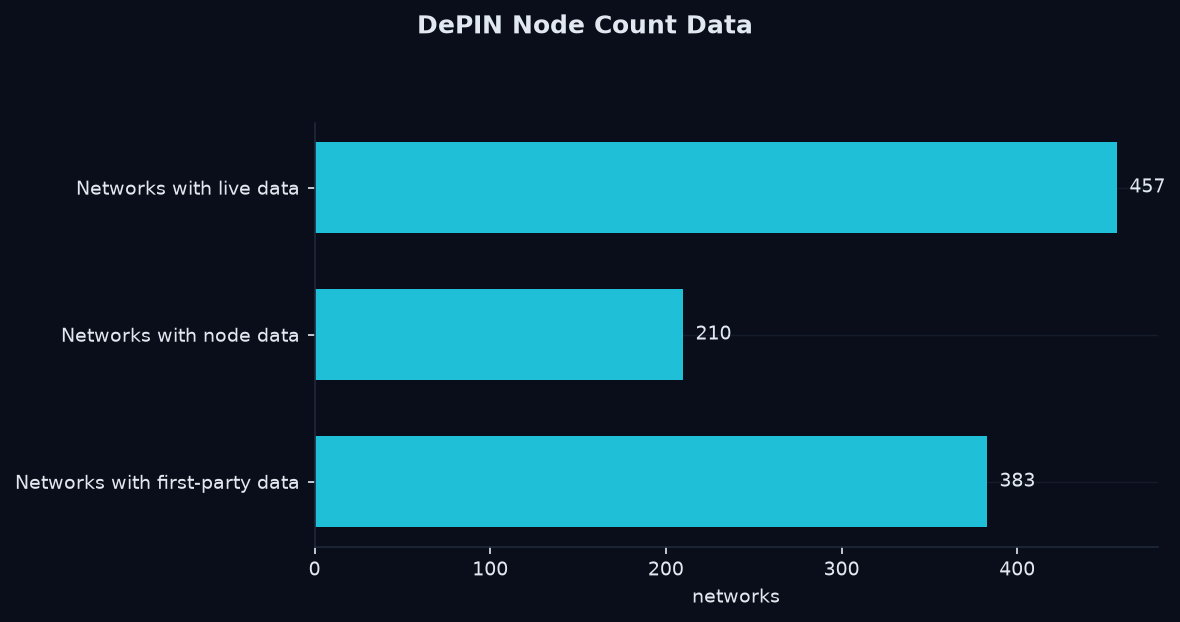
At Kairos Signal we track verifiable active node counts across the 372 networks we serve live data for. Verifiable means the count traces to a first-party source — the network's own API, its RPC chain, or a first-party stats endpoint — and carries a verify_url.
Registered vs Active: The Two Counts
The single most important distinction in node data:
- Registered / total nodes — what the network's registry advertises.
- Active / earning nodes — what is actually online and doing work.
A Worked Example
Consider a network reporting 50,000 registered nodes and 12,000 active. A marketing page will quote 50,000. A diligence analysis needs both: the 50,000 is potential capacity, the 12,000 is current reality. If you're buying into utilization or fee growth, the active number is the one that matters — and knowing both is what separates real data from vanity metrics.
Coverage Across the Category
Node data is uneven across DePIN categories. Compute networks (Akash, io.net, Render) publish active node telemetry because they need it to run. Storage networks (Filecoin, Storj) track providers and storage nodes on-chain. Sensor and wireless networks often publish dashboards with no API, which pushes their counts toward the catalog-only tier.
That's why our coverage tiers matter: 296 networks have first-party telemetry (where node counts are most trustworthy), 78 are on-chain market only, and 339 are catalog-only with no verifiable count.
Query Node Count Data
# Active nodes for one network
curl "https://api.kairossignal.com/v1/networks/{network}?fields=nodes_active" \
  -H "X-API-Key: *"
Compare node counts across a category
curl "https://api.kairossignal.com/v1/compare?concept=NODES_ACTIVE&category=compute"
Rank networks by active nodes
curl "https://api.kairossignal.com/v1/compare?metric=NODES_ACTIVE&sort=desc"
Every value carries source, as_of, verify_url, and a freshness verdict. Open the verify URL and confirm the count yourself — no trusting the provider.
The Integrity Principle
Node count is where "provenance or silence" matters most, because it's where the market is most dishonest. If we can't point to the exact endpoint a node count came from, we don't serve it. We'd rather omit a node count than present an inflated one. Daily batches are Merkle-rooted and timestamped to Bitcoin via OpenTimestamps, so a historical node count is provably the value that was true that day.
Why Active Beats Registered for Diligence
For diligence, active is the decision-relevant number. It reflects the workforce actually earning, which drives fees and utilization. Registered is context — it tells you the ceiling. Basing an investment thesis on registered node counts means building on the network's own marketing, which is exactly what verifiable data exists to correct.
FAQ
What is the difference between registered and active nodes? Registered is what the network advertises; active is what's online and working. The gap is the utilization signal. Why are node counts so inflated? Because most networks quote their biggest number. Verifiable data traces the count to a first-party source with averify_url.
Can I verify a node count? Yes — every value carries a verify_url pointing at the network's own telemetry or chain.
Explore node data → · Get a free key →
A Worked Diligence Sweep
A practical use of node count data is the cross-category sweep. Pull the NODES_ACTIVE concept across a category, then pull NODES_REGISTERED, and compute the ratio. The networks with the highest active-to-registered ratios are the ones with the most working capacity relative to their advertising; the lowest are carrying the most idle inventory. That single ranked table is one of the highest-signal views in DePIN diligence.
Why Registered Is Still Useful
Registered counts aren't worthless — they define the ceiling. A network with 100k registered and 20k active has a large pool of potential capacity that could be activated, which matters for future supply. The skill is reading both: registered for the ceiling and potential, active for the current reality. A network with a big registered base and growing active count is genuinely scaling; one with a big registered base and flat active count is accumulating idle inventory.
Read more: DePIN Telemetry · Bittensor Subnet Data · io.net GPU Data
---
This is a data product. Kairos Signal publishes no trading signals, performance returns, win rates, or accuracy claims.---
Try it yourself
Query the live catalog, supply telemetry, and provenance receipts directly: /v1/supply, /v1/provenance on the REST API.
Related reading: how we read supply telemetry from 296 networks · why registered capacity is not deployed capacity · DePIN infrastructure data · DePIN Intelligence guide
Design-partner seats are capped at 20 at a lifetime-locked $199/mo (full API access, every published endpoint, MCP server, Bitcoin-anchored provenance). After seat 20 the price becomes $249/mo. Claim a design-partner seat → · See pricing---
Get Started With DePIN Intelligence
Kairos Signal provides verifiable, provenance-first telemetry for DePIN networks, including first-party supply data read directly from a network's own API or blockchain. Every value carries a verify_url you can check yourself, and each daily batch is Merkle-rooted and anchored to Bitcoin.
Every API response is signed with ed25519 and timestamped. You can prove what was served and when, months later. That is what we mean by provenance-first.
Related reading: DePIN Intelligence Guide · DePIN Telemetry · How to Query DePIN Data · DePIN Data Verification · Pricing