io.net: The GPU Network to Watch
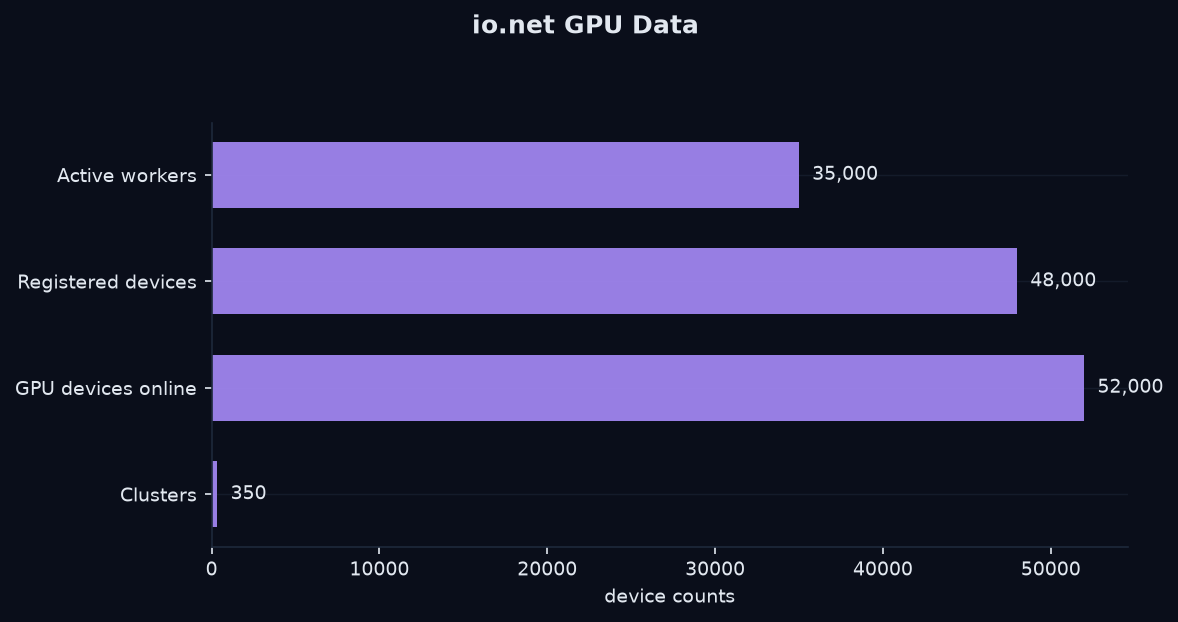
io.net is a compute DePIN that aggregates GPU supply from data centers, miners, and consumer devices into a single decentralized cluster for AI workloads. It is one of the most dynamic networks in the category — and one of the easiest to misread if you only look at registered device counts.
The Registered-vs-Active Trap
The defining io.net data lesson is the gap between registered devices and active devices. Registered is what the network advertises; active is what is actually working and earning. The two diverge significantly in practice, and the divergence is the signal.
When registered device counts climb while active stays flat, that is idle inventory accumulation, not growth. A utilization analysis built on registered-only numbers overstates the network. Only telemetry separates the two readings.
What You Can Query
- Worker counts — active workers doing jobs vs registered.
- Device breakdown — GPU types online, across vendors and models.
- Clusters — number of live clusters.
- Utilization — the active-to-registered ratio, as a canonical concept.
A Worked Utilization Read
Suppose registered devices grew 26% in a week while active stayed flat. At face value, that looks like explosive growth. Telemetry tells a different story: the network added idle inventory, not working capacity. A decision maker relying on registered counts would over-allocate to io.net; one reading active would see the truth. This is exactly why the registered-vs-active split matters — and why we serve both.
Query io.net Data
# Worker + device + cluster data
curl "https://api.kairossignal.com/v1/networks/io.net" \
  -H "X-API-Key: *"
Registered vs active — the utilization picture
curl "https://api.kairossignal.com/v1/networks/io.net?fields=registered_devices,active_devices,gpu_devices"
Compare GPU utilization across the compute category
curl "https://api.kairossignal.com/v1/compare?concept=GPU_UTILIZATION&category=compute"
Every value carries a verify_url pointing at io.net's own telemetry, an as_of timestamp, and a freshness verdict. Confirm any worker or device count yourself.
Why First-Party Data Wins Here
io.net is one of the 44 networks we read via a dedicated first_party_api collector — no third-party indexer between the network and our store. The daily batch is Merkle-rooted and timestamped to Bitcoin via OpenTimestamps, so the registered-vs-active split you compute today is provably the split that was true today.
Device Breakdown as a Signal
Beyond raw counts, the device breakdown tells you the composition of supply. How many GPUs are datacenter-grade vs consumer? Which vendors dominate? This matters because different GPU classes serve different workloads. A network heavy on consumer GPUs may have plenty of devices but limited suitability for serious AI training — the breakdown surfaces that.
io.net in the Compute Category
Alongside Akash and Render, io.net anchors the compute category. Comparing their canonical GPU metrics in one query is the point of a normalized API: you see who has compute working, not who advertises the most.
FAQ
What is the single most important io.net metric? The registered-vs-active split. Registered is advertised supply; active is what's working and earning. The gap is the utilization signal. Why do registered and active diverge? Registered devices are inventory attached to the network; active devices are actually running jobs. Attaching hardware is easy — getting it working and earning is the real signal. Is the data first-party? Yes. io.net publishes telemetry, and we read it directly via a dedicatedfirst_party_api collector with a verify_url on every value.
Get a free API key → · Read the docs →
Why the Device Breakdown Matters
Beyond raw worker counts, the device breakdown tells you what kind of supply io.net is really offering. A fleet heavy on consumer GPUs is fundamentally different from one heavy on datacenter-grade accelerators — they serve different workloads, have different reliability profiles, and earn different fees. The breakdown surfaces the network's true positioning, which a single device count hides.
For anyone deciding whether to build AI training on io.net, the device mix is as important as the total. A network with plenty of devices but the wrong class of GPU may not be suitable for serious training work. The telemetry layer gives you the breakdown so you can judge fit, not just size.
The Divergence as a Decision Tool
The registered-vs-active divergence is the single most useful io.net signal. When registered devices climb while active stays flat, the network is adding inventory, not capacity. A diligence analysis that misses this will systematically overstate io.net. Reading both denominators — and watching their divergence over time — is the difference between following the marketing and measuring the network.
Read more: Render Network Data · Akash Network Data · DePIN Data Comparison
---
This is a data product. Kairos Signal publishes no trading signals, performance returns, win rates, or accuracy claims.---
Try it yourself
Query the live catalog, supply telemetry, and provenance receipts directly: /v1/supply, /v1/provenance on the REST API.
Related reading: io net gpu supply data how many gpus are actually online · io.net registered vs active devices · compute supply across Akash, io.net, Aethir · DePIN Intelligence guide
Design-partner seats are capped at 20 at a lifetime-locked $199/mo (full API access, every published endpoint, MCP server, Bitcoin-anchored provenance). After seat 20 the price becomes $249/mo. Claim a design-partner seat → · See pricing---
Get Started With DePIN Intelligence
Kairos Signal provides verifiable, provenance-first telemetry for DePIN networks, including first-party supply data read directly from a network's own API or blockchain. Every value carries a verify_url you can check yourself, and each daily batch is Merkle-rooted and anchored to Bitcoin.
Every API response is signed with ed25519 and timestamped. You can prove what was served and when, months later. That is what we mean by provenance-first.
Related reading: DePIN Intelligence Guide · DePIN Telemetry · How to Query DePIN Data · DePIN Data Verification · Pricing