Render: GPU for Creative and AI Workloads
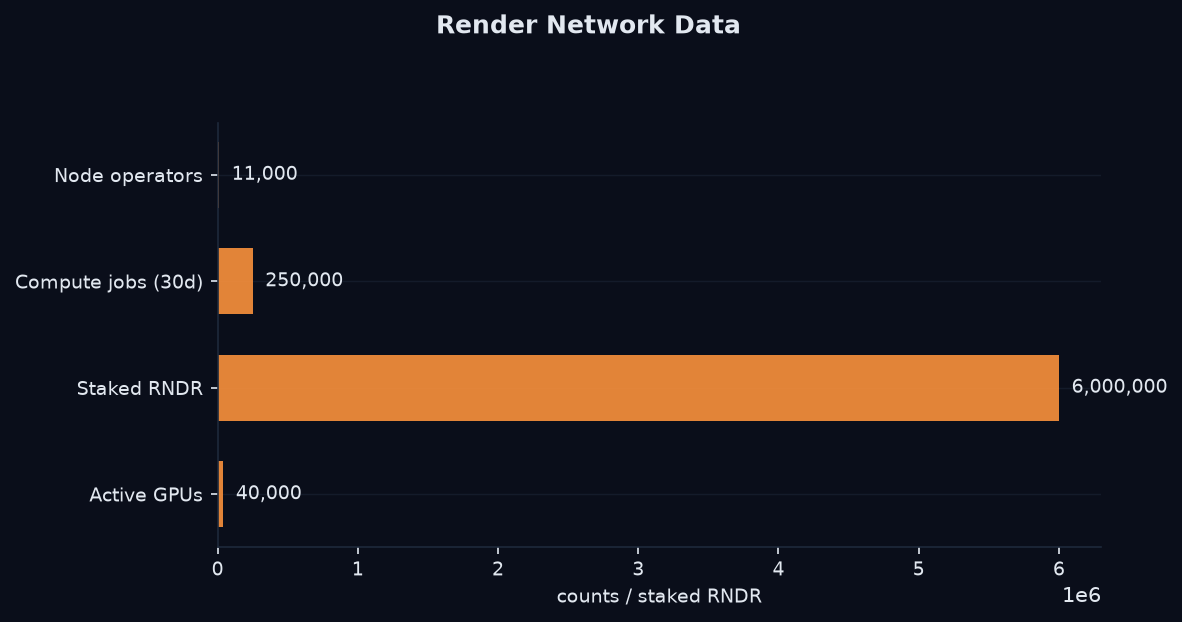
Render Network is the compute DePIN built for rendering — originally 3D content, now increasingly AI inference. Its data picture has three layers: GPU nodes doing the work, compute jobs being executed, and a staking layer that secures the network.
The Three Layers
1. GPU Nodes
Render runs node operators who attach GPUs to the network. The meaningful number is not the total registered GPUs but the active nodes actually executing jobs. As with every compute network, registered-vs-active is the utilization signal.
2. Compute Jobs
Job volume is the economic heartbeat. How many compute jobs run over a window, and what GPU hours do they consume? This is the activity layer that separates a working network from a populated one.
3. Staking
Render uses RNDR staking for node reputation and security. Total RNDR staked, the number of staking node operators, and the delegator base all describe how much value the market has locked into the network's security.
A Three-Layer Read
The three layers tell a story together. Suppose node operators are growing, job volume is rising, and RNDR staked is climbing. That's a healthy network: more capacity, more work, more committed capital. Now imagine job volume flat while node operators grow — you'd suspect idle capacity. Staking adds a third dimension: high RNDR staked with falling jobs suggests capital locked into a network that isn't yet earning. Read all three, not one.
Query Render Data
# Nodes + jobs + staking in one call
curl "https://api.kairossignal.com/v1/networks/render" \
  -H "X-API-Key: *"
Activity-focused fields
curl "https://api.kairossignal.com/v1/networks/render?fields=node_operators,compute_jobs_30d,rndr_staked"
GPU utilization across the compute category
curl "https://api.kairossignal.com/v1/compare?concept=GPU_UTILIZATION&category=compute"
Every value carries a verify_url, an as_of timestamp, and a freshness verdict. Confirm any node, job, or staking number against Render's own data.
Staking as a Health Signal
Staking is a useful differentiator for Render. RNDR staked is capital the market has locked into the network — a confidence signal that token price alone doesn't capture. Combined with active GPU utilization and job volume, it gives a three-dimensional view of network health.
Render in the Compute Category
Render is one of the three anchors of our compute coverage, alongside Akash and io.net. Comparing their canonical GPU metrics in one query is exactly what a normalized DePIN API enables — you see who has compute working and who has value locked in, in comparable units.
The daily batch is Merkle-rooted and timestamped to Bitcoin via OpenTimestamps, so any historical reading is provably the value that was true that day.
FAQ
What are Render's three data layers? GPU nodes (capacity), compute jobs (activity), and RNDR staking (committed capital). Read all three together for the full picture. Why does staking matter? RNDR staked is capital locked into the network's security and reputation. It's a confidence signal — the market putting money behind the network's operation. How is Render comparable to Akash and io.net? All three normalize into canonical compute concepts, soGPU_UTILIZATION is directly comparable across them in one query.
Get a free API key → · Read the docs →
The Three Layers as a Health Dashboard
Render's three layers — nodes, jobs, and staking — form a complete health dashboard when read together:
- GPU nodes show capacity and utilization (registered vs active).
- Compute jobs show the economic activity (throughput).
- RNDR staked shows committed capital (confidence).
Why Staking Differentiates Render
Not every compute DePIN has a staking layer. Render's RNDR staking adds a capital-commitment dimension that pure compute networks lack. It tells you how much value the market has locked into the network's security and reputation — a confidence signal that a token price alone can't capture. Combined with utilization and job volume, it gives Render a three-dimensional data picture that's richer than most of the category.
Read more: io.net GPU Data · Akash Network Data · DePIN Protocol Fees
---
This is a data product. Kairos Signal publishes no trading signals, performance returns, win rates, or accuracy claims.---
Try it yourself
Query the live catalog, supply telemetry, and provenance receipts directly: /v1/supply, /v1/provenance on the REST API.
Related reading: render network gpu supply data api tutorial · compute supply across Akash, io.net, Aethir · DePIN infrastructure data · how we read supply telemetry from 296 networks
Design-partner seats are capped at 20 at a lifetime-locked $199/mo (full API access, every published endpoint, MCP server, Bitcoin-anchored provenance). After seat 20 the price becomes $249/mo. Claim a design-partner seat → · See pricing---
Get Started With DePIN Intelligence
Kairos Signal provides verifiable, provenance-first telemetry for DePIN networks, including first-party supply data read directly from a network's own API or blockchain. Every value carries a verify_url you can check yourself, and each daily batch is Merkle-rooted and anchored to Bitcoin.
Every API response is signed with ed25519 and timestamped. You can prove what was served and when, months later. That is what we mean by provenance-first.
Related reading: DePIN Intelligence Guide · DePIN Telemetry · How to Query DePIN Data · DePIN Data Verification · Pricing