The Revenue Question
The most important question you can ask about any DePIN network is deceptively simple: does it actually make money? A token price is not revenue. Revenue is protocol fees — real economic activity captured by the network for providing infrastructure.
The answer splits DePIN into two camps: networks that generate genuine protocol fees from actual usage, and networks that have a token but no economic engine behind it. Tracking that distinction is a core job of DePIN data.
How We Track Fees
Protocol fees are read from chain state — the same first-party sourcing that covers supply and telemetry. We normalize fee data into a canonical PROTOCOL_FEE concept, comparable across networks, with the fee asset and its market value layered on for a USD read.
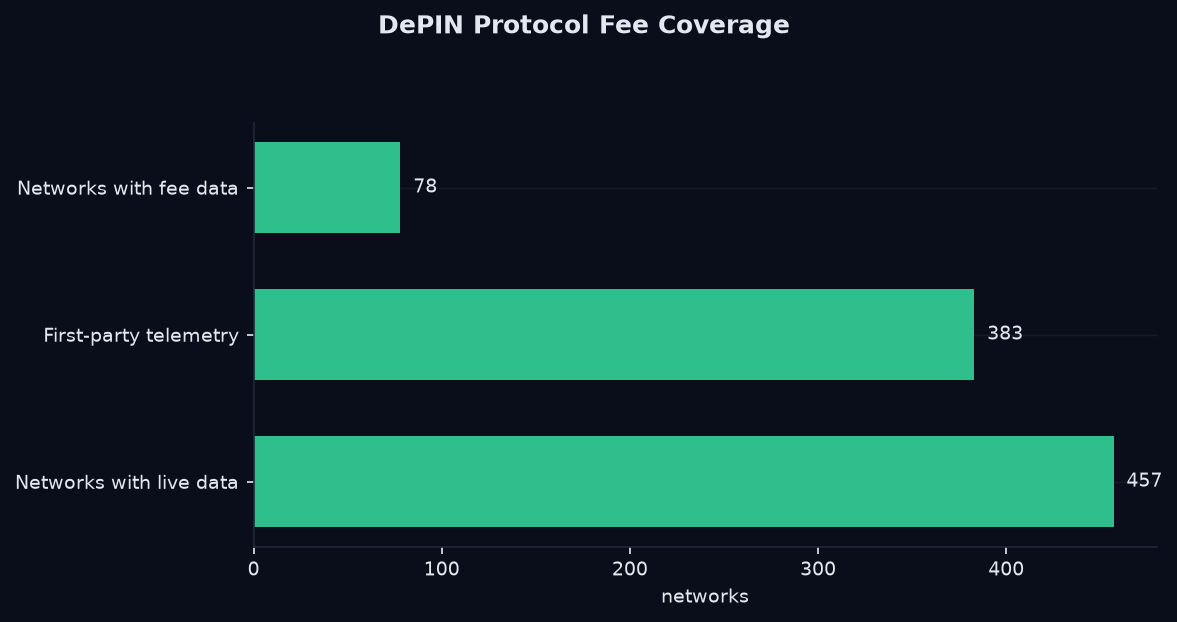
The coverage picture:
| Data type | Networks | |---|---| | Networks with live data | 327 | | With fee / revenue series | subset of the 78 on-chain networks + service networks | | First-party telemetry | 296 |
Service networks — compute (Akash, Render), storage (Filecoin, Storj), video (Livepeer) — are where genuine protocol fees live, because they charge for real work. Many sensor and wireless DePINs have token economies but thin fee streams, which the data makes visible.
The Signal
A network that earns real protocol fees has a revenue engine. That changes how you value it: fees provide a fundamental (even if early) measure of demand, whereas a pure token economy is priced on narrative. Comparing PROTOCOL_FEE across a category shows you, at a glance, which networks the market is actually paying for work.
Reading Fees Correctly
Protocol fees are most informative relative to other layers:
- Fees vs utilization. High fees with high utilization is a network both used and earning. High fees with low utilization may be overcharging a thin base.
- Fees vs TVL. High fees on modest TVL is efficient capital; low fees on high TVL is capital committed without much earning.
- Fee trend. A rising fee trend is the strongest fundamental — real demand growing.
Query Fee Data
# Protocol fees for one network
curl "https://api.kairossignal.com/v1/network/AKT/revenue" \
  -H "X-API-Key: *"
Fees across a whole category
curl "https://api.kairossignal.com/v1/compare?concept=PROTOCOL_FEE&category=compute"
Fee trend over 90 days
curl "https://api.kairossignal.com/v1/supply?network=livepeer&metric=protocol_fee&window=90d"
Every value carries a verify_url pointing at the chain, an as_of timestamp, and a freshness verdict. Confirm any fee reading against the explorer yourself.
Fees + Utilization = The Full Picture
Protocol fees are the revenue side; utilization is the demand side. Together they answer "is this network both used and earning?" A network with high utilization but no fees may be giving work away; high fees with low utilization may be overcharging a thin base. The two canonical concepts read together are far more informative than either alone.
Daily batches are Merkle-rooted and timestamped to Bitcoin via OpenTimestamps, so a historical fee reading is provably the value that was true that day.
FAQ
What counts as a protocol fee? Real economic activity captured by the network for providing infrastructure — compute leases, storage deals, transcoding fees — read from chain state. Why do service networks dominate fees? Because they charge for real work. Compute, storage, and video networks earn fees from actual usage; many sensor and wireless networks have token economies with thin fee streams. Can I compare fees across networks? Yes —PROTOCOL_FEE is a canonical concept, comparable across networks in a single compare query.
Explore fee data → · Get a free key →
The Fee Taxonomy
Protocol fees come in different forms, and reading them correctly means knowing which you're looking at. Compute networks earn from leases. Storage networks earn from deals. Video networks earn from transcoding. Each fee type reflects a different kind of real work, and all of them are captured on-chain.
The distinction matters for comparison. A storage network's deal fees and a compute network's lease fees are different economic animals, even though both normalize into the PROTOCOL_FEE concept. Comparing them is most meaningful within a category, where the work being paid for is comparable. Cross-category fee comparison tells you which categories are monetizing, not which network is "better."
Fees vs the Token Economy
The deepest divide in DePIN is between networks that earn fees and networks that just hold a token. Fee-earning networks have a revenue engine — a fundamental measure of demand, however early. Token-only economies are priced on narrative. When you're comparing two networks in the same category, the one with real protocol fees and a rising fee trend is fundamentally different from the one with a big market cap and no underlying revenue. The fee data makes that difference visible.
Read more: Livepeer Network Data · Render Network Data · DePIN Analytics
---
This is a data product. Kairos Signal publishes no trading signals, performance returns, win rates, or accuracy claims.---
Try it yourself
Query the live catalog, supply telemetry, and provenance receipts directly: /v1/networks, /v1/provenance on the REST API.
Related reading: 2026 08 17 depin revenue data which networks actually generate protocol fees · DePIN on-chain data · DePIN Intelligence guide · DePIN network data: 372 networks, 138 sources
Design-partner seats are capped at 20 at a lifetime-locked $199/mo (full API access, every published endpoint, MCP server, Bitcoin-anchored provenance). After seat 20 the price becomes $249/mo. Claim a design-partner seat → · See pricing---
Get Started With DePIN Intelligence
Kairos Signal provides verifiable, provenance-first telemetry for DePIN networks, including first-party supply data read directly from a network's own API or blockchain. Every value carries a verify_url you can check yourself, and each daily batch is Merkle-rooted and anchored to Bitcoin.
Every API response is signed with ed25519 and timestamped. You can prove what was served and when, months later. That is what we mean by provenance-first.
Related reading: DePIN Intelligence Guide · DePIN Telemetry · How to Query DePIN Data · DePIN Data Verification · Pricing