Livepeer: The Video Infrastructure DePIN
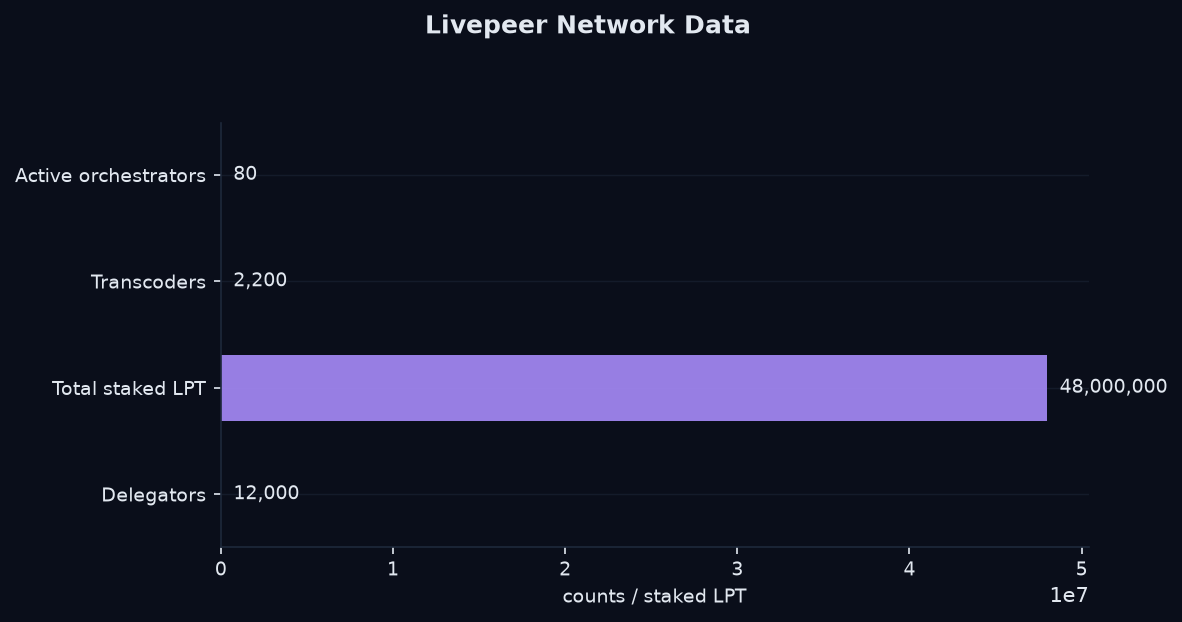
Livepeer is the DePIN for video transcoding — converting video into the formats and resolutions that streams need. Its network has two roles that matter for data: orchestrators, who do the transcoding work and set prices, and transcoders, who process the video frames. Around them sits a staking layer of delegators who stake LPT to back orchestrators.
The Roles and What They Tell You
- Orchestrators — the work coordinators. Active orchestrator count reflects how many competitive transcoding businesses are on the network.
- Transcoders — the processing nodes doing the actual transcodes. Volume here is the throughput story.
- Delegators & staked LPT — the security and reputation layer. Total LPT staked is capital locked into the network's trust model.
- Fees — transcoding fees earned, in LPT-denominated terms, read from chain state.
Fees: Does the Network Earn?
For a service network like Livepeer, protocol fees are the purest health signal — real economic activity from actual transcoding, not token speculation. We read fee data from chain state and normalize it into a canonical PROTOCOL_FEE concept, comparable across networks. That lets you see which DePINs actually generate revenue rather than just holding a token.
Query Livepeer Data
# Orchestrators + transcoders + staking
curl "https://api.kairossignal.com/v1/networks/livepeer" \
  -H "X-API-Key: *"
Activity and fee fields
curl "https://api.kairossignal.com/v1/networks/livepeer?fields=active_orchestrators,transcoders,lpt_staked"
Protocol fees across the network
curl "https://api.kairossignal.com/v1/network/livepeer/revenue"
Every value carries a verify_url, an as_of timestamp, and a freshness verdict. Confirm any orchestrator, transcoder, or fee number against Livepeer's own explorer.
The Staking Dimension
LPT staked is capital locked into the network's trust model — delegators back orchestrators with LPT, and that stake is slashing collateral. A rising staking base with rising fees is a network both trusted and earning. A large staking base with thin fees is capital committed to a network that isn't generating much economic activity. The two together are the diligence picture.
Anchored and First-Party
Livepeer is among the networks we serve with first-party sourcing. The daily batch is Merkle-rooted and timestamped to Bitcoin via OpenTimestamps, so a historical fee or transcoder reading is provably the value that was true that day.
FAQ
What is the difference between an orchestrator and a transcoder? Orchestrators coordinate work and set prices; transcoders process the actual video frames. The orchestrator-to-transcoder ratio reveals whether the coordination layer is well utilized. Why do protocol fees matter for Livepeer? Fees are real revenue from actual transcoding — the purest health signal. A token price alone can't tell you whether the network is earning. Is Livepeer data first-party? Yes — read from chain state and Livepeer's own data with averify_url on every value.
Get a free API key → · Read the docs →
The Orchestrator-to-Transcoder Ratio
Livepeer's two roles — orchestrators who coordinate and set prices, and transcoders who process frames — produce one of the category's most informative ratios. A network with many orchestrators but a thin transcoder base is underutilizing its coordination layer; the orchestrators are competing for work that isn't there. A tight transcoder base relative to orchestrators suggests healthy competition for real throughput. The ratio tells you more than either number alone.
Fees as the Pure Signal
For a service network like Livepeer, protocol fees are the cleanest health indicator. Fees come from actual transcoding — real work performed for real clients — not from token speculation. A fee trend is the market's direct payment for Livepeer's utility. When you're evaluating whether Livepeer is genuinely used, the fee series is where to look, and it's comparable across networks via the canonical PROTOCOL_FEE concept.
The Staking Commitment
LPT staked is capital locked into Livepeer's trust model — delegators back orchestrators, and that stake is slashing collateral. A growing staking base tells you the market is committing capital to the network's security and reputation. Read together with fees and utilization, it completes a three-dimensional picture: committed capital, real revenue, and actual demand.
Read more: DePIN Protocol Fees · DePIN On-Chain Data · DePIN Data Feeds
---
This is a data product. Kairos Signal publishes no trading signals, performance returns, win rates, or accuracy claims.---
Try it yourself
Query the live catalog, supply telemetry, and provenance receipts directly: /v1/supply, /v1/provenance on the REST API.
Related reading: DePIN infrastructure data · how we read supply telemetry from 296 networks · DePIN network data: 372 networks, 138 sources · DePIN Intelligence guide
Design-partner seats are capped at 20 at a lifetime-locked $199/mo (full API access, every published endpoint, MCP server, Bitcoin-anchored provenance). After seat 20 the price becomes $249/mo. Claim a design-partner seat → · See pricing---
Get Started With DePIN Intelligence
Kairos Signal provides verifiable, provenance-first telemetry for DePIN networks, including first-party supply data read directly from a network's own API or blockchain. Every value carries a verify_url you can check yourself, and each daily batch is Merkle-rooted and anchored to Bitcoin.
Every API response is signed with ed25519 and timestamped. You can prove what was served and when, months later. That is what we mean by provenance-first.
Related reading: DePIN Intelligence Guide · DePIN Telemetry · How to Query DePIN Data · DePIN Data Verification · Pricing