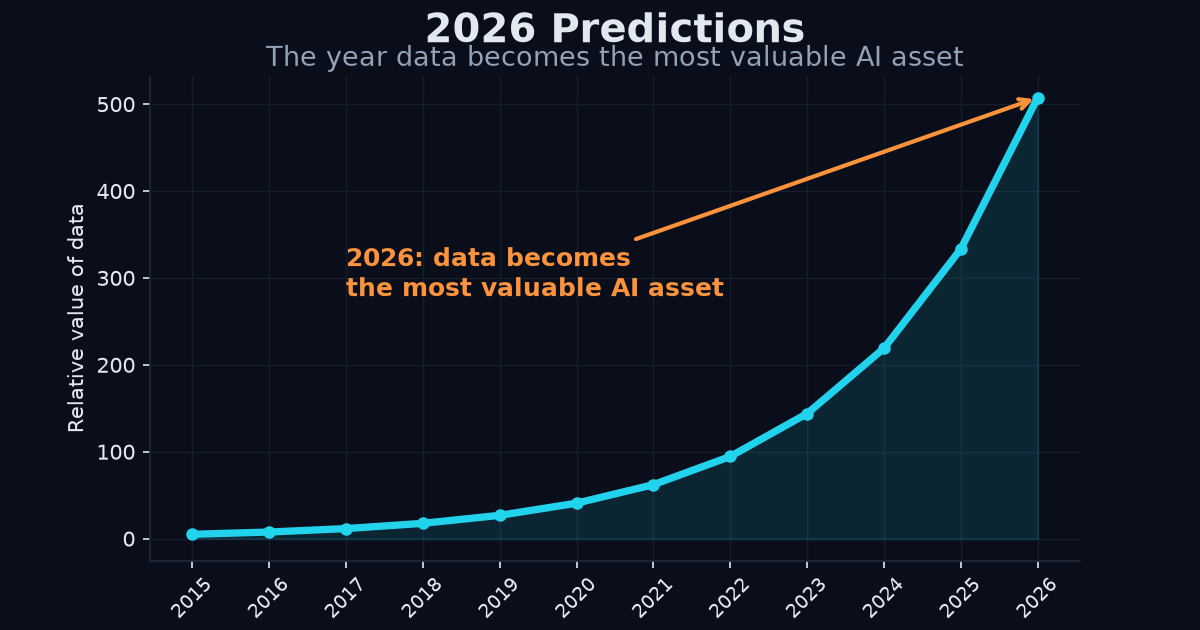
2026 Predictions: The Year Data Becomes the Most Valuable AI Asset
Introduction
What This Means for Data Providers
If data is the most valuable AI asset, then the providers who capture the value are the ones who make data reliable enough to act on. Volume alone is commoditizing; verified, canonical, source-anchored data is not.
This is why we invest so heavily in provenance — every value source-verifiable, every batch Bitcoin-anchored, every gap honestly labeled. As the autonomous data economy matures, the premium shifts decisively toward data an agent can trust without a human audit. That is the asset that becomes most valuable.
The Role of Verifiable Data
The prediction that data becomes the most valuable AI asset has a corollary: unverifiable data becomes a liability. As AI agents make more consequential decisions on infrastructure telemetry, the ability to trace a value to its source and prove it was not altered becomes the property that separates data worth paying for from data too risky to trust.
This is the direction we are building toward — a data layer where every value is canonical, source-verifiable, and Bitcoin-anchored. As the autonomous data economy grows, the premium shifts from raw volume to verified volume: data an agent can act on without a human audit.
In the rapidly evolving landscape of artificial intelligence (AI), 2026 stands out as a pivotal year where data transitions from a mere input to the most valuable AI asset. As we delve into this transformative period, it's crucial to understand the underlying trends and technologies that will drive this shift. This article explores four key predictions shaping the autonomous data economy: consolidation of agent marketplaces, mandatory data provenance, exponential growth in structured data products, and the landmark achievement of a $1 million autonomous transaction.
1. Agent Marketplaces Consolidate
The rise of AI agents—autonomous entities capable of executing tasks on their own—is set to trigger significant consolidation within agent marketplace ecosystems. As more businesses recognize the efficiency gains from automated decision-making processes, we anticipate a convergence of smaller players into larger platforms offering integrated solutions. This consolidation will enhance interoperability and standardization across diverse sectors, making data assets more accessible and valuable.
Why It Matters:- Efficiency Gains: Automated workflows reduce operational costs and increase transaction speed.
- Standardization: Unified protocols ensure seamless interaction between disparate AI agents.
2. Data Provenance Becomes Mandatory
With the explosion of unstructured data, the need for transparency and trust in information becomes paramount. By 2026, data provenance—the traceability of data from its origin to its current state—will be mandated across industries. This shift ensures that AI models are trained on reliable, verifiable datasets, mitigating risks associated with biased or fraudulent data.
Why It Matters:- Regulatory Compliance: Aligns with emerging regulations demanding accountability in AI decision-making.
- Trust Enhancement: Consumers and regulators can confidently leverage AI-driven insights knowing the source is transparent.
3. Structured Data Products Surge by 10x
The transition from unstructured to structured data products will see a tenfold increase in value. Structured formats enable more efficient processing, storage, and analysis by machine learning algorithms. Industries ranging from finance to healthcare will leverage these enhanced datasets to unlock deeper insights and predictive capabilities.
Why It Matters:- Scalability: Easier integration into existing systems and infrastructure.
- Insight Depth: High-quality structured data fuels more accurate AI predictions and models.
4. First $1M Autonomous Transaction Achieved
A landmark milestone in the autonomous data economy is the execution of a $1 million transaction entirely powered by AI agents. This achievement demonstrates not only technological feasibility but also economic viability, paving the way for larger-scale autonomous operations across various sectors.
Why It Matters:- Proof of Concept: Validates the potential of fully automated financial transactions.
- Industry Adoption: Encourages broader deployment of AI-driven systems in commerce and finance.
Conclusion
As we approach 2026, the convergence of these trends underscores a fundamental shift: data is becoming the most valuable asset driving AI innovation. Embracing these changes will be critical for businesses aiming to stay competitive in an increasingly automated world. To explore how Kairos Signal can help harness this data revolution, visit our checkout page and unlock unprecedented insights today.
---
Kairos Signal: MCP-native. Schema-validated. Cryptographically footprint ``
---
Try it yourself
Query the live catalog, supply telemetry, and provenance receipts directly:
/v1/networks, /v1/supply on the REST API.
Related reading: DePIN Intelligence guide · DePIN network data: 372 networks, 138 sources · how we read supply telemetry from 296 networks · the DePIN developer guide
Design-partner seats are capped at 20 at a lifetime-locked $199/mo (full API access, every published endpoint, MCP server, Bitcoin-anchored provenance). After seat 20 the price becomes $249/mo. Claim a design-partner seat → · See pricing
---
Why This Matters for DePIN Intelligence
The DePIN sector has grown, but the data infrastructure to analyze its networks remains fragmented. Most platforms aggregate token prices and market caps from CoinGecko or DefiLlama — useful, but not sufficient for infrastructure analysis. The scarce layer is supply-side telemetry: actual node counts, GPU supply, storage capacity, bandwidth deployed, and utilization ratios. These numbers live on many different data sources, each with its own API format, rate limits, and update cadence.
Kairos Signal exists to solve that problem. We maintain collectors across blockchains and first-party network APIs, normalizing everything into a single schema with provenance on every row. The result is live series across DePIN networks, including first-party telemetry — data read directly from the network's own endpoint, not estimated or imputed.
For developers building DePIN analytics tools, researchers evaluating network health, or traders assessing supply-demand dynamics, this means one API call instead of 50. For autonomous AI agents, the MCP server provides structured access with self-serve credits — no human, no card, just USDC on Base.
Get Started With DePIN Intelligence
Kairos Signal provides verifiable, provenance-first telemetry for DePIN networks, including first-party supply data read directly from a network's own API or blockchain. Every value carries a
verify_url` you can check yourself, and each daily batch is Merkle-rooted and anchored to Bitcoin.
Three ways to access:
Every API response is signed with ed25519 and timestamped. You can prove what was served and when, months later. That is what we mean by provenance-first.
Related reading: DePIN Intelligence Guide · DePIN Telemetry · How to Query DePIN Data · DePIN Data Verification · Pricing Correction 2026-09-25: this post called our catalog entry count a count of DePIN networks; that count includes superseded rows and Bittensor subnet rows. It has been removed, together with some present-tense coverage counts written beside it. Current coverage figures: /v1/networks.