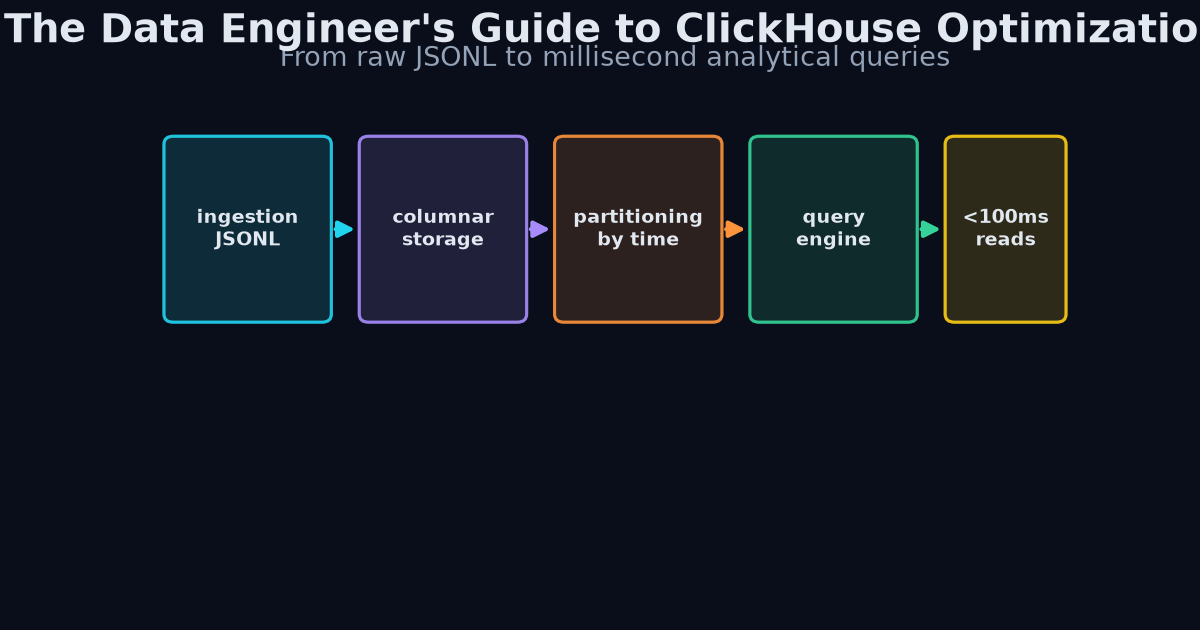
 The Data Engineer's Guide to ClickHouse Optimization
Published on March 28, 2026
Introduction
The Data Engineer's Guide to ClickHouse Optimization
Published on March 28, 2026
Introduction
In the rapidly evolving landscape of the autonomous data economy, structured intelligence, and AI agent commerce, efficient database management is paramount. As a leading provider of enriched signals, Kairos Signal emphasizes the importance of performance tuning in ClickHouse—a high-performance OLAP database designed for real-time analytics. This guide delves into partition keys, the ORDER BY clause, materialized views, and the three critical settings most data engineers overlook.
Why Optimization MattersOptimization in ClickHouse isn’t just about speed; it’s about cost efficiency, scalability, and ensuring your analytical pipelines remain responsive as data volumes grow exponentially. With AI-driven applications demanding near-instantaneous insights, suboptimal configurations can lead to delayed decision-making, inflated operational costs, and missed opportunities.
1. Partition Keys: The Foundation of PerformancePartition keys are the backbone of ClickHouse’s performance optimization strategy. By logically segmenting your data based on time or categorical attributes (e.g., region, product type), you enable the database engine to perform range scans more efficiently.
Best Practices:- Time-Based Partitions: Ideal for temporal data analysis. Use a
DateorDateTimecolumn as your partition key to facilitate quick access to recent or historical datasets. - Dynamic Partitioning: Leverage ClickHouse’s dynamic partitioning feature to avoid the overhead of creating static partitions that don’t scale with new data.
The ORDER BY clause is often underutilized in performance optimization discussions but plays a crucial role in query execution plans.
Optimization Tips:- Index Utilization: Ensure your SELECT queries include columns that match the ordering criteria to benefit from index pruning, reducing I/O operations.
- Avoid Unnecessary Sorting: Design your schema and queries to minimize sorting. Group related data logically to reduce computational overhead during reads.
Materialized views are pre-computed representations of complex query results stored as separate tables in ClickHouse.
Implementation Strategies:- Incremental Updates: Configure materialized views to update incrementally, preserving performance gains without the cost of full table scans.
- Selective Refreshes: Apply refresh policies based on data volatility. High-volume transactional data may require more frequent updates compared to historical snapshots.
These critical settings often lead to suboptimal performance if misconfigured:
Mastering ClickHouse optimization is essential for leveraging the full potential of real-time analytics in today’s AI-driven marketplaces. By implementing partition keys judiciously, optimizing ORDER BY clauses, utilizing materialized views effectively, and mastering key settings, you can ensure your data pipelines remain performant, scalable, and cost-efficient.
Call to ActionExplore Kairos Signal’s comprehensive suite of enriched signals designed for the autonomous data economy. To access our cutting-edge data products and integrate them into your AI-driven solutions, visit Kairos Signal Data Products or secure your optimized ClickHouse environment today at Checkout Kairos Signal.
``
---
Try it yourself
Why Columnar Storage Fits DePIN Telemetry
ClickHouse is well-suited to DePIN data because the dominant query pattern is time-range scanning over a handful of metrics — exactly what columnar storage optimizes. Our store holds roughly 697K rows across 11,857 live series, and most analytics query a narrow slice of series over a wide time window. Columnar compression and vectorized execution make those scans fast, which matters when an agent or analyst is comparing utilization across many networks in a single query.
The Optimization Tradeoffs We Made
The classic ClickHouse tradeoffs — primary key design, partition granularity, and materialized aggregates — are all driven by the access pattern. We partition by time and key by network+metric so that cross-network comparisons scan only the columns and ranges they need. The result is a store that serves canonical, verifiable series at the speed a decision tool requires, without over-provisioning.
Query the live catalog, supply telemetry, and provenance receipts directly: /v1/networks, /v1/supply on the REST API.
Related reading: the JSONL→ClickHouse pipeline · our SQLite buffer layer at 100GB · DePIN Intelligence guide · DePIN network data: 372 networks, 138 sources
Design-partner seats are capped at 20 at a lifetime-locked $199/mo (full API access, every published endpoint, MCP server, Bitcoin-anchored provenance). After seat 20 the price becomes $249/mo. Claim a design-partner seat → · See pricing---
Why This Matters for DePIN Intelligence
The DePIN sector has grown, but the data infrastructure to analyze its networks remains fragmented. Most platforms aggregate token prices and market caps from CoinGecko or DefiLlama — useful, but not sufficient for infrastructure analysis. The scarce layer is supply-side telemetry: actual node counts, GPU supply, storage capacity, bandwidth deployed, and utilization ratios. These numbers live on many different data sources, each with its own API format, rate limits, and update cadence.
Kairos Signal exists to solve that problem. We maintain collectors across blockchains and first-party network APIs, normalizing everything into a single schema with provenance on every row. The result is live series across DePIN networks, including first-party telemetry — data read directly from the network's own endpoint, not estimated or imputed.
For developers building DePIN analytics tools, researchers evaluating network health, or traders assessing supply-demand dynamics, this means one API call instead of 50. For autonomous AI agents, the MCP server provides structured access with self-serve credits — no human, no card, just USDC on Base.
Get Started With DePIN Intelligence
Kairos Signal provides verifiable, provenance-first telemetry for DePIN networks, including first-party supply data read directly from a network's own API or blockchain. Every value carries a verify_url` you can check yourself, and each daily batch is Merkle-rooted and anchored to Bitcoin.
Three ways to access:Every API response is signed with ed25519 and timestamped. You can prove what was served and when, months later. That is what we mean by provenance-first.
Related reading: DePIN Intelligence Guide · DePIN Telemetry · How to Query DePIN Data · DePIN Data Verification · Pricing Correction 2026-09-25: this post called our catalog entry count a count of DePIN networks; that count includes superseded rows and Bittensor subnet rows. It has been removed, together with some present-tense coverage counts written beside it. Current coverage figures: /v1/networks.