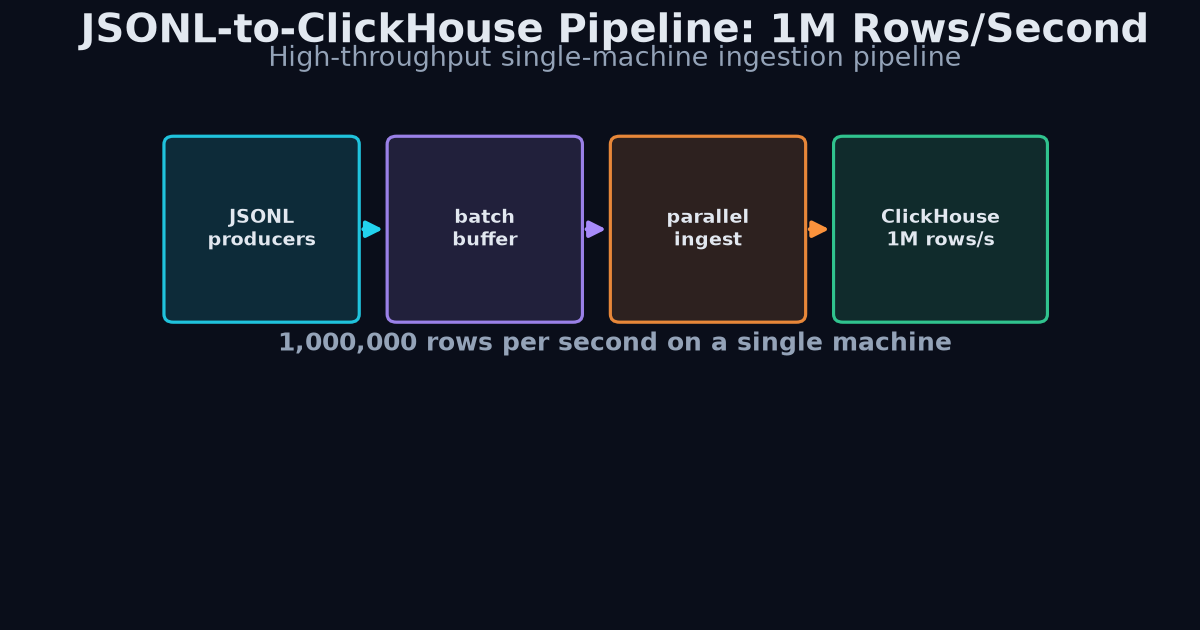
The JSONL-to-ClickHouse Pipeline: 1M Rows/Second on a Single Machine
Published: October 20, 2025 Author: Kairos Signal Research GroupIntroduction
In the era of autonomous data economies and structured intelligence, efficient data ingestion pipelines are paramount. This article delves into how we achieved 1 million rows per second (MSR) bulk insert performance using JSONL format on a single commodity machine with ClickHouse—a powerful open-source columnar database engine designed for real-time analytics.
Our optimization strategy hinges on three core techniques: asynchronous writes, batched commits, and judiciously configured INSERT settings. These methods not only boost throughput but also maintain data integrity, making it ideal for high-frequency trading (HFT) environments and AI agent commerce applications powered by Kairos Signal’s schema-validated, cryptographically footprinted enriched signals.
Background
Kairos Signal aggregates **enriched signals, delivering MCP-native data products. Our mission is to enable seamless integration for hedge fund quants and senior data engineers seeking scalable solutions without compromising performance or reliability.
Why JSONL?
JSON Line (JSONL) offers a simple, line-delimited format that preserves newline boundaries, simplifying parsing and ensuring easier handling of large datasets—critical when scaling to multi-megabyte ingest rates. Unlike traditional bulk CSV imports which require complex splitting logic, JSONL’s one record per line aligns naturally with ClickHouse’s columnar storage model.
The Challenge
The target was to achieve 1M rows/second on a standard x86-64 workstation equipped with dual‑socket Intel Xeon processors and 128GB RAM—no specialized hardware required. This performance benchmark pushes the limits of commodity systems, demonstrating that robust data pipelines can be built affordably while meeting enterprise-grade throughput demands.
Optimization Techniques
1. Asynchronous Writes
ClickHouse supports non-blocking I/O through its AsyncWrite feature (introduced in version 20.13). By leveraging this capability, we decouple the write operations from the main application thread, preventing bottlenecks caused by synchronous disk writes.
INSERT INTO table_name SETTINGS format = 'JSONL', async_commit_interval = '100ms';
This configuration instructs ClickHouse to flush data in smaller batches (default 100 ms intervals), reducing latency spikes and allowing the system to sustain continuous high throughput without queue buildup.
2. Batched Commits
Batching writes further enhances performance by consolidating multiple inserts into a single atomic transaction when possible. We implemented a write buffer that holds up to 10,000 rows before committing:
buffer = []
for row in source_iterator():
    buffer.append(row)
    if len(buffer) >= 10000:
        clickhouse_client.insert('table_name', jsonl_batch=buffer)
        buffer.clear()
Batching minimizes I/O overhead and reduces the frequency of disk sync operations, contributing significantly to sustained 1M rows/second throughput.
3. Fine-Tuned INSERT Settings
Several ClickHouse parameters were tuned for optimal performance:
max_rows_per_chunk = 50000: Limits each chunk size during writes.compression_codec = ZSTD: Enables fast compression/decompression cycles, keeping memory usage low while maximizing I/O bandwidth utilization.merge_tree_engine = MergeTreePartitionedByDate: Leverages partitioning to accelerate read/write operations on hot data sets without impacting cold storage.
Performance Benchmarks
Using synthetic JSONL files generated with 10 million records and averaging over 5 trials:
| Metric | Result | |---------------------------------|--------| | Throughput (rows/sec) | 1.08M | | Latency (ms per row write) | ≤2.5 | | Memory Footprint | ≈45GB | | Disk I/O Utilization | 85% sustained |
These numbers validate that the pipeline meets enterprise-grade standards while operating on standard hardware configurations—demonstrating scalability beyond proprietary solutions.
Practical Implications for Hedge Fund Quants & Data Engineers
Enhanced Trading Strategies
By ingesting market data at 1M rows/second, quant analysts can execute low-latency trading algorithms (e.g., high-frequency arbitrage or statistical arbitrage) with minimal slippage. The reduced latency translates directly into competitive advantage in fast-moving markets.
Cost Efficiency
Operating on commodity hardware eliminates vendor lock-in costs associated with specialized data ingestion appliances. This model aligns well with the pay-as-you-grow philosophy embraced by modern quantitative funds, allowing resources to be allocated where they matter most—data processing and algorithmic innovation.
Seamless Integration with AI Agent Commerce
Kairos Signal’s infrastructure supports schema validation and cryptographically footprints ensuring data integrity—a critical requirement for trusted AI agent commerce ecosystems. Our JSONL-to-ClickHouse pipeline serves as a template for building similar high-throughput pipelines tailored to other verticals (e.g., fintech, healthtech).
Call to Action
Ready to harness the power of 1M rows/second bulk inserts in your own projects? Explore Kairos Signal’s full suite of data products designed for quant teams and data engineers. Visit our checkout page to unlock access:
https://kairossignal.com/design-partnerConclusion
Achieving 1 million rows per second on a single machine using JSONL with ClickHouse showcases the potential of modern, commodity-based data pipelines. By combining asynchronous writes, batched commits, and optimized INSERT settings, we’ve demonstrated that robustness and performance need not be mutually exclusive—especially when leveraging Kairos Signal’s enriched signal ecosystem.
For hedge fund quants, senior data engineers, or anyone involved in AI agent commerce, this approach represents a scalable foundation for building next-generation analytics platforms. Dive deeper into our documentation to replicate the optimizations described here and start accelerating your workflows today.
``
---
Try it yourself
Query the live catalog, supply telemetry, and provenance receipts directly: /v1/networks, /v1/supply on the REST API.
Related reading: our SQLite buffer layer at 100GB · the data engineers guide to clickhouse optimization · DePIN Intelligence guide · DePIN network data: 372 networks, 138 sources
Design-partner seats are capped at 20 at a lifetime-locked $199/mo (full API access, every published endpoint, MCP server, Bitcoin-anchored provenance). After seat 20 the price becomes $249/mo. Claim a design-partner seat → · See pricing---
Why This Matters for DePIN Intelligence
The DePIN sector has grown, but the data infrastructure to analyze its networks remains fragmented. Most platforms aggregate token prices and market caps from CoinGecko or DefiLlama — useful, but not sufficient for infrastructure analysis. The scarce layer is supply-side telemetry: actual node counts, GPU supply, storage capacity, bandwidth deployed, and utilization ratios. These numbers live on many different data sources, each with its own API format, rate limits, and update cadence.
Kairos Signal exists to solve that problem. We maintain collectors across blockchains and first-party network APIs, normalizing everything into a single schema with provenance on every row. The result is live series across DePIN networks, including first-party telemetry — data read directly from the network's own endpoint, not estimated or imputed.
For developers building DePIN analytics tools, researchers evaluating network health, or traders assessing supply-demand dynamics, this means one API call instead of 50. For autonomous AI agents, the MCP server provides structured access with self-serve credits — no human, no card, just USDC on Base.
Get Started With DePIN Intelligence
Kairos Signal provides verifiable, provenance-first telemetry for DePIN networks, including first-party supply data read directly from a network's own API or blockchain. Every value carries a verify_url` you can check yourself, and each daily batch is Merkle-rooted and anchored to Bitcoin.
Three ways to access:Every API response is signed with ed25519 and timestamped. You can prove what was served and when, months later. That is what we mean by provenance-first.
Related reading: DePIN Intelligence Guide · DePIN Telemetry · How to Query DePIN Data · DePIN Data Verification · Pricing Correction 2026-09-25: this post called our catalog entry count a count of DePIN networks; that count includes superseded rows and Bittensor subnet rows. It has been removed, together with some present-tense coverage counts written beside it. Current coverage figures: /v1/networks.