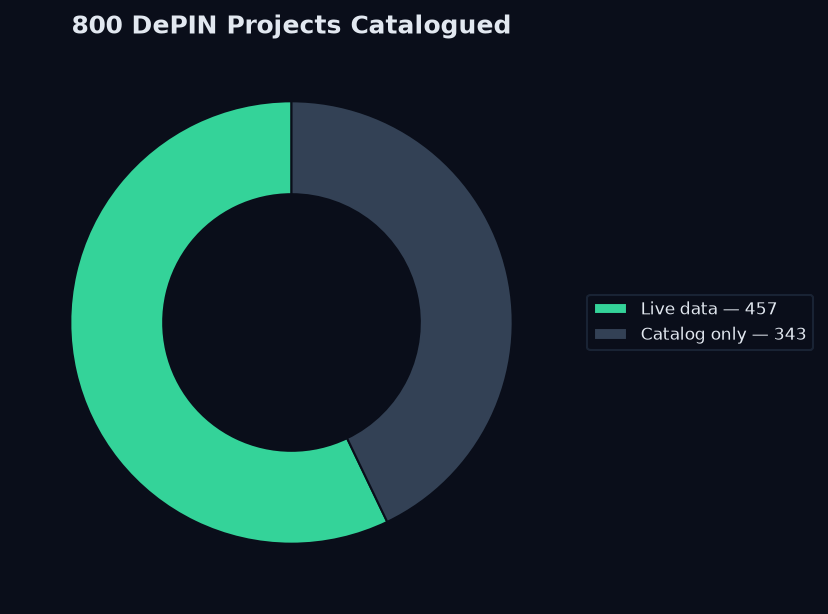
The 800-Project Catalog
DePIN is a crowded landscape, and no single source lists every project. At Kairos Signal we keep a DePIN networks catalogue — the most complete public list we know of. But a list is only useful if it tells you what it actually knows about each network, which is why ours carries a coverage tier on every entry.
The Coverage Tiers
Not all 800 entries have live data, and pretending otherwise is how bad lists are made. Our catalog is honest about it:
| Tier | Networks | What you get | |---|---|---| | First-party telemetry | 296 | Live infrastructure metrics from the network's own API/chain | | On-chain market only | 78 | Token supply and market data, no infra telemetry | | Catalog only | 339 | Directory entry — name, category, chain — no public feed | | Live data | 327 | Everything with verifiable values | | Catalogued total | 800 | The full list |
The catalog-only entries are labeled explicitly so you can filter them in one line of code instead of discovering mid-build that a "listed" network has no data.
69 Sources Behind the List
Every live entry traces to a real source. The top contributors by network count:
subtensor_rpc — 129evm_blockscout — 118bsc_rpc — 50solana_rpc — 49first_party_api — 44ethereum_rpc — 32Across those sources the list carries 11,857 live series and roughly 697K rows in ClickHouse.
Query the List
# The catalog, with coverage tier
curl "https://api.kairossignal.com/v1/networks" \
  -H "X-API-Key: *"
Filter to first-party telemetry only
curl "https://api.kairossignal.com/v1/networks?tier=first_party"
Filter to catalog-only (no feed) entries
curl "https://api.kairossignal.com/v1/networks?tier=catalog_only"
Filter by category (compute, storage, wireless, AI, sensors)
curl "https://api.kairossignal.com/v1/networks?category=compute"
Each entry carries source, as_of, verify_url, and a freshness verdict — the provenance contract applies to the list itself, not just the metrics.
The Category Breakdown
The 800 projects cluster into recognizable categories. Compute (Akash, io.net, Render, Aethir), storage (Filecoin, Storj), wireless (Helium, WeatherXM), AI/ML (Bittensor subnets), and sensors each form a dense cluster. The list is filterable by category so you can study one vertical at a time — and see where data coverage is deep vs thin within each.
What a Good List Is For
A complete DePIN networks list is a map. It tells you where the category is dense (compute, storage), where it's sparse, and — critically — where data doesn't exist yet. The catalog-only tier is that "data doesn't exist" layer, and naming it is what separates a useful map from a vanity directory.
FAQ
How is this list different from a directory? Every entry carries a coverage tier and provenance. A directory lists projects; our list tells you which have verifiable live data, which are on-chain only, and which have no feed at all. Why are 339 networks catalog-only? Because they expose no verifiable public feed. We label them rather than fabricate numbers. A list that pretends everything is covered is a list that can't be trusted. Can I filter the list? Yes — by tier, category, and source, via thenetworks endpoint.
Browse the live list → · Full API reference →
How the List Is Maintained
An 800-project catalog is not a one-time scrape; it's a living process. New networks launch, existing ones migrate chains, and coverage tiers change as networks expose or remove public feeds. Each entry carries a coverage tier and a source, so the list reflects the current state of the ecosystem rather than a stale snapshot. When a network starts publishing a verifiable feed, it moves from catalog-only into the live tier — the map updates with reality.
Using the List for Research
The catalog is a research tool, not just a directory. Because every entry has a tier, you can:
- Scope a category by filtering to compute, storage, wireless, AI, or sensors.
- Find the transparent projects by filtering to first-party telemetry.
- Find the research frontier by listing catalog-only networks — the projects where you'll need manual work.
Read more: DePIN Coverage Map · DePIN Network Data · DePIN Infrastructure Data
---
This is a data product. Kairos Signal publishes no trading signals, performance returns, win rates, or accuracy claims.---
Try it yourself
Query the live catalog, supply telemetry, and provenance receipts directly: /v1/supply, /v1/provenance on the REST API.
Related reading: DePIN infrastructure data · how we read supply telemetry from 296 networks · DePIN network data: 372 networks, 138 sources · DePIN Intelligence guide
Design-partner seats are capped at 20 at a lifetime-locked $199/mo (full API access, every published endpoint, MCP server, Bitcoin-anchored provenance). After seat 20 the price becomes $249/mo. Claim a design-partner seat → · See pricing---
Get Started With DePIN Intelligence
Kairos Signal provides verifiable, provenance-first telemetry for DePIN networks, including first-party supply data read directly from a network's own API or blockchain. Every value carries a verify_url you can check yourself, and each daily batch is Merkle-rooted and anchored to Bitcoin.
Every API response is signed with ed25519 and timestamped. You can prove what was served and when, months later. That is what we mean by provenance-first.
Related reading: DePIN Intelligence Guide · DePIN Telemetry · How to Query DePIN Data · DePIN Data Verification · Pricing Correction 2026-09-25: this post called our catalog entry count a count of DePIN networks; that count includes superseded rows and Bittensor subnet rows, so it has been removed. Current coverage figures: /v1/networks.