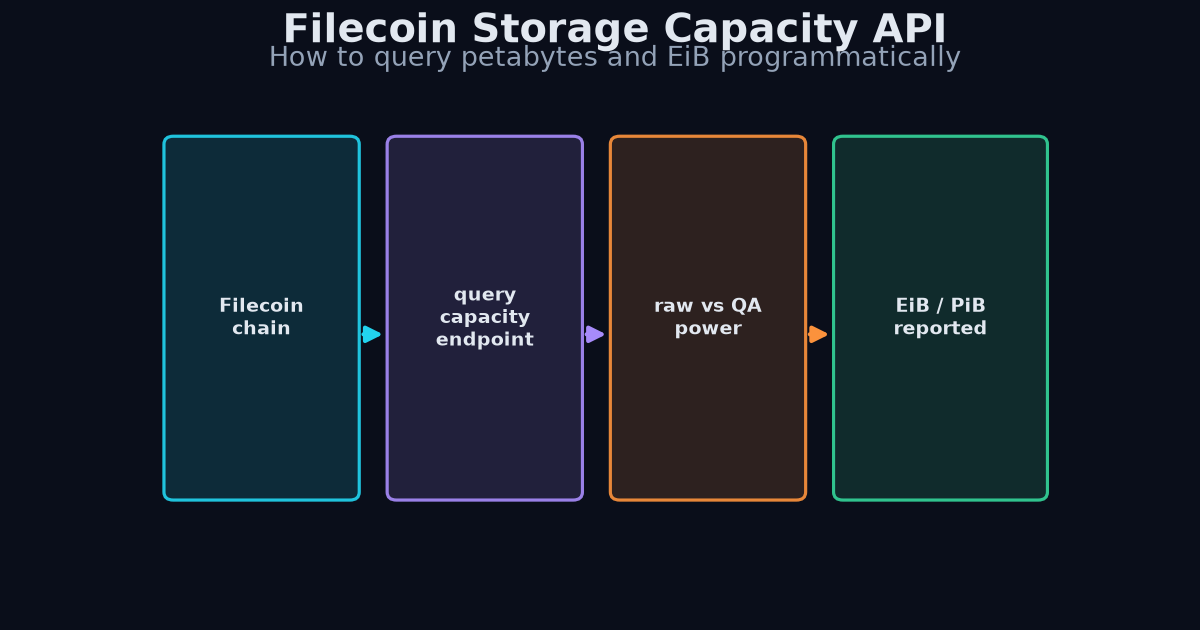
The Filecoin Capacity Data Problem
What the Metrics Tell You
Filecoin's storage metrics — total capacity, active storage, and utilization — answer the questions that matter for a storage buyer or analyst:
- Total/registered capacity — what the network claims to offer.
- Active storage — capacity actually under a live deal.
- Utilization — active over registered; the real demand signal.
- Storage providers — how distributed the supply is.
Filecoin is the largest decentralized storage network, and its headline number — total storage capacity — is routinely misreported. Depending on the source, you'll see raw capacity in EiB (exbibytes), active storage, or pledged capacity, and these aren't interchangeable. Querying Filecoin storage data programmatically means getting the units and the metric definition right, or your dashboard will quietly inflate the network's true footprint.
Here's how to query Filecoin storage capacity the right way.
The Filecoin Metrics That Matter
- Total/registered storage capacity — the raw power the network advertises
- Active storage — capacity actually being used for deals
- Utilization rate — active storage as a fraction of registered capacity; the closest thing to a "fill rate"
- Storage providers (miners) — the count and distribution of providers behind the capacity
Querying Filecoin Storage Data
With a Kairos Signal API key, Filecoin capacity is one call:
# Filecoin supply + storage capacity
curl "https://kairossignal.com/v1/networks/filecoin" \
  -H "X-API-Key: YOUR_API_KEY"
Storage-specific telemetry with declared units
curl "https://kairossignal.com/v1/networks/filecoin?fields=storage_total_capacity,storage_active,storage_utilization"
Compare storage utilization across storage networks
curl "https://kairossignal.com/v1/compare?network=filecoin&concept=STORAGE_UTILIZATION"
Every value returns with declared units and a verify_url pointing to the Filecoin chain explorer. You can confirm the exact figure and unit at the source instead of trusting a scraped dashboard.
PiB vs EiB: The 1024x Trap
Filecoin capacity is reported in PiB (pebibytes, 2^50 bytes) and EiB (exbibytes, 2^60 bytes). One EiB equals 1024 PiB. A dashboard that reads a raw-power figure in EiB and displays it as petabytes is off by three orders of magnitude — the difference between "the network stores 18 units of data" and "the network stores 18,000 units."
This is not a cosmetic unit label. It changes investment conclusions, capacity planning, and the comparability of Filecoin against other storage networks. When we normalize Filecoin's native fields into canonical concepts, we carry the declared unit through the entire pipeline so a consumer never has to guess whether a number is PiB or EiB. The same storage_active concept on Filecoin and on Storj is directly comparable because both are unit-declared and source-verifiable.
Registered vs. Active: The Fill Rate
The headline "total raw capacity" describes what the network could store, not what it does store. Active capacity — the storage actually under a live deal — is the metric that reflects real usage. The ratio of the two is the network's utilization, or "fill rate."
- A network with high raw capacity and low utilization is idle inventory, not demand.
- A network with modest raw capacity and high utilization is genuinely serving demand.
storage_registered, storage_active, and storage_utilization, so your tooling can distinguish the two automatically.
Why Verifiable Capacity Matters
For developers building storage-market tools, utilization is the real signal — it tells you whether the network is being used, not just whether capacity exists. For investors, registered-vs-active capacity separates marketing from reality. For AI agents, canonical, unit-declared Filecoin data prevents the PiB/EiB errors that silently corrupt downstream decisions.
Each daily batch is Merkle-rooted and timestamped to Bitcoin via OpenTimestamps, so the capacity you read today is provably today's value.
Query Filecoin storage data with a free API key → — new registrants get $5 in free credits. See the full API documentation and pricing. Talk to us about design-partner access for production storage tooling →---
This is a data product. Kairos Signal publishes no trading signals or accuracy claims. All values are measured facts with verifiable provenance.Get Started With DePIN Intelligence
Kairos Signal provides verifiable, provenance-first telemetry for DePIN networks, including first-party supply data read directly from a network's own API or blockchain. Every value carries a verify_url you can check yourself, and each daily batch is Merkle-rooted and anchored to Bitcoin.
Every API response is signed with ed25519 and timestamped. You can prove what was served and when, months later. That is what we mean by provenance-first.
Related reading: DePIN Intelligence Guide · DePIN Telemetry · How to Query DePIN Data · DePIN Data Verification · Pricing