The DePIN Data Problem
The Decision Loop for an Infrastructure Agent
An autonomous infrastructure agent — one that provisions compute, storage, or bandwidth — runs a continuous loop: observe the network, compare options, decide, act, and verify. Every step depends on data quality:
active_providers to active_devices).A gap in any step — a non-canonical metric, an unverifiable supply figure, a stale value — degrades the whole loop. Provenance-first, canonical data is what lets each step run reliably.
Why Agents Need Canonical Concepts
An agent cannot be expected to reverse-engineer dozens of incompatible native schemas. When every network's supply data maps to the same canonical concepts with declared units, the agent's comparison logic is written once and works everywhere. That is the difference between an agent that can reason across the DePIN sector and one that is locked to a single network's API.
An AI agent deciding where to rent GPUs has a genuine infrastructure problem: Akash, io.net, Render, and Aethir all offer decentralized compute, at different prices, with different real utilization. Choosing among them requires live supply and pricing data — and the agent needs that data to be machine-readable and verifiable, because an agent can't call a help desk to ask whether a number is real.
The catch is that most DePIN data is built for human eyeballs, not agent loops. It's scraped dashboards, inconsistent field names, and unverifiable claims. Agents need the same data in a canonical schema with provenance attached.
What Agents Actually Need
An agent making an infrastructure decision needs four things from DePIN data:
gpu_active, cpu_available, storage_capacity must mean the same thing across networks, or a comparison is meaningless.This is exactly the problem Kairos Signal solves. We catalog DePIN networks, read first-party telemetry from many of them, map native field names into canonical concepts, and attach a verify_url to every value.
The Agent Loop
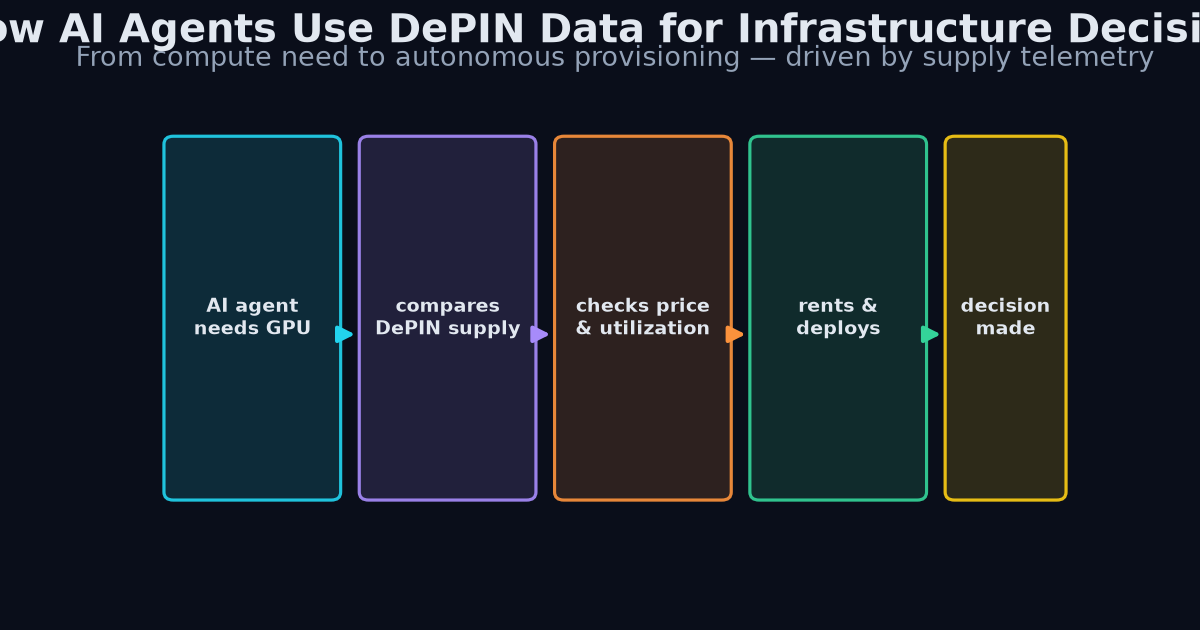
An agent's decision loop looks like this: discover candidate networks → pull supply and pricing for each → normalize to a common schema → compute cost and utilization → choose → verify the data before committing. Every step depends on the previous one, and the whole loop collapses if the data isn't canonical and verifiable.
Query It Like an Agent Would
# Compare compute supply and utilization across Akash, io.net, and Render
curl "https://kairossignal.com/v1/compare?concept=GPU_ACTIVE&networks=akash,io.net,render" \
  -H "X-API-Key: $KS_API_KEY"
Pull pricing and supply for a single network in one call
curl "https://kairossignal.com/v1/networks/io.net?fields=gpu_active,price_usd" \
  -H "X-API-Key: $KS_API_KEY"
Every field returns a verify_url so the agent can programmatically confirm a value against its upstream source before acting. That verification step is what separates an agent making real infrastructure decisions from one trusting a scraped number.
Why Provenance Matters to Agents
An agent's decisions compound. A single bad utilization figure cascades into a wrong cost model, a wrong network choice, and a wrong budget. Bitcoin-anchored provenance — each daily batch Merkle-rooted and timestamped via OpenTimestamps — gives the agent a way to check, not just trust. And point-in-time archiving means an agent that reasons about the past gets the past's values, never a restated present.
Agents can only decide on data they can verify. Give them that, and they stop guessing. Get a free API key →---
This is a data product. Kairos Signal publishes no trading signals, performance returns, win rates, or accuracy claims.---
Try it yourself
Query the live catalog, supply telemetry, and provenance receipts directly: /v1/supply, /v1/provenance on the REST API.
Related reading: the DePIN MCP server · the 10 MCP tools · how ai agents discover and use mcp servers · how AI agents buy DePIN data
Start with a free API key — $5 in credits, no credit card — and query the live networks, their series, and the MCP server. Try the API free → · See pricing
---
Get Started With DePIN Intelligence
Kairos Signal provides verifiable, provenance-first telemetry for DePIN networks, including first-party supply data read directly from a network's own API or blockchain. Every value carries a verify_url you can check yourself, and each daily batch is Merkle-rooted and anchored to Bitcoin.
Every API response is signed with ed25519 and timestamped. You can prove what was served and when, months later. That is what we mean by provenance-first.
Related reading: DePIN Intelligence Guide · DePIN Telemetry · How to Query DePIN Data · DePIN Data Verification · Pricing Correction 2026-09-25: this post called our catalog entry count a count of DePIN networks; that count includes superseded rows and Bittensor subnet rows. It has been removed, together with some present-tense coverage counts written beside it. Current coverage figures: /v1/networks.