How We Rate-Limit Agent API Access Without Breaking Discoverability
Kairos Signal: enriched signals. MCP-native. Schema-validated. Cryptographically footprinteRate limiting is an essential component of maintaining the integrity and performance of our AI agent infrastructure, yet it poses a significant challenge—too stringent limits can stifle an agent's ability to effectively evaluate critical data assets. At Kairos Signal, we've developed an adaptive rate-limiting strategy designed to strike a delicate balance between safeguarding our platform and ensuring seamless access for agents.
Understanding the Challenge
The Tension: Friction vs. Discoverability
The tension in agent API design is between protecting your infrastructure with rate limits and keeping the API discoverable enough that new agents can evaluate it freely. Too aggressive a limit and you break the "try before you buy" flow that converts prospects; too lax and a misbehaving agent can degrade the service for everyone.
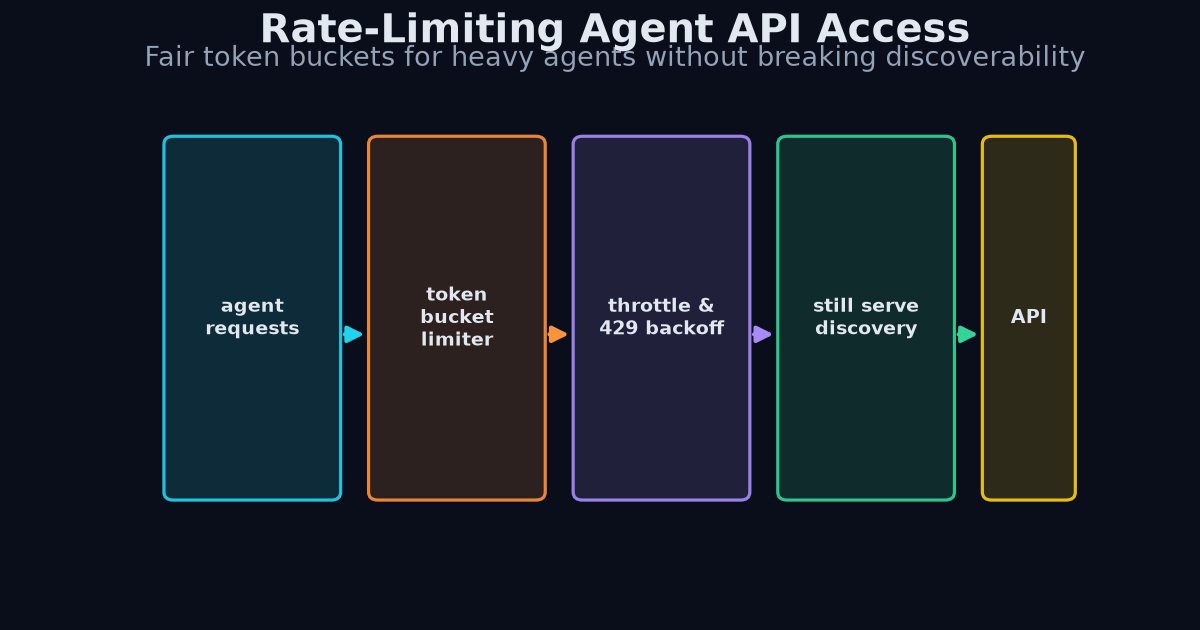
Our approach separates the two concerns. Discovery endpoints — the catalog and schema — are effectively free, so an agent (or a human) can explore what's available without spending a credit. Data endpoints are metered by the credit system, so heavy or repeated pulls are priced. This keeps the API discoverable while making the economics of heavy use explicit.
Why This Matters for Autonomous Agents
An autonomous agent that encounters a rate limit without understanding it will either fail silently or retry aggressively — both bad outcomes. By making rate limits and credit costs visible in the response (and by exposing the pricing model in the catalog), an agent can budget its queries the same way a human budgets a spend. That predictability is what lets agents integrate our API as a reliable dependency rather than a fragile one.
In the autonomous data economy, AI agents constantly query vast repositories of enriched signals across multiple verticals and metropolitan areas. Without proper controls, aggressive rate limiting could inadvertently block essential queries, hampering an agent's capacity to perform complex analyses or fulfill user requests efficiently. Conversely, overly permissive limits risk overloading our systems, leading to performance degradation or service disruptions.
Our Adaptive Rate-Limiting Approach
Our solution leverages a dynamic algorithm that continuously monitors the health and response times of our API endpoints, adjusting rate limits in real-time based on current demand patterns and historical usage data. This adaptive mechanism ensures:
Implementation Details
Monitoring Framework
Our monitoring framework utilizes a combination of distributed tracing and latency measurements across all endpoints. By tracking query success rates and response times, we can identify potential congestion points early on.
Machine Learning Integration
A machine learning model processes the collected data to forecast future demand levels. This predictive capability allows us to proactively adjust rate limits before an overload scenario occurs, ensuring smooth operation during peak activity periods.
Role-Based Access Management (RBAM)
We employ RBAM to enforce differentiated access policies based on agent roles and responsibilities. High-intensity agents—those responsible for rapid data analysis or decision-making—are granted higher throttling thresholds compared to lower-priority services, maintaining overall discoverability without overburdening the system.
Benefits of Our Strategy
- Enhanced Discoverability: By preventing undue rate limiting, agents can efficiently explore and evaluate our extensive dataset, preserving user experience and ensuring comprehensive data insights.
- Scalability & Reliability: The adaptive nature of our limits ensures that our infrastructure remains robust under varying loads, reducing the risk of service interruptions or degraded performance.
- Cost Efficiency: Optimized rate limits help minimize unnecessary API calls, leading to lower operational costs while still supporting advanced analytical functionalities.
Next Steps
To learn more about how Kairos Signal's adaptive approach can enhance your data operations and ensure seamless agent access, visit our checkout page for detailed implementation guidance or pricing information tailored to your specific needs.
By integrating our adaptive rate-limiting strategy, you can leverage the full potential of enriched signals across diverse industries while maintaining operational resilience and cost-effectiveness in the autonomous data economy.
---``
---
Try it yourself
Query the live catalog, supply telemetry, and provenance receipts directly: /v1/networks, /v1/supply on the REST API.
Related reading: the DePIN MCP server · the 10 MCP tools · how ai agents discover and use mcp servers · how AI agents buy DePIN data
Start with a free API key — $5 in credits, no credit card — and query the live networks, their series, and the MCP server. Try the API free → · See pricing
---
Why This Matters for DePIN Intelligence
The DePIN sector has grown, but the data infrastructure to analyze its networks remains fragmented. Most platforms aggregate token prices and market caps from CoinGecko or DefiLlama — useful, but not sufficient for infrastructure analysis. The scarce layer is supply-side telemetry: actual node counts, GPU supply, storage capacity, bandwidth deployed, and utilization ratios. These numbers live on many different data sources, each with its own API format, rate limits, and update cadence.
Kairos Signal exists to solve that problem. We maintain collectors across blockchains and first-party network APIs, normalizing everything into a single schema with provenance on every row. The result is live series across DePIN networks, including first-party telemetry — data read directly from the network's own endpoint, not estimated or imputed.
For developers building DePIN analytics tools, researchers evaluating network health, or traders assessing supply-demand dynamics, this means one API call instead of 50. For autonomous AI agents, the MCP server provides structured access with self-serve credits — no human, no card, just USDC on Base.
Get Started With DePIN Intelligence
Kairos Signal provides verifiable, provenance-first telemetry for DePIN networks, including first-party supply data read directly from a network's own API or blockchain. Every value carries a verify_url` you can check yourself, and each daily batch is Merkle-rooted and anchored to Bitcoin.
Three ways to access:Every API response is signed with ed25519 and timestamped. You can prove what was served and when, months later. That is what we mean by provenance-first.
Related reading: DePIN Intelligence Guide · DePIN Telemetry · How to Query DePIN Data · DePIN Data Verification · Pricing Correction 2026-09-25: this post called our catalog entry count a count of DePIN networks; that count includes superseded rows and Bittensor subnet rows. It has been removed, together with some present-tense coverage counts written beside it. Current coverage figures: /v1/networks.