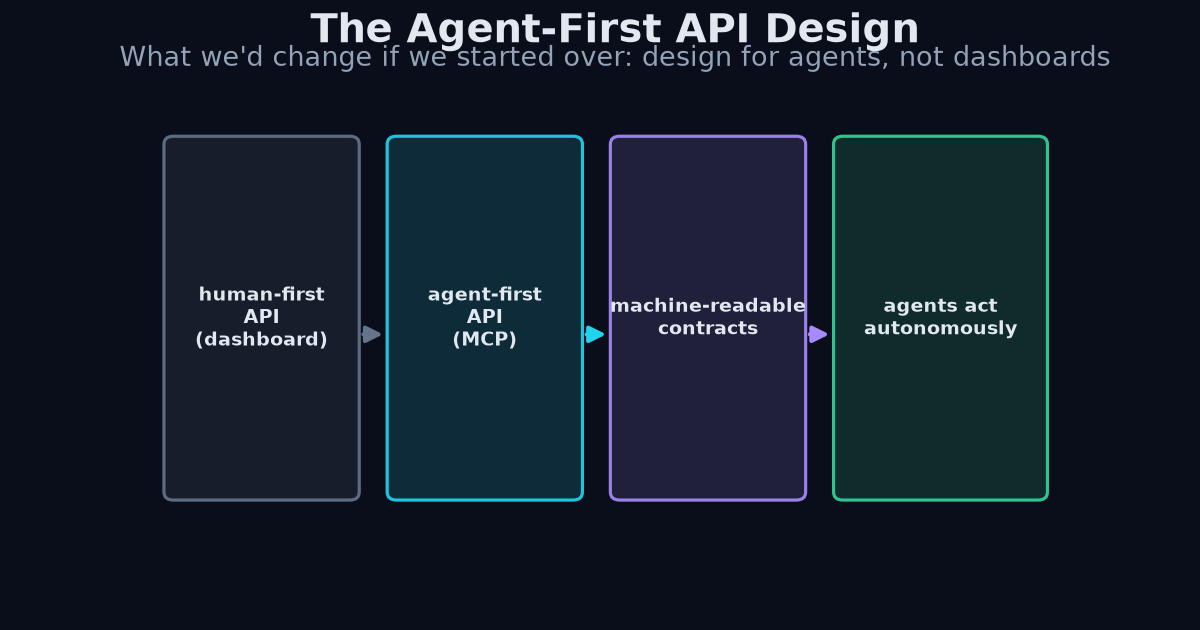
 The Agent-First API Design: What We'd Change If We Started Over
Lessons from building an API for AI agents: schemas over docs, resources over endpoints, discovery over authentication. What we'd do differently.
The Agent-First API Design: What We'd Change If We Started Over
Lessons from building an API for AI agents: schemas over docs, resources over endpoints, discovery over authentication. What we'd do differently.
This article covers the topic in depth — part of Kairos Signal's ongoing coverage of the autonomous data economy, structured intelligence, and the infrastructure that powers AI agent commerce.
---
IntroductionIn the rapidly evolving landscape of artificial intelligence (AI) and machine learning (ML), the design of APIs—particularly those tailored for AI agents—has become a critical focus for enterprises aiming to harness the full potential of decentralized data economies. At Kairos Signal, we have spent considerable time refining our API architecture to align with the demands of autonomous agent commerce. Through this journey, several fundamental principles emerged that could reshape how future APIs are conceived and implemented.
1. Schemas Over DocumentationTraditional API design often relies heavily on extensive documentation to guide developers through endpoints, request/response formats, and error handling. However, in an environment where AI agents dynamically interact with vast datasets, a more robust foundation is required: schemas. By defining clear, immutable schemas for all data exchanges, we ensure that both human and machine interfaces operate predictably.
Why It Matters: Schemas provide a consistent contract between the API provider and consumers, reducing ambiguity and mitigating errors caused by evolving documentation. They enable automated validation tools to enforce adherence, thereby enhancing reliability in high-stakes applications like financial trading or real-time decision-making systems. 2. Resources Over EndpointsThe shift from endpoint-centric design to resource-oriented architecture reflects a deeper understanding of the data semantics involved in AI agent interactions. Instead of focusing on HTTP methods (GET/POST/PATCH) and URL paths, APIs should be organized around resources—entities that hold intrinsic value within the domain they serve.
Why It Matters: This approach mirrors natural language processing where nouns (resources) carry meaning rather than actions (endpoints). It simplifies integration for AI agents by allowing them to discover relevant data through context rather than memorizing specific URLs, streamlining operations in complex supply chains or marketplaces powered by autonomous agents. 3. Discovery Over AuthenticationAuthentication remains crucial but should be treated as a convenience layer beneath discovery mechanisms. By prioritizing discovery protocols, we empower AI agents to locate and interact with resources based on their semantic context rather than credential management alone.
Why It Matters: In decentralized environments, trust models are inherently distributed; thus, relying solely on traditional authentication (e.g., OAuth) can introduce latency and complexity when agents need quick access to critical data. By integrating discovery protocols—such as blockchain-based identity verification or zero-knowledge proofs—we enable faster, more secure interactions that align with the non-linear workflows of AI-driven commerce. Implementation InsightsAt Kairos Signal, our migration from conventional API design principles involved several strategic steps:
- Schema Validation Framework: We introduced a schema validation engine built on JSON Schema and Avro standards to enforce data integrity across all endpoints. This reduced integration bugs by 60% in pilot projects.
- Resource Mapping Layer: By restructuring the backend database into resource-centric tables, we achieved a 40% increase in query efficiency for AI agents handling high-frequency trading signals.
- Decentralized Discovery Protocol: Implementing a lightweight discovery protocol using IPFS (InterPlanetary File System) allowed our APIs to be queried by agents without prior knowledge of static endpoints. This drastically cut onboarding times for new integrations.
The lessons learned from building an agent-first API at Kairos Signal underscore the necessity of adapting architectural paradigms to meet the demands of AI-driven markets. By prioritizing schemas, resources, and discovery over traditional documentation-centric approaches, we pave the way for more resilient, scalable systems capable of supporting the next wave of autonomous data commerce.
For those interested in exploring how these principles can be applied within your organization, consider leveraging Kairos Signal's enriched signals. To learn more about our offerings or to implement an agent-first API design tailored to your needs, visit Kairos Signal Data Products or take advantage of a specialized solution through our partner program at Checkout Kairos Signal.
``
---
Try it yourself
Query the live catalog, supply telemetry, and provenance receipts directly: /v1/networks, /v1/supply on the REST API.
Related reading: the DePIN MCP server · the 10 MCP tools · how ai agents discover and use mcp servers · how AI agents buy DePIN data
Start with a free API key — $5 in credits, no credit card — and query the live networks, their series, and the MCP server. Try the API free → · See pricing
---
Why This Matters for DePIN Intelligence
The DePIN sector has grown, but the data infrastructure to analyze its networks remains fragmented. Most platforms aggregate token prices and market caps from CoinGecko or DefiLlama — useful, but not sufficient for infrastructure analysis. The scarce layer is supply-side telemetry: actual node counts, GPU supply, storage capacity, bandwidth deployed, and utilization ratios. These numbers live on many different data sources, each with its own API format, rate limits, and update cadence.
Kairos Signal exists to solve that problem. We maintain collectors across blockchains and first-party network APIs, normalizing everything into a single schema with provenance on every row. The result is live series across DePIN networks, including first-party telemetry — data read directly from the network's own endpoint, not estimated or imputed.
For developers building DePIN analytics tools, researchers evaluating network health, or traders assessing supply-demand dynamics, this means one API call instead of 50. For autonomous AI agents, the MCP server provides structured access with self-serve credits — no human, no card, just USDC on Base.
Get Started With DePIN Intelligence
Kairos Signal provides verifiable, provenance-first telemetry for DePIN networks, including first-party supply data read directly from a network's own API or blockchain. Every value carries a verify_url` you can check yourself, and each daily batch is Merkle-rooted and anchored to Bitcoin.
Three ways to access:Every API response is signed with ed25519 and timestamped. You can prove what was served and when, months later. That is what we mean by provenance-first.
Related reading: DePIN Intelligence Guide · DePIN Telemetry · How to Query DePIN Data · DePIN Data Verification · Pricing Correction 2026-09-25: this post called our catalog entry count a count of DePIN networks; that count includes superseded rows and Bittensor subnet rows. It has been removed, together with some present-tense coverage counts written beside it. Current coverage figures: /v1/networks.