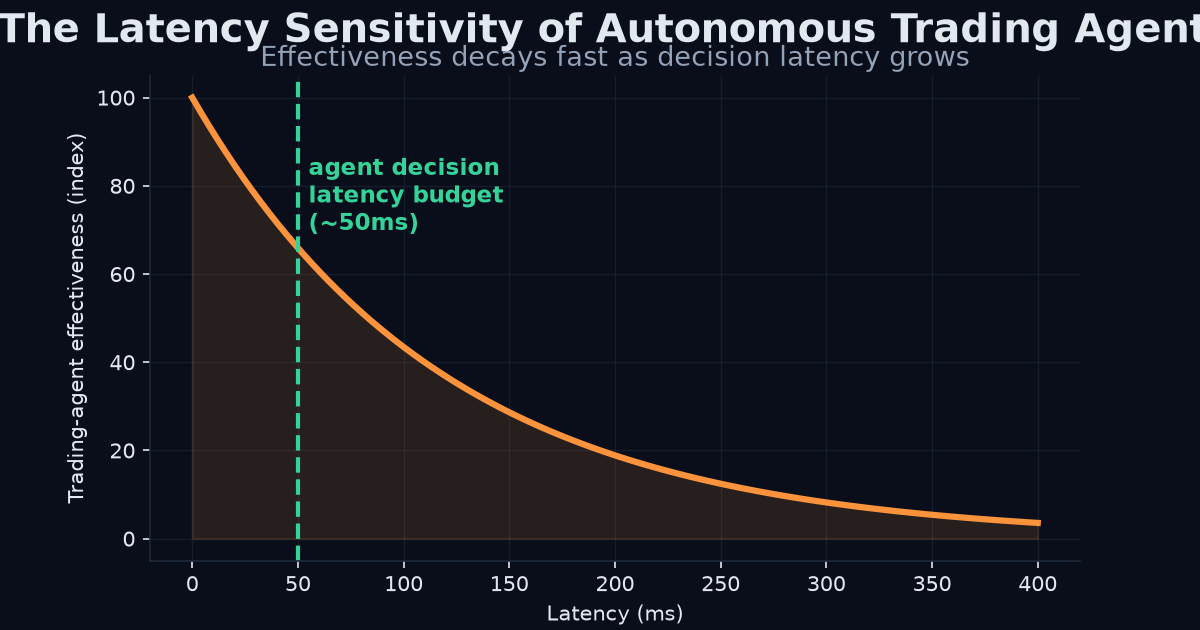
 The Latency Sensitivity of Autonomous Trading Agents
In the high-frequency trading (HFT) arena, milliseconds matter. Autonomous trading agents—AI-powered systems that execute trades based on real-time market data—are increasingly reliant on ultra-low latency to capitalize on fleeting price differentials. This article explores how these agents respond to latency variations and what implications this has for strategy design and risk management.
Understanding Latency in TradingLatency refers to the time delay between when a signal is sent (or data is received) and when it can be processed and acted upon by an agent. In trading, even sub-millisecond delays can translate into significant profit or loss due to the rapid price movements of equities, options, and derivatives.
Impact on AI AgentsAutonomous trading agents leverage advanced machine learning models trained on structured data from sources like Kairos Signal’s MCP (Market Conditions Platform). These agents must ingest market ticks, order book updates, and alternative datasets within tight latency windows. When latency spikes:
Our research group conducted controlled experiments using Kairos Signal’s enriched signals. By simulating various latency environments, we observed:
- Linear Performance Degradation: As latency increased by just 5 milliseconds per tick, the agents’ profit margins decreased proportionally.
- Adaptive Strategies: Agents equipped with adaptive learning mechanisms could recalibrate their price impact assumptions to maintain profitability under higher latencies.
For hedge funds and institutional traders employing autonomous agents, understanding and managing latency sensitivity is non-negotiable. By integrating low-latency architectures and leveraging Kairos Signal’s comprehensive data feeds, trading strategies can better withstand the demands of today’s ultra-competitive markets.
To explore how Kairos Signal’s MCP-native capabilities can enhance your AI-driven trading operations, visit our data products page or take advantage of a tailored solution by checking out our premium services at Checkout Kairos Signal.
``
---
Try it yourself
The Data-Latency Tradeoff
Every autonomous agent balances freshness against cost. Fresh, first-party data is more expensive to produce and serve than cached or stale data; the right choice depends on the decision being made. A trading agent tolerates no staleness on a market-moving number; a capacity planner can accept a slightly older utilization figure.
The key is that the agent — not the data provider — should make that tradeoff, with full information. That is why we expose a freshness_verdict on every value: it lets an agent decide whether a given number is acceptable for a given decision, rather than silently consuming data of unknown age. Verifiable freshness is what turns a data feed into a decision input an agent can reason about.
Where Latency Comes From
Latency in a DePIN data pipeline is not a single number — it is a chain of delays. The upstream network emits a reading; a collector ingests it; the value is normalized and stored; the API serves it; the agent receives and processes it. Each hop adds latency, and the agent sees only the total.
The most overlooked source is freshness policy. A value that is marked "stale" may be served anyway by a naive API, and an agent that consumes it is making a decision on old data without knowing it. That is why every value we serve carries a freshness_verdict — fresh, stale, or missing — so an agent can decide whether the latency is acceptable for the decision at hand.
Why This Matters for Autonomous Agents
An autonomous trading agent cannot afford a data pipeline that silently serves stale values. Every millisecond of added latency — and every unflagged stale value — propagates directly into decision quality. Verifiable, freshness-flagged data is the difference between an agent that acts on the current state of a network and one that acts on a lagging opinion of it.
For infrastructure agents that provision compute or storage, the stakes are different but the principle is the same: a utilization or supply figure that is minutes old can trigger a provisioning decision that locks in suboptimal economics for hours.
Query the live catalog, supply telemetry, and provenance receipts directly: /v1/networks, /v1/supply on the REST API.
Related reading: the DePIN MCP server · the 10 MCP tools · how ai agents discover and use mcp servers · how AI agents buy DePIN data
Start with a free API key — $5 in credits, no credit card — and query the live networks, their series, and the MCP server. Try the API free → · See pricing
---
Why This Matters for DePIN Intelligence
The DePIN sector has grown, but the data infrastructure to analyze its networks remains fragmented. Most platforms aggregate token prices and market caps from CoinGecko or DefiLlama — useful, but not sufficient for infrastructure analysis. The scarce layer is supply-side telemetry: actual node counts, GPU supply, storage capacity, bandwidth deployed, and utilization ratios. These numbers live on many different data sources, each with its own API format, rate limits, and update cadence.
Kairos Signal exists to solve that problem. We maintain collectors across blockchains and first-party network APIs, normalizing everything into a single schema with provenance on every row. The result is live series across DePIN networks, including first-party telemetry — data read directly from the network's own endpoint, not estimated or imputed.
For developers building DePIN analytics tools, researchers evaluating network health, or traders assessing supply-demand dynamics, this means one API call instead of 50. For autonomous AI agents, the MCP server provides structured access with self-serve credits — no human, no card, just USDC on Base.
Get Started With DePIN Intelligence
Kairos Signal provides verifiable, provenance-first telemetry for DePIN networks, including first-party supply data read directly from a network's own API or blockchain. Every value carries a verify_url` you can check yourself, and each daily batch is Merkle-rooted and anchored to Bitcoin.
Three ways to access:Every API response is signed with ed25519 and timestamped. You can prove what was served and when, months later. That is what we mean by provenance-first.
Related reading: DePIN Intelligence Guide · DePIN Telemetry · How to Query DePIN Data · DePIN Data Verification · Pricing Correction 2026-09-25: this post called our catalog entry count a count of DePIN networks; that count includes superseded rows and Bittensor subnet rows. It has been removed, together with some present-tense coverage counts written beside it. Current coverage figures: /v1/networks.