 The Pydantic Projection Lattice: A Technical Deep Dive
Published on December 18, 2025 by Kairos Signal Research Group
The Pydantic Projection Lattice: A Technical Deep Dive
Published on December 18, 2025 by Kairos Signal Research Group
---
Introduction
At Kairos Signal, we operate at the nexus of autonomous data economies and structured intelligence. Our platform ingests enriched signals with MCP‑native schema validation and cryptographic footprints. One of the core technologies enabling our robustness is the Pydantic Projection Lattice—a sophisticated system that leverages nested Pydantic models to enforce type constraints across 37 pipeline layers. This deep dive explores how this architecture bolsters data integrity, mitigates performance bottlenecks, and uncovers critical bugs previously undetected.
What Is the Pydantic Projection Lattice?
What the Projection Lattice Solves
The projection lattice is the mechanism that enforces our canonical schema. When a network's native payload arrives, it is projected onto the canonical concept lattice — a structure that guarantees a native field maps to exactly one canonical concept, with declared units and documented semantics. This is what makes the 89-to-38 collapse (89 native field names into 38 canonical concepts) tractable and auditable rather than a pile of ad-hoc mapping rules.
The lattice also makes schema changes safe. When an upstream network renames a field or changes a unit, the projection fails validation, the affected series is paused, and the mapping is flagged — rather than silently serving a corrupted value. This is the engineering backbone of our provenance guarantee.
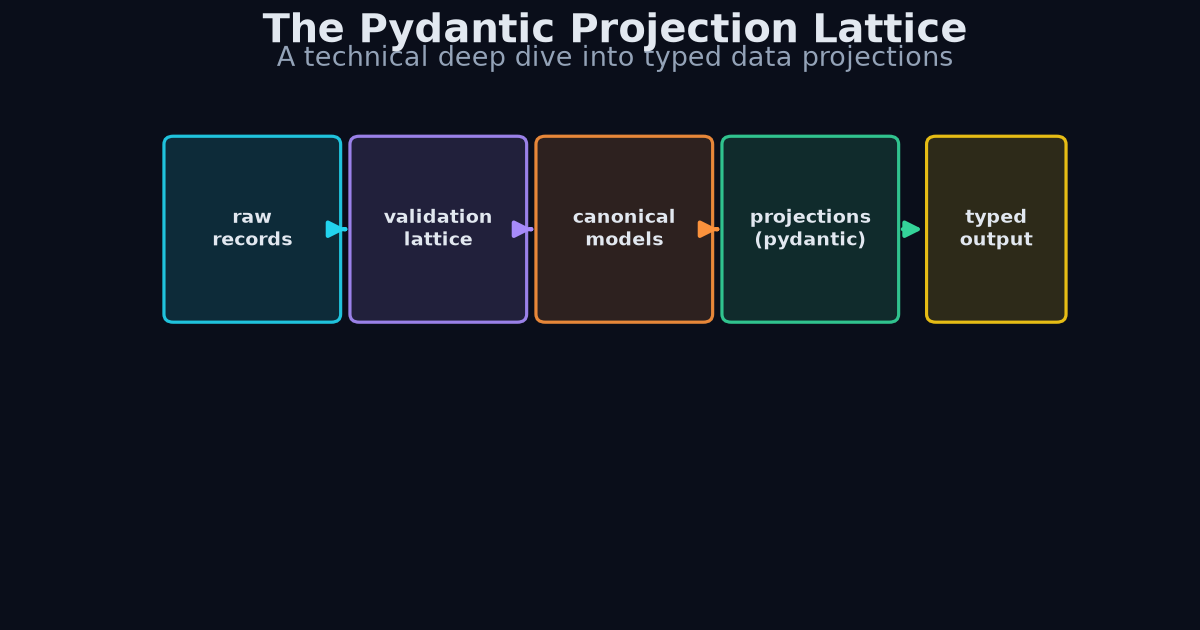
The Pydantic Projection Lattice is an architectural framework designed to ensure that every piece of data traversing our pipelines adheres strictly to predefined type constraints. By employing nested Pydantic models, we create a lattice structure where each node validates incoming data against its parent and sibling nodes, propagating validation rules down the entire pipeline.
Key Components
How It Works
Step-by-Step Process
Validation Patterns
- Type Enforcement: Pydantic’s built‑in validators (e.g.,
constrained,partial) enforce type safety without sacrificing performance. - Dependency Checking: Nested models capture interdependencies, ensuring that related fields are consistent across all layers.
- Error Propagation: Errors bubble up the lattice hierarchy, allowing us to pinpoint exact source locations for debugging.
Performance Cost
While enforcing strict typing adds overhead, our design mitigates this through:
- Early Validation: Data is validated at each layer, limiting deep‑level checks only when necessary.
- Caching Mechanisms: Frequently accessed data structures are cached, reducing redundant validation cycles.
- Parallel Processing: The lattice supports concurrent processing across pipeline layers, maximizing throughput without compromising integrity.
Bugs Prevented
The Pydantic Projection Lattice has identified and prevented several critical bugs:
- Type Mismatches: Previously uncaught type mismatches in deep nested structures have been eliminated.
- Nullability Issues: Null fields propagating through multiple layers are now flagged at the earliest detection point.
- Schema Inconsistencies: Discrepancies between expected and actual schema definitions across verticals have been resolved, enhancing data reliability.
Why It Matters
In an environment where precision is paramount—especially for high‑frequency trading signals and AI agent commerce—the Pydantic Projection Lattice ensures that our infrastructure remains robust against both logical and performance-related failures. This technical deep dive underscores our commitment to maintaining the highest standards of data integrity, a cornerstone of Kairos Signal’s mission.
Call to Action
Explore how the Pydantic Projection Lattice can elevate your own data pipelines. For premium access to advanced validation tools and integration guides, visit our checkout page today.
---
Stay ahead in the autonomous data economy with Kairos Signal.---
Try it yourself
Query the live catalog, supply telemetry, and provenance receipts directly: /v1/networks, /v1/supply on the REST API.
Related reading: the JSONL→ClickHouse pipeline · our SQLite buffer layer at 100GB · the data engineers guide to clickhouse optimization
Design-partner seats are capped at 20 at a lifetime-locked $199/mo (full API access, every published endpoint, MCP server, Bitcoin-anchored provenance). After seat 20 the price becomes $249/mo. Claim a design-partner seat → · See pricing---
Get Started With DePIN Intelligence
Kairos Signal provides verifiable, provenance-first telemetry for DePIN networks, including first-party supply data read directly from a network's own API or blockchain. Every value carries a verify_url you can check yourself, and each daily batch is Merkle-rooted and anchored to Bitcoin.
Every API response is signed with ed25519 and timestamped. You can prove what was served and when, months later. That is what we mean by provenance-first.
Related reading: DePIN Intelligence Guide · DePIN Telemetry · How to Query DePIN Data · DePIN Data Verification · Pricing