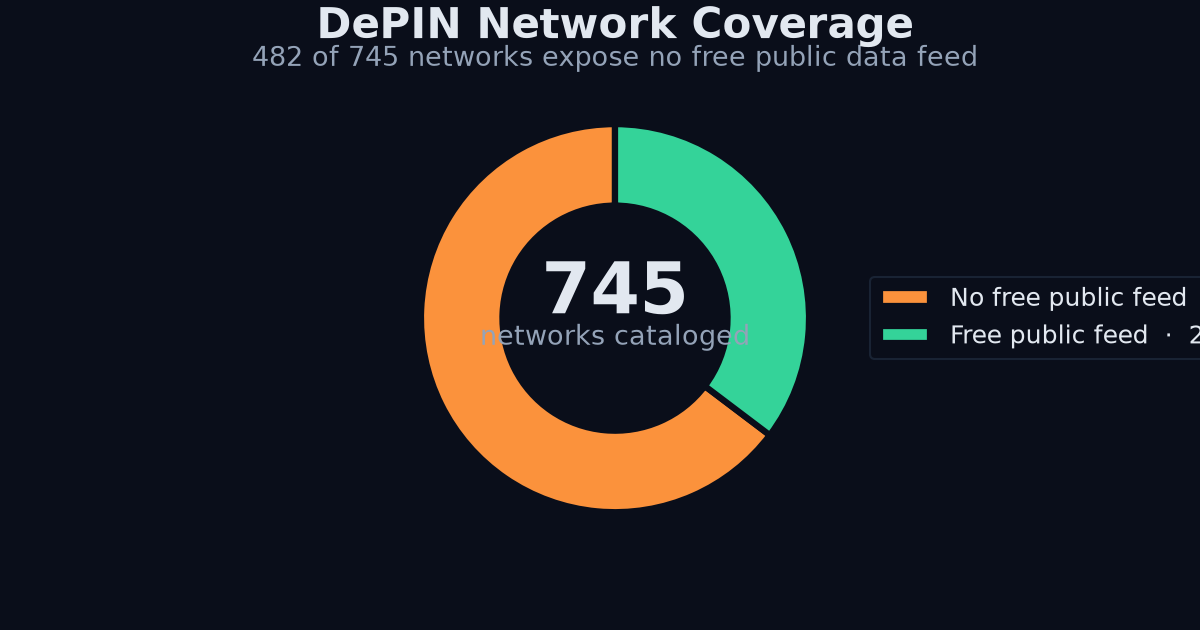
At Kairos Signal, our topological mapping of Decentralized Physical Infrastructure Networks (DePIN) had cataloged 745 distinct networks (as of 2026-08-14) operating across varying L1s and L2s. When we evaluate the empirical observability of these networks, the landscape fractures violently: 263 networks carry live, queryable state data, and a mere 171 expose first-party supply telemetry (e.g., geolocation, hardware status, uptime proofs). The remaining 482 networks—roughly 64.7% of the ecosystem—have no free public feed.
In traditional data engineering, the instinct when faced with a missing variable $X_{miss}$ is to impute. One might model the expected supply based on tokenomics, market cap, or social sentiment. This is an epistemic fallacy. In spatial-temporal infrastructure modeling, naming what you do not cover is fundamentally more honest, and mathematically more rigorous, than generating estimates from uncorrelated priors.
This post explores the architecture of the not_covered map—a topological surface of known unknowns—and why researchers must adopt it to understand where physical data infrastructure is genuinely missing versus merely dark.
The Epistemic Boundary of DePIN Observability
Let $S$ be the universal set of DePIN networks. We can partition $S$ into three disjoint subsets based on telemetry availability:
$$ S = S_{live} \cup S_{telemetry} \cup S_{dark} $$
Where:
- $S_{live}$: Networks with queryable state roots ($|S_{live}| = 263$)
- $S_{telemetry} \subset S_{live}$: Networks exposing first-party supply proofs ($|S_{telemetry}| = 171$)
- $S_{dark}$: Networks with no free public feed ($|S_{dark}| = 482$)
This is a catastrophic failure of modeling.
Missing Not At Random (MNAR)
Data is typically categorized as Missing Completely At Random (MCAR), Missing At Random (MAR), or Missing Not At Random (MNAR). DePIN telemetry for $S_{dark}$ is overwhelmingly MNAR. A network obscures its telemetry because its supply is deficient, its node distribution is sybil-attacked, or its
node distribution is sybil-attacked, or its operators deliberately withhold data because transparency would expose poor fundamentals.
When data is MNAR, imputation is not just inaccurate — it is structurally biased. The very networks that would lower your supply estimates are the ones missing from the dataset. Filling $S_{dark}$ with model predictions systematically overstates supply and understates concentration risk. A quant analyst who imputes node counts for dark networks is not being rigorous; they are laundering a prior belief into the appearance of data.
The not_covered Map in Practice
At Kairos Signal we do not estimate what we cannot observe. Instead we maintain an explicit not_covered map — a machine-readable boundary of where our coverage ends. Each entry records the network, why it is unobservable (no public RPC, gated API, private chain), when we last attempted access, and what we tried. The key convention is that a dark network carries node_count: null, never 0. A zero is a measurement; a null is an assertion of ignorance. Conflating the two is the most common data sin in DePIN analytics.
This map is exposed through the API so that researchers and agents can filter it in one line:
# List only networks we can actually observe
curl "https://api.kairossignal.com/v1/networks?coverage=live" -H "X-API-Key: *"
List networks explicitly marked as not covered
curl "https://api.kairossignal.com/v1/networks?coverage=catalog_only" -H "X-API-Key: *"
Why This Matters
The value of explicitly mapping $S_{dark}$ is that it converts an unknown into a bounded unknown. A researcher can compute an upper bound on global GPU supply by assuming the dark set is arbitrarily large, and a lower bound by assuming it is empty. That interval is honest and actionable. Modeled estimates, by contrast, present a single confident number with no bound on its error — worse than useless.
This is the same principle we apply to every value we serve: provenance or silence. If we cannot point to the exact source of a number, we do not serve it. The not_covered map is the negative space of that guarantee — the explicit record of what we refuse to invent.
---
Try it yourself
Query the live catalog, supply telemetry, and provenance receipts directly: /v1/networks, /v1/supply on the REST API.
Related reading: DePIN infrastructure data · how we read supply telemetry · DePIN network data · DePIN Intelligence guide
Start with a free API key — $5 in credits, no credit card — and query live network data and the MCP server. Try the API free → · See pricing
---
Get Started With DePIN Intelligence
Kairos Signal provides verifiable, provenance-first telemetry for DePIN networks, with first-party supply data read directly from each network's own API or blockchain. Current counts are published live at /v1/networks. Every value carries a verify_url you can check yourself, and each daily batch is Merkle-rooted and anchored to Bitcoin.
Every API response is signed with ed25519 and timestamped. You can prove what was served and when, months later. That is what we mean by provenance-first.
Related reading: DePIN Intelligence Guide · DePIN Telemetry · How to Query DePIN Data · DePIN Data Verification · Pricing