DePIN (Decentralized Physical Infrastructure Networks) inherently suffers from an oracle problem magnified by physicality. Unlike purely on-chain state, physical state—GPU utilization, antenna uptime, sensor readings—is trivially spoofable. When a quant model or an autonomous agent ingests a DePIN metric, it is fundamentally trusting an off-chain observer. Traditional aggregator-style data products mask this trust assumption by computing statistical summaries—means, medians, TWAPs—over opaque datasets, presenting a single point of failure as ground truth.
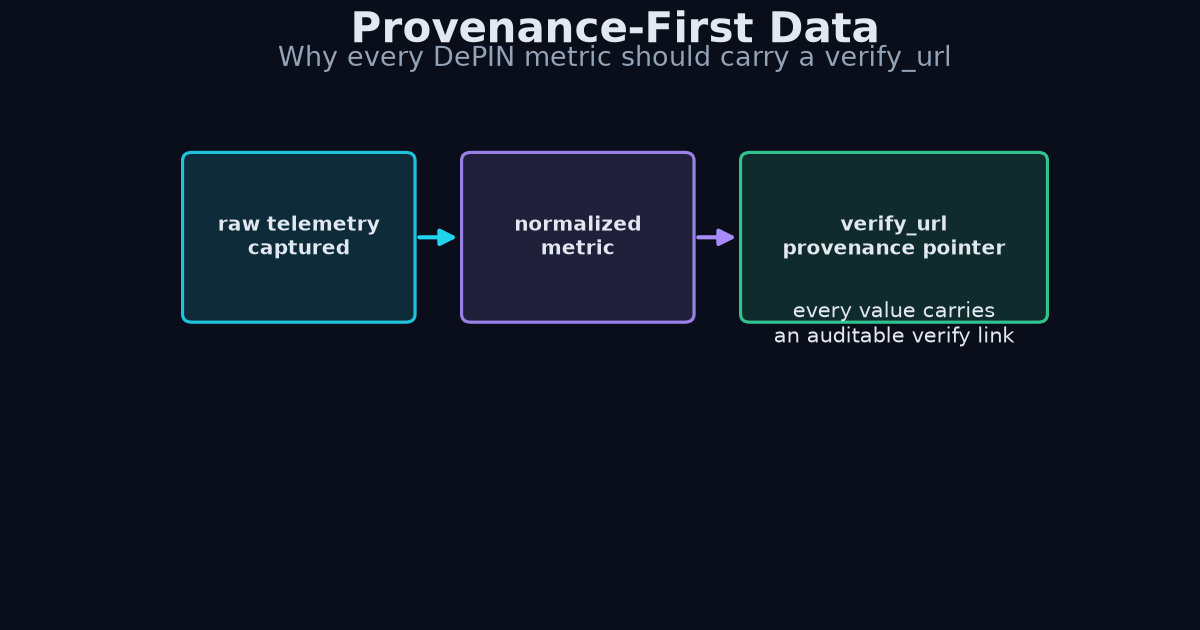
At Kairos Signal, we categorically reject aggregator-style data products for DePIN metrics. Instead, we enforce a provenance-first architecture. In this paradigm, a datum without cryptographically verifiable provenance is considered adversarial by default. Every scalar value we emit must carry its source, a strict as_of timestamp, and a public verify_url pointing to the immutable upstream API.
This post details the architectural patterns, cryptographic commitments, and programmatic verification loops required to build a provenance-first data pipeline for DePIN.
The Anatomy of a Provenance-First Metric
Standard data pipelines treat metadata as an afterthought—a schema tag or a column in a slowly changing dimension table. In a provenance-first architecture, the metadata is co-equal with the value. It must be structurally impossible to serialize a metric without its provenance envelope.
Consider a standard JSON payload for a GPU compute price:
{
  "metric_id": "gpu_compute_tflops_4090_us_east",
  "value": 82.41,
  "as_of": 1716211200,
  "source": "kairos-node-0x8a4b...c2f1",
  "verify_url": "https://api.kairos.io/v1/verify/metric/gpu_compute_tflops_4090_us_east/1716211200"
}
Field Definitions
* value: The scalar observation. Here, $82.41$ represents the spot price per TFLOP.
* as_of: A UNIX timestamp representing the logical time of observation, not the time of ingestion. This distinction is critical for backfilling and temporal alignment.
* source: The cryptographic identity (e.g., public key hash or peer ID) of the node that generated the observation.
* verify_url: A deterministic URI that resolves to the raw, signed observation from the source, alongside the cryptographic proofs necessary to validate
the value. A consumer opens the verify_url and retrieves the exact signed observation the value was derived from, plus enough cryptographic context to confirm it was not altered in transit or at rest.
Verification Without Trust
The point of the verify_url is that it removes the aggregator as a trusted intermediary. Anyone — a human auditor or an autonomous agent — can:
verify_url to retrieve the raw upstream observation.as_of timestamp is within the declared freshness window.This last step is what separates provenance from a mere link. A verify_url that points to a source you control proves nothing; a verify_url plus a Merkle root anchored to Bitcoin proves the value existed at a specific time and has not been altered since. This is the same commitment scheme used by timestamping and certificate transparency — applied to physical infrastructure telemetry.
Why Agents Need This
An autonomous agent deciding whether to buy GPU compute or allocate capital to a storage network cannot afford to trust a dashboard. It needs machine-readable, cryptographically verifiable data. Our REST API serves every metric with its provenance envelope, and the MCP server exposes the same values to agents that speak the Model Context Protocol. An agent can programmatically verify any value before acting on it, closing the loop between "data says" and "data proves."
This is why we insist every metric carries a verify_url: not as a marketing flourish, but as a structural requirement of trustworthy infrastructure data. Across the 372 networks we serve with live data, every one of the 11,857 series carries a provenance envelope. Provenance is not a luxury feature — it is the prerequisite for a data product any rational agent can trust.
Try it yourself — verify a value in one request:
# Pull a value and its provenance envelope
curl "https://api.kairossignal.com/v1/supply?network=akash" -H "X-API-Key: *"
Verify a specific value independently
curl "https://api.kairossignal.com/v1/provenance?value_id=..." -H "X-API-Key: *"
---
Try it yourself
Query the live catalog, supply telemetry, and provenance receipts directly: /v1/networks, /v1/supply on the REST API.
Related reading: DePIN data provenance · Merkle-rooted batch integrity · how verify_url works · how we verify every DePIN number
Design-partner seats are capped at 20 at a lifetime-locked $199/mo (full API access, every published endpoint, MCP server, Bitcoin-anchored provenance). After seat 20 the price becomes $249/mo. Claim a design-partner seat → · See pricing---
Get Started With DePIN Intelligence
Kairos Signal provides verifiable, provenance-first telemetry for DePIN networks, including first-party supply data read directly from a network's own API or blockchain. Every value carries a verify_url you can check yourself, and each daily batch is Merkle-rooted and anchored to Bitcoin.
Every API response is signed with ed25519 and timestamped. You can prove what was served and when, months later. That is what we mean by provenance-first.
Related reading: DePIN Intelligence Guide · DePIN Telemetry · How to Query DePIN Data · DePIN Data Verification · Pricing